Rare English silver watch with annular tourbillon Circa 1903
- Kenmerk
- SA0469
- Diameter
- 59 mm
- Estimate
- € 8.000 - 16.000
- Price sold
- -
Very rare silver watch with an annular tourbillon by Andrew Taylor
–
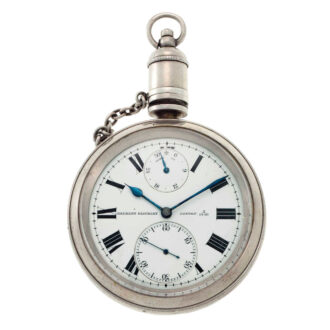
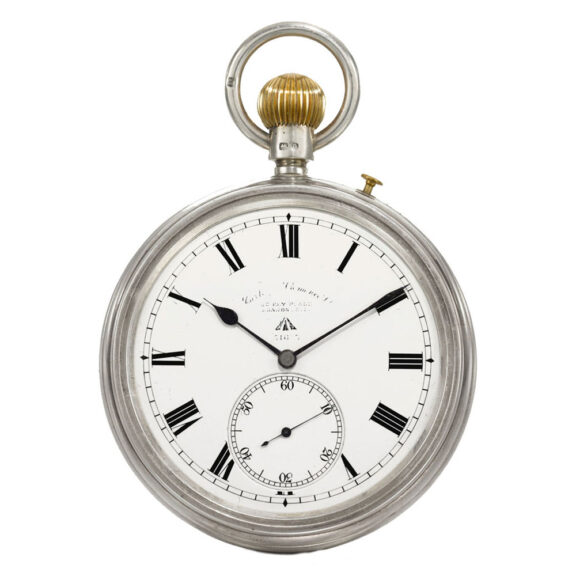
A very rare and unusual English silver open-faced keyless watch with an annular tourbillon, circa 1903.
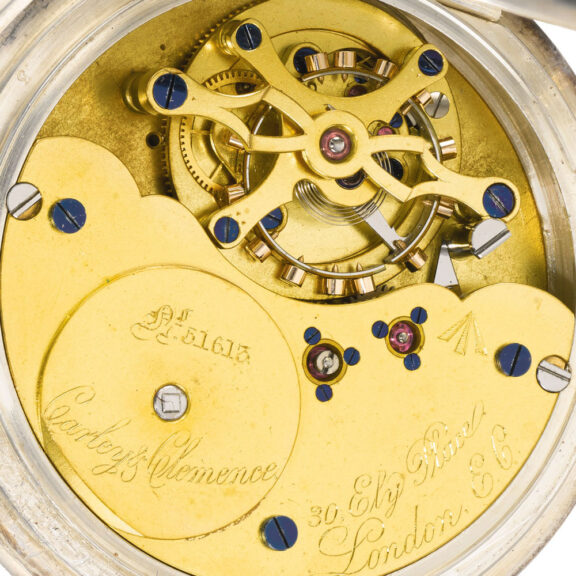
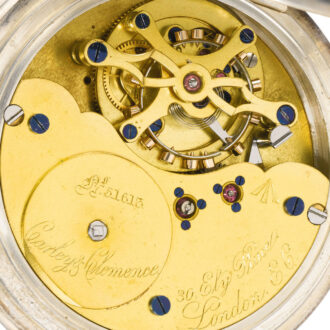
Gilded half-plate movement, 52 1/2 minute revolving carriage with lever escapement, bimetallic compensation balance, free-sprung spiral spring with double overcoil, signed Carley & Clemence, 30 Ely Place, London E.C. and with Admiralty broad arrow, ebauche with maker’s mark AT for Andrew Taylor to dial side of pillar plate.
White enamel dial, Roman numerals, outer minute ring, subsidiary seconds, blued steel hands, signed with Admiralty broad arrow. Plain silver case, the back with Admiralty broad arrow, with maker’s mark C & Co in an oval cameo for Carley & Clemence Ltd, bezel, cuvette, mid-case, and case back all numbered.
–
Diameter: 59 mm
–
Signed: Carley & Clemence 30 Ely Place London E.C.
–
In the early 1890s, Danish watchmaker Bahne Bonniksen, working in Coventry, England, developed the carrousel revolving carriage for the escapement in order to eliminate errors of rate in vertical positions. Patented in 1893 (English Patent No. 21421), Bonniksen described his invention as: “a watch as robust as any ordinary English watch and nearly as precise as an atmospheric regulator or marine chronometer”. The following year, 1894, saw the entry of carrousel watches at the Kew Observatory timing trials for the first time, significantly, all achieved marks above 80 out of 100. And in 1896, carrousels came top both at Kew and at the Royal Observatory’s Admiralty Deck watch trials (see research by C. Woodward reported by S.B. de Save for Antiquarian Horology, No. 6, Vol. 29, December 2006). Andrew Taylor was working in Coventry and clearly saw the potential of the carrousel and patented his ‘annular’ tourbillon in September 1895. The name ‘annular’ is derived from the patentee’s description in which he refers to the ring of the interior cut teeth fitted to the pillar plate as an ‘annular wheel’. Although based on similar principles, the annular tourbillon was more expensive to produce than its rival, the carousel, and was not a commercial success. Nevertheless, clearly the Admiralty were impressed by the performance of Taylor’s movements, our research suggests that the few that survive were all marked with the Admiralty broad arrow.
–
Carley & Clemence was a business partnership between George Carley and Josef Auguste Clemence and the firm supplied a variety of different watches to the Admiralty.
Signed: Carley & Clemence 30 Ely Place London E.C.
Share this page: