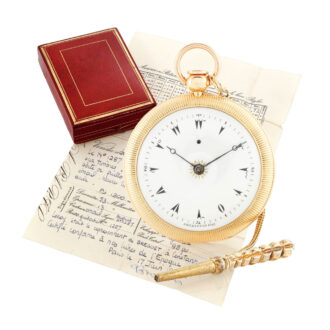
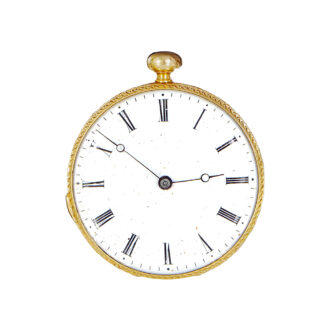
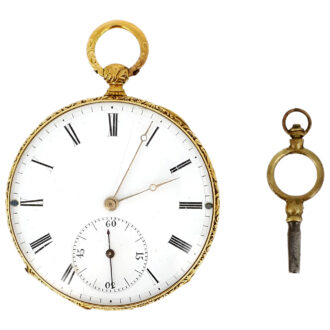
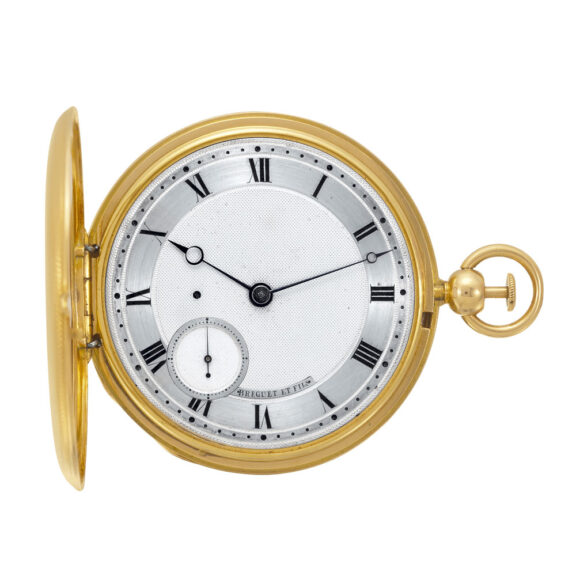
French 18 Carat gold half quarter repeating pocket watch Circa 1817
- Kenmerk
- TA1741
- Diameter
- 48 mm
- Estimate
- € 35.000 - 70.000
- Price sold
- € 72.000
Gold hunting cased pocket watch
–
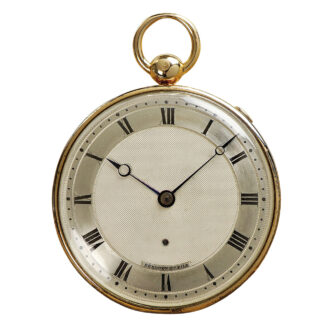
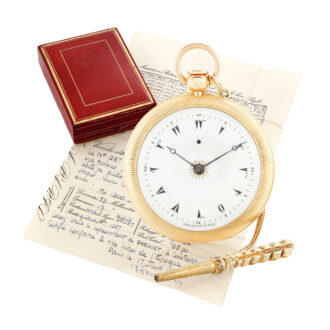
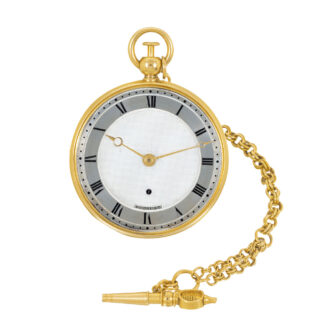
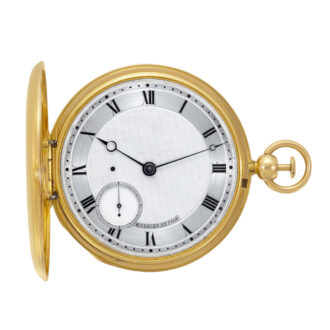
An extremely fine and important French, very thin 18 Carat gold hunting cased, jump-hour, half quarter repeating pocket watch, circa 1817. Built on the principles of the Garde Temps, with extensive jeweling and lever escapement. Accompanied by a certificate. Sold to the Duc de Frias on January 12, year unrecorded for 4,800 Francs.
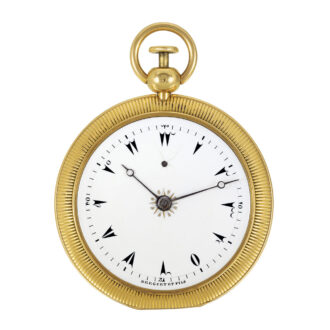
An engine-turned case, the back cover with a very small engraved monogram in the centre. Gold cuvette secured by a screw.
–
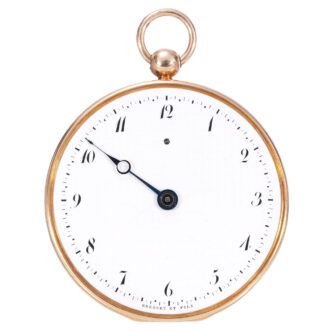
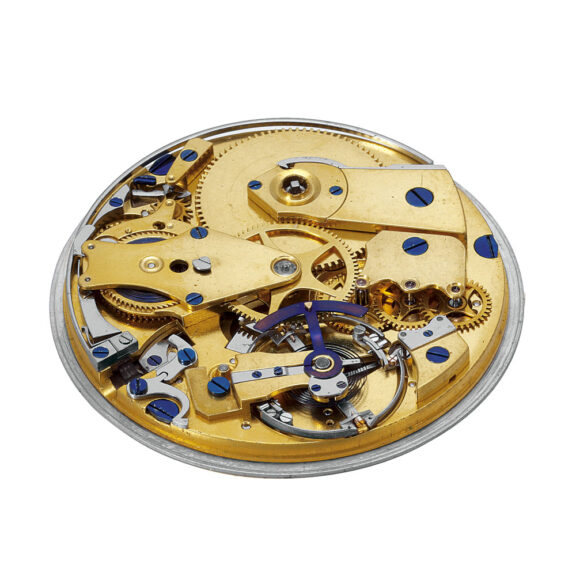
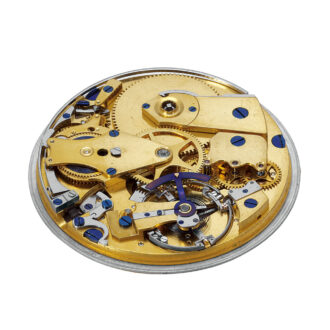
Silver dial brushed chapter ring with radial Roman numerals, outer dot minute divisions, eccentric subsidiary seconds, engine-turned centre. Blued steel Breguet hands. A frosted gilt movement, fully jewelled wheel train, jewelled elongated counterpoised straight-line lever escapement withdrawal, balance with compensation affixes, the adjusting screws within the rim, top pivot with pare-chute, blued steel Breguet balance spring with blued steel anchor-type regulation arm, repeating on a single gong activated by depressing a pull-and-twist piston in the pendant. Dial and cuvette signed.
–
Diameter: 48 mm
–
Signed: Breguet Paris
–
The year that this watch was sold to the Duc de Frias is omitted from the Breguet archives but it is likely to have been between 1815 and 1817 judging by the dates of sale of the watches with preceding and ascending numbers. This watch is extremely special for several reasons and exemplifies Breguet’s genius both from an aesthetic as well as a technical point of view. It was sold to the Duc de Frias for the then incredible sum of 4,800 Francs, making it one of Breguet’s most expensive watches and more costly than the celebrated and complicated General Yermoloff sold in 1817 and on par with the cost of an astronomical carriage clock. The watch has many of Breguet’s best known technical features which are rarely found together in one watch, especially one of this size and slimness. It is hunting-cased and half-quarter repeating and has a jumping-hour hand, the escapement and balance are built on the principles of the garde temps which were used only in Breguet’s best watches. Exceptionally, the entire wheel train is fully jewelled to the centre wheel at a time when any jeweling was very unusual even in Breguet watches, this makes the present watch one of Breguet’s most interesting and desirable watches for the collector and Breguet historian, it is also in a very good state of preservation.
–
Extra thin movements: A great deal of care and skill is required to produce extra thin watch movements; this is reflected in their cost. In the past, whereas most regular watch movements were surprisingly inexpensive – for instance, the cost to Breguet for a souscription movement could have been as low as 24 francs, while the whole watch cost 600 francs – thin movements were very costly. In the early 1830s, when Breguet began making watches with seven and eight ligne movements, these were priced at 3,000 to 4,000 francs. The cost was equal to – and often higher – than that of a regular-sized watch with repetition, alarm, and calendar. Only the wealthiest clients could afford them. An excerpt from Watch the Difference by Philippe Poniz, Vox, Summer 2003.
Signed: Breguet Paris
Share this page: