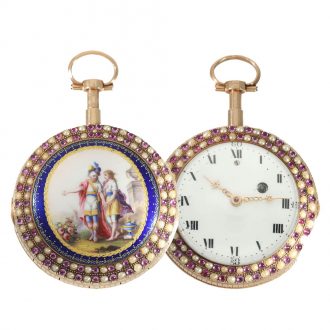
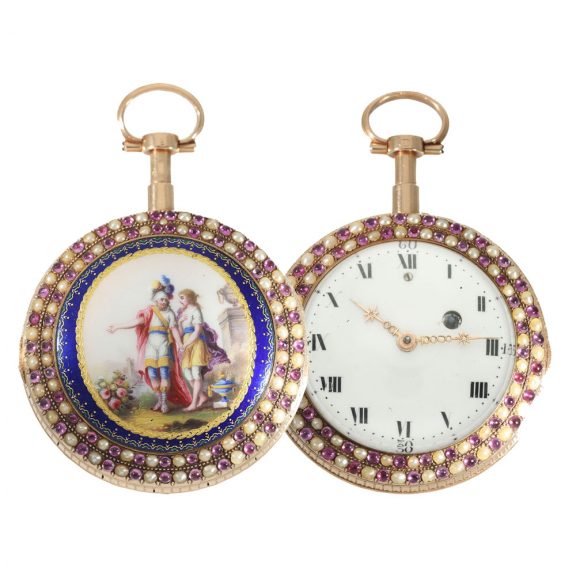
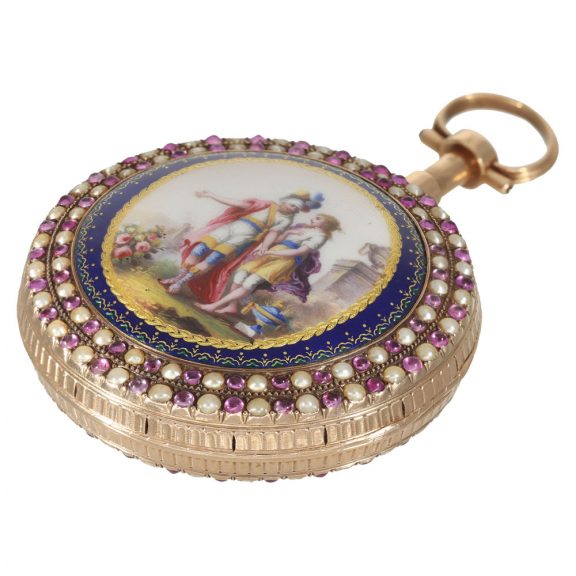
Austrian gold and enamel museum quality verge watch Circa 1780
- Kenmerk
- HC1773
- Diameter
- 50 mm
- Estimate
- € 7.000 - 14.000
- Price sold
- € 8.050
Gold important repeater for the Chinese market
–
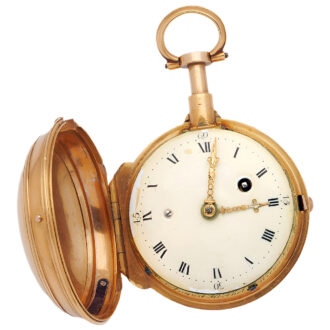
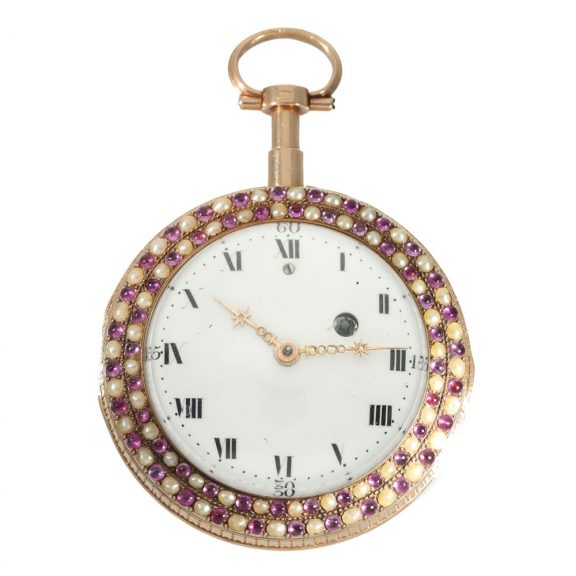
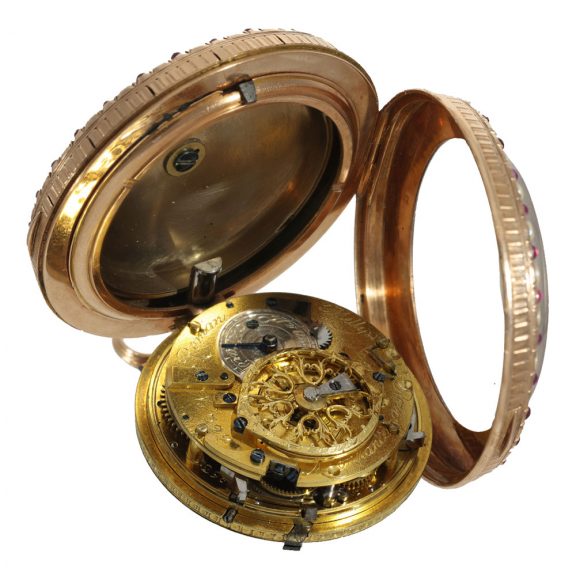
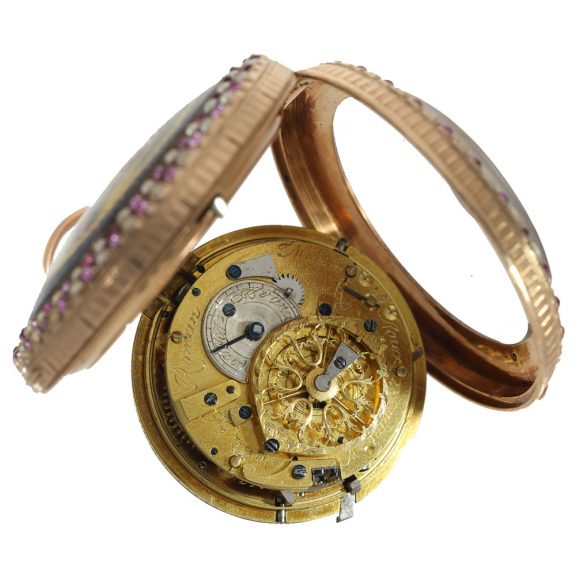
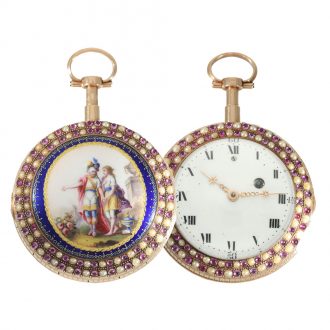
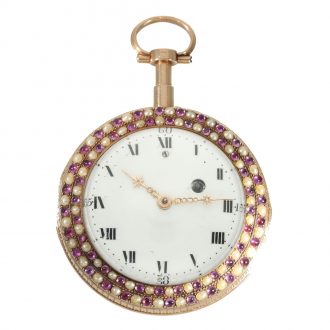
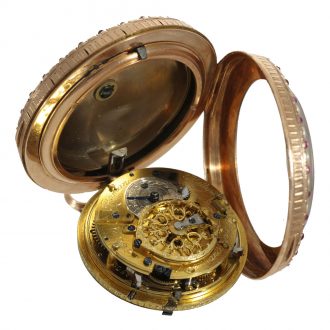
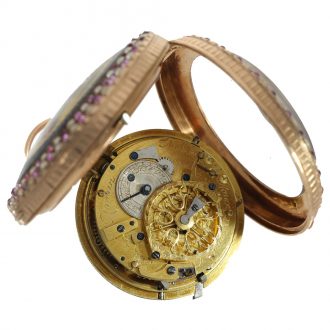
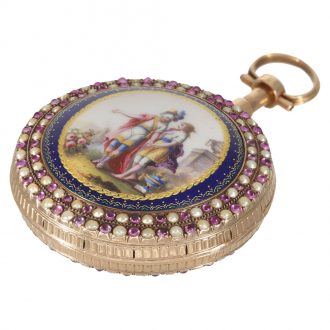
A large and important, museum quality, quarter repeating pocket watch, probably, made for the Chinese market by Roman Melly & Roux in Constance, Austria at the time, circa 1780. The splendour case of this unusual watch was crafted from 18 carat gold and features a polychrome enamel painting surrounded by pailloné enamel on the back lid, double rows of rubies and half pearls on both sides, fine sound openings in the band and a bell. The white enamel dial has Roman hour numerals, outer minute divisions, Arabic quarter hour numerals and fine gold hands. The numbered movement is fitted with a verge escapement and repeats the hours and quarter hours.
The movement is signed.
–
Diameter: 49.5 mm
–
Weight: 87 g
–
Signed: Roman Melly & Roux à Constance
–
This is possibly the earliest known pocket watch by these famous makers. Gold and enamel verge watches set with stones and pearls, which also have a repeater on a bell, are highly sought after and extremely valuable collector’s items. Comparable pieces can be found in the Hermitage Collection and the Patek Philippe Museum in Geneva.
–
Roman Melly & Roux
The watchmaking company Roman Melly & Roux was founded by Swiss artisans from Geneva in 1778 and operated from Constance (Konstanz), when the city was part of Habsburg Austria. The firm is known for producing high quality, complicated and artistically decorated pocket watches and made luxurious timepieces with movements signed “Roman, Melly & Roux à Constance”.
Many of their watches featured intricate polychrome enamel paintings and precious stones. They also produced technically advanced watches, such as a rare quarter repeater pocket watch from around 1770.
Ami Melly served as the company’s first director from 1778 to 1785, he was succeeded by François Roman.
After December 26th, 1805, when the treaty of Pressburg was signed, Constance ceased to be part of Austria, which may have impacted the company’s operations. The firm’s last known production dates are around 1830.
Signed: Roman Melly & Roux à Constance
Share this page: