Swiss gold chronometer with one-minute tourbillon Circa 1982
- Kenmerk
- TA1516
- Diameter
- 61 mm
- Estimate
- € 60.000 - 120.000
- Price sold
- € 91.750
Gold hunting cased pocket watch
–
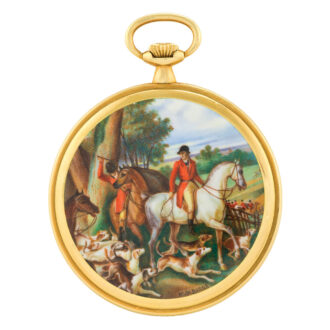
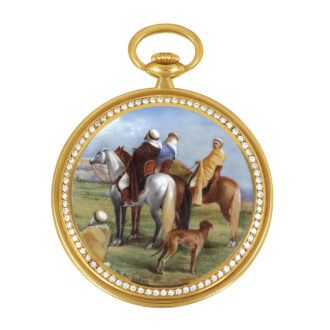
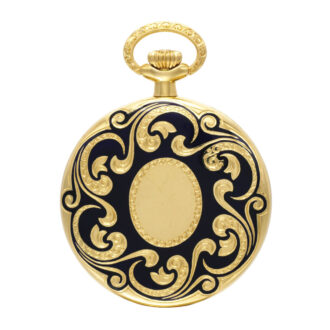
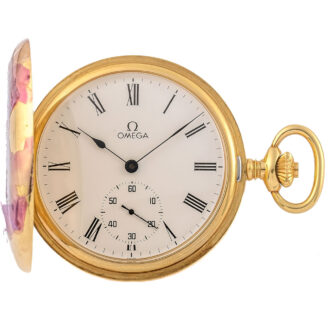
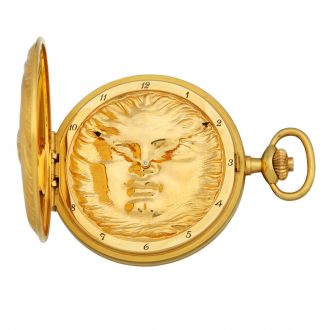
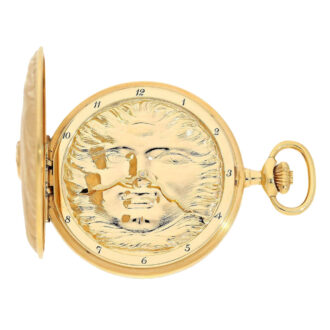
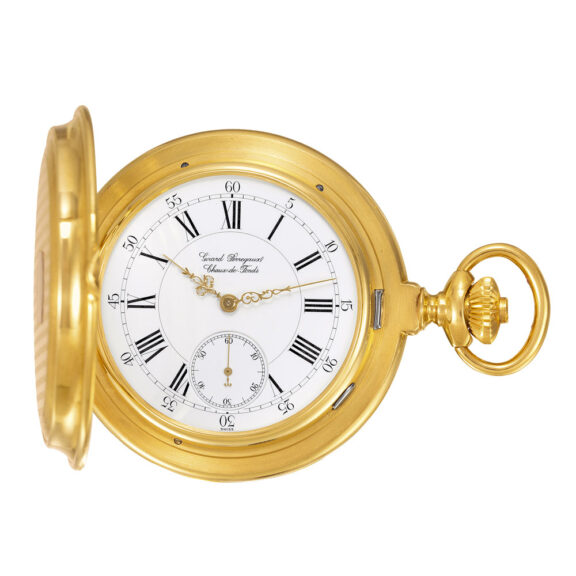
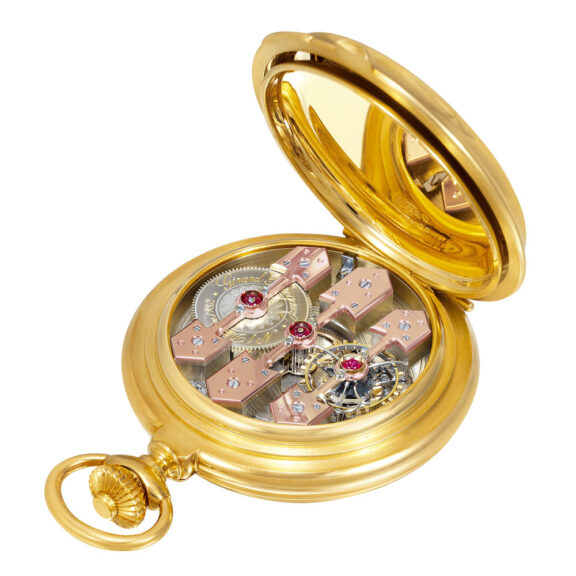
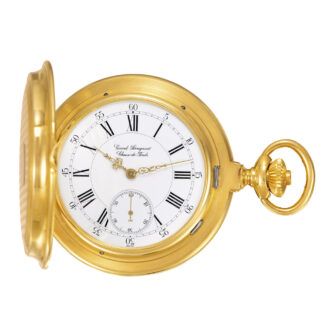
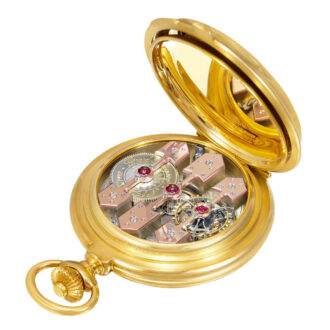
An extremely fine and very rare Swiss, large 18 Carat yellow gold hunting cased keyless pocket watch, circa 1982. Perregaux calibre one-minute tourbillon carriage, detent chronometer escapement, Guillaume balance, three golden bridge movement. A solid, polished and engine-turned case, stepped back and front covers, vacant cartouche, engine-turned interior covers. Hinged gold cuvette, glazed gold-rimmed cover for viewing the movement.
–
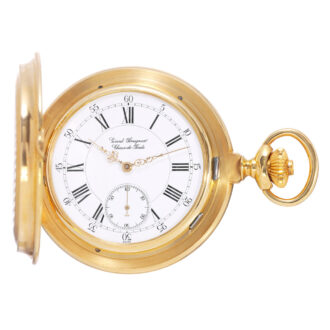
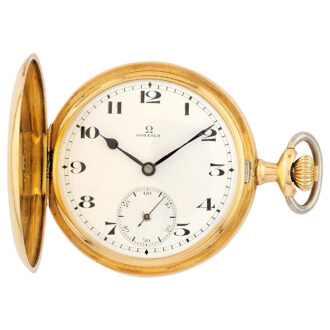
White enamel dial with radial Roman and outer Arabic numerals, minute track, subsidiary seconds. Gold Louis XV hands. First quality movement with three parallel golden bridges, 16 jewels, gold wheel train, Perregaux calibre one-minute tourbillon regulator with pivoted detent escapement, Anibal-brass Guillaume balance with gold temperature adjustment screws, blued steel balance spring with Phillips terminal curve and amplitude limiting device, index regulator. Dial, case and movement signed. Property of a European Collector.
–
Diameter: 61 mm
–
Signed: Girard-Perregaux Chaux-de-Fonds
–
An exact replica of the watch in the Girard Perregaux Museum, this magnificent pocket chronometer with one-minute tourbillon regulator Sous Trois Ponts d’Or is part of a very small series started in 1981 and planned to be produced in twenty examples (to date only 17 pieces have been completed; these are regarded by collectors as the most beautiful tourbillons ever made). Fitted with a pivoted detent escapement, mounted on a one-minute tourbillon carriage they are identical to the original watch, patented in March 1884. A period model was acquired at auction to provide the required reference. The present watch, the first of the series of these new tourbillons with three gold bridges was ready by December, 1982. An objective evaluation of that achievement can be found in the opinion of the curator of the International Museum of Horology in La Chaux de Fonds, Andre Curtis: With all the severity of an experienced horology teacher, I’d say that watchmakers thirty years ago or so swore only by the achievements of the old masters of their trade. Yet with all their merits, none of them ever achieved a level of finish on a par with this, even on their most exceptional timepieces. In a word, this Tourbillon embodies the highest degree of quality that I have ever come across in my entire career. The Tourbillon’s exacting precision was further confirmed by stringent tests carried out by the Swiss Official Chronometer Testing Authority. This body issued the Tourbillon a pocket chronometer rating certificate inscribed with the mention of, particularly good results. This impressive performance was matched by every other Tourbillon in the series. Girard Perregaux The origins of the firm go back to Jean-François Bautte, who became famous for his extra flat watches and founded a manufactory in Geneva, in which all the various facets of the trade were housed under one roof, which was an innovation at the time. In 1837, Jacques Bautte and Jean Samuel Rossel took the reins of the illustrious firm. In 1852, Girard & Cie was founded by Constant Girard, who, two years later, married Marie Perregaux. The combination of their two names resulted in the birth, in La Chaux de Fonds in 1856, of the Girard-Perregaux Company. In 1903, Constant Girard-Gallet succeeded his father at the head of the firm. In 1906, he acquired the celebrated Maison Bautte, merging it with Girard Perregaux et Cie. In the early 20th century, Count Ferdinand von Zeppelin used Girard-Perregaux timepieces during his aeronautical experiments. In 1928, the German watchmaker Otto Graef, owner of the MIMO Brand (Manufacture Internationale de Montres Or) took over the capital shares of Girard Perregaux. In 1998, the firm acquired the Villa Marguerite, a turn of the century building, which would be renovated in order to house the new Girard-Perregaux Museum. In 1999, Girard Perregaux presented a self-winding version of its famous Three Gold Bridges Tourbillon, thanks to an ingenious system featuring a platinum micro-rotor under the mainspring. Trois Ponts d’Or on March 25, 1884, a patent was filed in the USA patent office stating: Be it known that I, Girard Perregaux of Chaux de Fonds, Republic of Switzerland, have invented and produced a new and original Design for a Watch Movement, of which the following is a full, clear and exact description: In a watch movement, the design for a bridge, consisting of a bridge having a central annular portion, spread out ends and bar-like portions between the said annular portions and ends, as shown. The design proved to be one of the most successful watch movement designs ever. It has been used by Girard Perregaux up to the present day. Their most prestigious watch, the thirteen wrist tourbillon uses the same design. The simple and bold yet elegant layout of the three bridge movement lends itself to the display of the tourbillon regulator.
Signed: Girard-Perregaux Chaux-de-Fonds
Share this page: