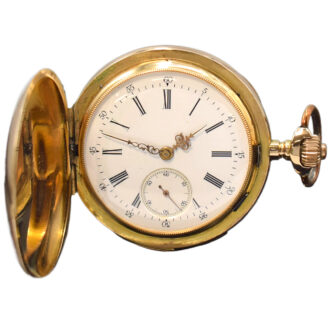
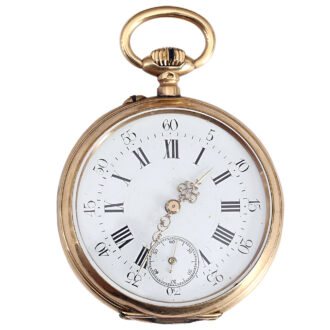
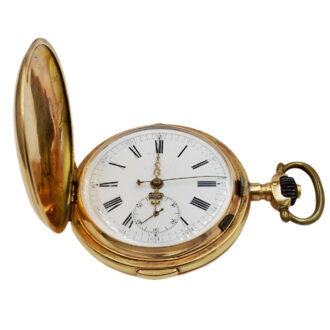
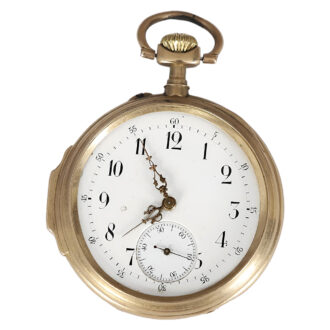
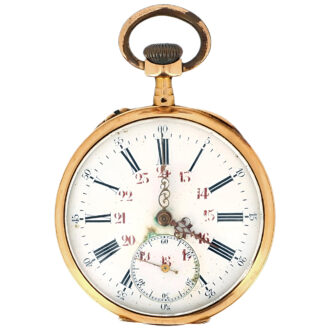
Swiss gold astronomic watch for the Indian market Circa 1900
- Kenmerk
- TA2152
- Diameter
- 62 mm
- Estimate
- € 120.000 - 220.000
- Price sold
- € 154.200
Gold astronomical lever with 13 complications
–
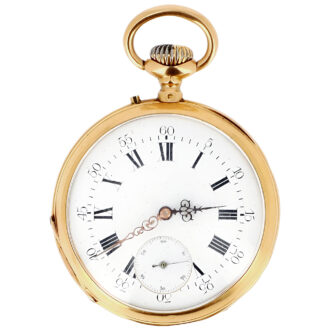
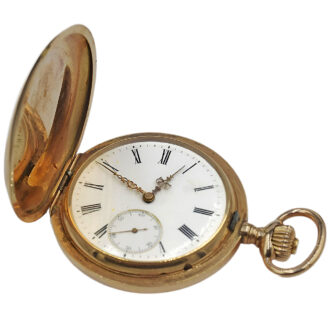
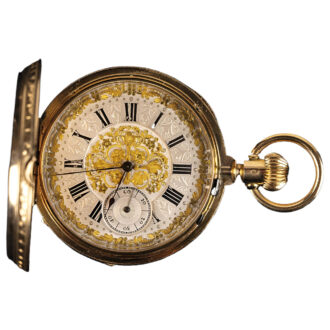
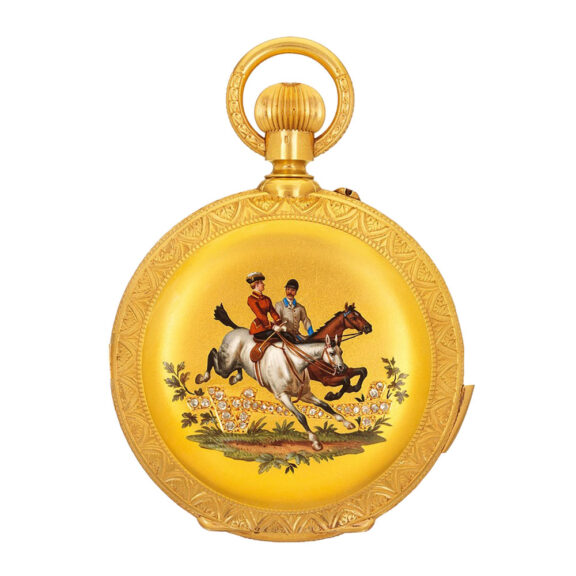
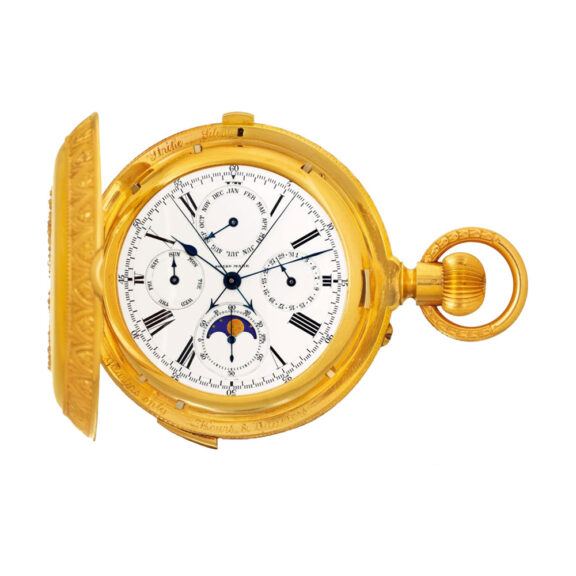
A very fine, heavy Swiss important and rare 18K yellow gold, enamel and diamond-set hunting faced minute repeating astronomic lever pocket watch made for the Indian market, circa 1900. Sold to the Sixth Nizam of Hyderabad, Mahbub Ali Khan who reigned from 1869 to 1911. The Hunt is a watch with 13 complications by Gideon & Co. An eight-day going two-train keyless clock watch with grande and petite sonnerie, triple date, chronograph, central progressive minute recording hand, moon phases and lunar calendar.
–
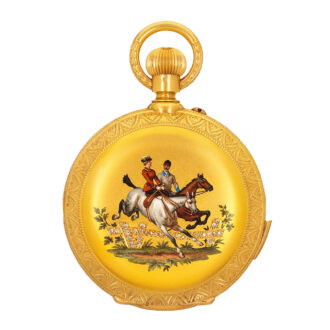
The band, bow and bezels are chased and engraved with stylized leaves and geometric patterns, the hinged and sprung front cover decorated with a finely painted on enamel scene of a lady and gentleman on horseback jumping a rose-cut diamond-set fence on a frosted gold ground, on the back cover a finely painted on enamel trophy composed of a pair of crossed riding crops, bridle, stirrups and a jockey’s cap amongst oak leaves on a frosted gold ground. A hinged gold cuvette engraved with the technical details.
–
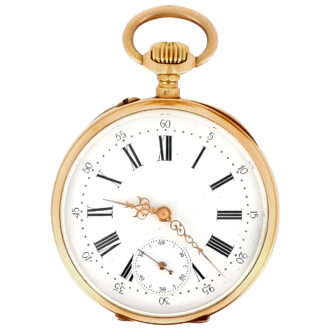
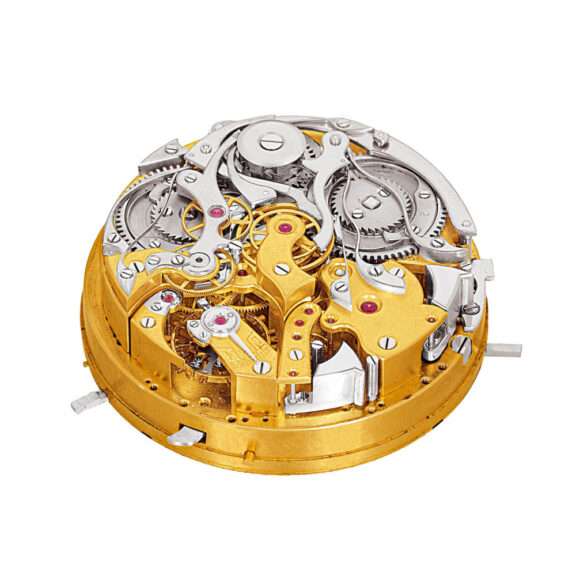
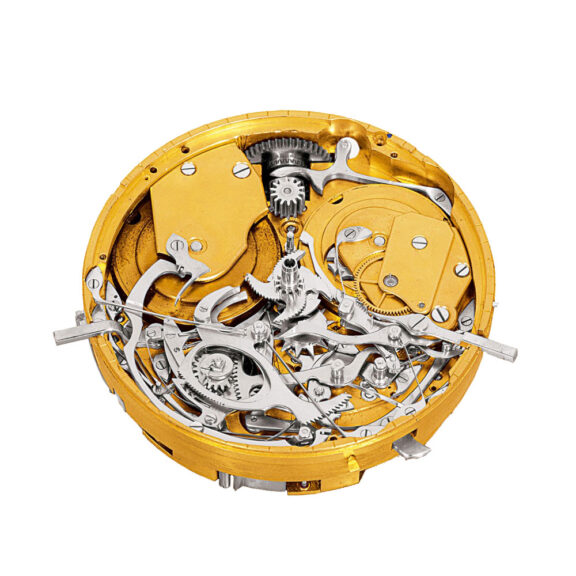
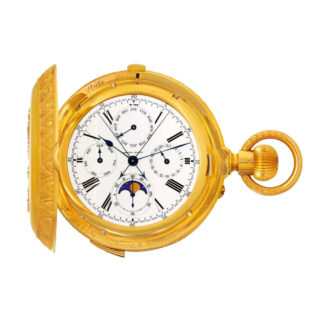
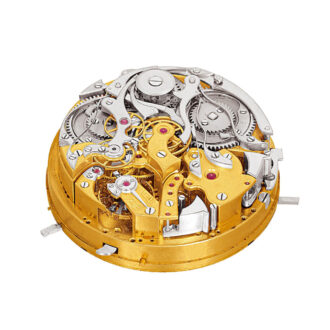
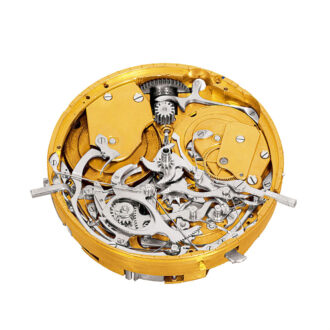
White enamel dial with radial Roman numerals, outer minute track and concentric fifths of a second track, Arabic five-minute numerals, subsidiary dials for seconds, date, days of the week and months, moon phase aperture with lunar age sector, blued steel spade hands. A frosted gilt movement attributable to Henry Grandjean & Cie, 39 jewels, two trains with tandem winding, visible chronograph mechanism activated by a button in the band, counterpoised straight-line lever escapement, cut bimetallic compensation balance, blued steel Breguet balance spring, index regulator, striking and repeating on gongs, the repeating via a trip-slide in the band. Cuvette signed the watchmaker, the case stamped JL within an oval.
–
Diameter: 62 mm
–
Signed: Gideon & Co Le Locle
–
This watch is the most complicated piece made for the Indian market to have ever been sold in an auction. It has the rare feature of a central progressive minute recording hand. This, along with the chronograph hand, gives the appearance of being a split-seconds chronograph. The design of the present watch recalls the height of the British Raj in India. It depicts a fashionable English couple out riding, along with the oak leaf and riding accessories. It is likely that the jockey’s cap shows the racing colours of the original purchaser. This combination of Swiss manufacture and English taste is peculiar to the Indian Market and was one aspect of the so-called Swiss period which of course includes the watches produced in Switzerland, with cases decorated purely in the Indian manner. The ruling Indian classes on the whole embraced the English gentry and actively participated in traditional English pastimes. Perhaps this watch was made for presentation to a Maharaja at a special race or equestrian event. On 1st January 1877, Queen Victoria has proclaimed Empress of India at a Durbar, or assembly of notables and princes, in Delhi. The Sovereign, who, incidentally never visited her Indian Empire, was represented by the Viceroy Lord Lytton.
–
The Queen sent a telegram, which read: We, Victoria, by the grace of God, Empress of India, and through our Viceroy, to all our officers, civil and military, and to all princes, chiefs, and peoples now at Delhi assembled, send our Royal and Imperial greeting and assure them of the deep interest and earnest affection with which we regard the people of our Indian Empire. We have witnessed with heartfelt satisfaction the reception they have accorded to our beloved son and have been touched by their loyalty and attachment to our House and Throne. We trust the present occasion may tend to unite in bonds of yet closer affection ourselves and our subjects, that from the highest to the humblest all may feel that under our rule the great principles of liberty, equity and justice are secured to them and that to promote their happiness, to add to their prosperity, and advance their welfare, are the ever-present aims and objects of our Empire’. The Princely States, bound by treaty to the crown, preserved control over their domestic affairs. Control over the directly ruled territories (about three-fifths of the total area) was exercised by the Secretary of State for India. The Sovereign is represented by a Governor-General or Viceroy, who is being assisted by a council ruled by India. The administration was staffed by the Indian Civil Service. The Indian Army, with British officers in charge, ensured Raj’s security in conjunction with a British Army garrison. The Raj ended in 1947 with the partitioning and subsequent granting of independence to India and Pakistan on 15th August 1947.
–
Henry Grandjean. Along with Constant Girard (later Girard-Perregaux), Henry Grandjean was one of the first to enter the South American Market. He was also, along with Ulysse Nardin, one of the first to establish a marine chronometer manufacturing business in Switzerland as well as an initiator of the Neuchâtel Observatory. In 1851, at the first Universal Exposition in London, Grandjean received a First Class medal. His list of medals continues until 1868, the year in which the company won an award for its marine chronometers. In the meantime, they also received at least eight different awards, not including those from the Observatory of Neuchâtel. Henry died in 1879 but it appears that the company continued for the next twenty years until 1899, the year in which Rossel & Fils registered their name as successors, who were also most likely running the company during these 20 years. On January 9, 1908, Rossel & Fils transferred the title to Charles-Ferdinand Perret.
The 13 complications of this watch are:
– grande sonnerie
– petite sonnerie
– minute repeat
– Strike and Silent
– eight days going for the time
– eight days going for the striking train
– days of the week
– the date
– months of the year
– split-seconds chronograph.
– minute recorder
– two trains
– moon phases
Signed: Gideon & Co Le Locle
Share this page: