Swiss 18K gold combined form watch and perfume sprinklers Circa 1806
- Kenmerk
- FA0256
- Diameter
- -
- Estimate
- € 250.000 - 500.000
- Price sold
- € 279.300
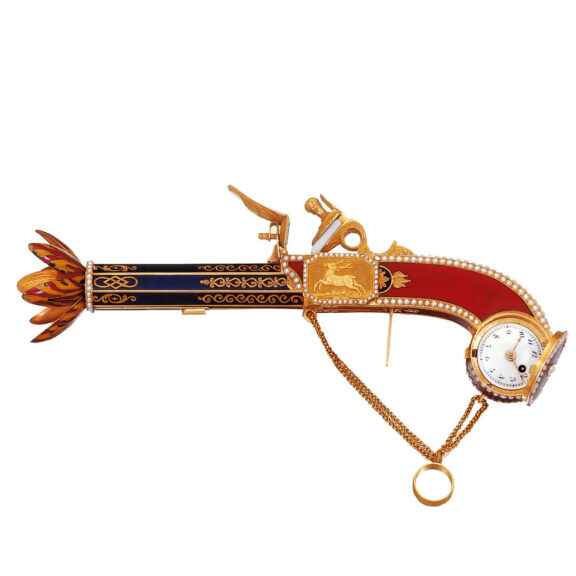
Gold pair of combined flintlock pistol shaped watch and perfume sprinklers
–
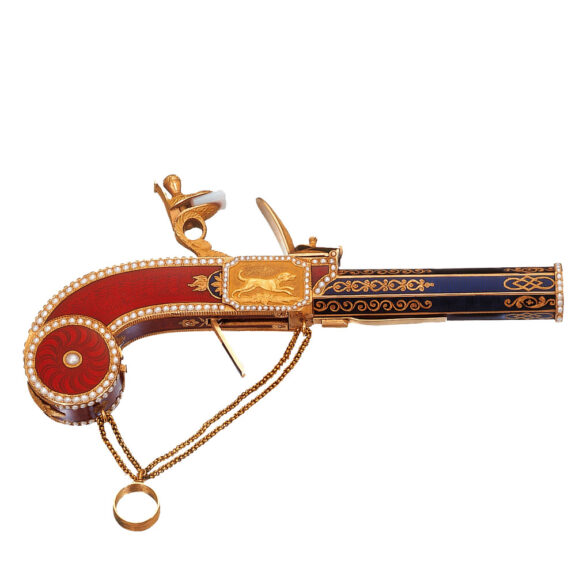
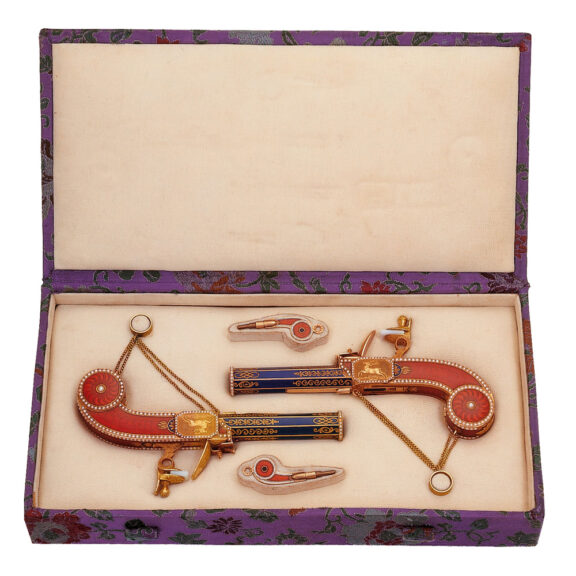
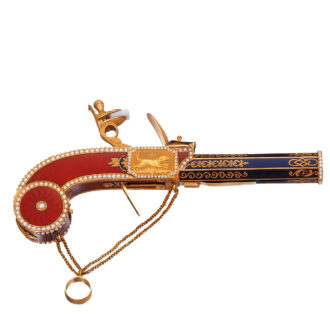
This is an extremely rare pair of perfume sprayers in the shape of flintlock pistols, each with a watch built in. They are made of 18-carat gold, enamel and pearls and were made for the Chinese market around 1806. They are attributed to Moulinié, Bautte & Cie of Geneva.
–
The movements
Each watch has a gilt brass movement built between two full plates held by round pillars. A chain and fusee keep the power steady. They have a verge escapement, a plain three-armed brass balance, and a pierced and engraved balance cock in the continental style.
–
The pistols
The grips are covered in see-through scarlet enamel over a guilloché pattern, a fine engraved design that shimmers through the enamel. They are decorated with small gold rosettes and a gold flower on black champlevé enamel and edged with half pearls. Further gold plaques, finely chased with a dog on one side and a stag on the other, are framed with half pearls.
–
The barrels are covered in see-through cobalt blue champlevé enamel over a guilloché pattern, with raised gold scrolls made to look like damascening, a decorative inlay often found on fine weapons.
–
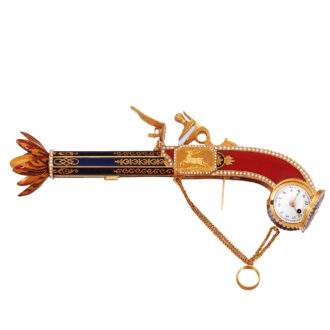
When the pistol is fired, a gold lotus flower with enamelled petals shoots out of the barrel and sprays perfume from its centre. Cocking the hammer and pulling the trigger sets the mechanism.
–
The watch is hidden in the end of the grip, behind spring-loaded front and back covers. Their bezels are set with half pearls and decorated with a guilloché rosette around a larger half pearl. The white enamel dial has Arabic numerals, minute markers around the edge and gold spade-shaped hands.
–
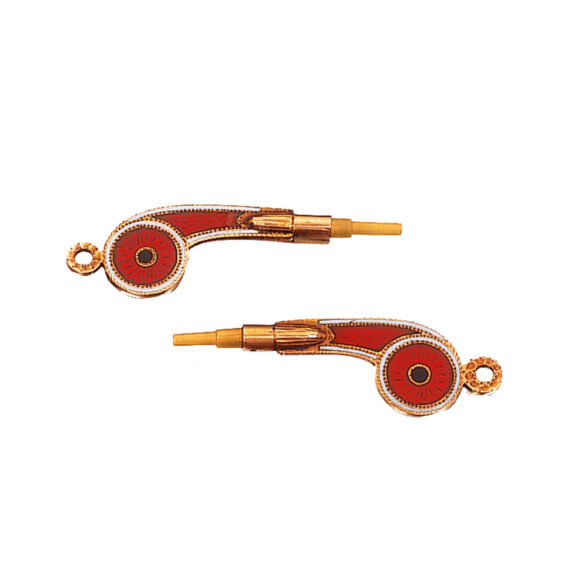
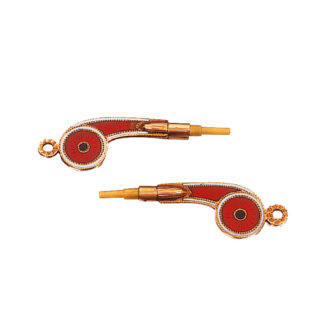
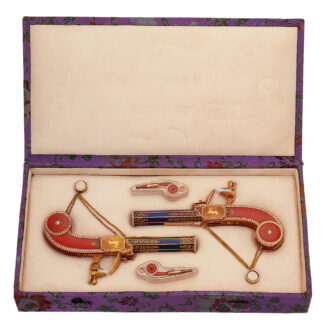
This exceptional pair comes in a fitted Chinese presentation box with its original winding keys. The keys are also shaped like pistols and decorated with matching see-through scarlet enamel and white enamel borders.
–
–
This is an extremely rare pair of perfume sprayers in the shape of flintlock pistols, each with a watch built in. They are made of 18-carat gold, enamel and pearls and were made for the Chinese market around 1806. They are attributed to Moulinié, Bautte & Cie of Geneva.
–
The movements
Each watch has a gilt brass movement built between two full plates held by round pillars. A chain and fusee keep the power steady. They have a verge escapement, a plain three-armed brass balance, and a pierced and engraved balance cock in the continental style.
–
The pistols
The grips are covered in see-through scarlet enamel over a guilloché pattern, a fine engraved design that shimmers through the enamel. They are decorated with small gold rosettes and a gold flower on black champlevé enamel and edged with half pearls. Further gold plaques, finely chased with a dog on one side and a stag on the other, are framed with half pearls.
–
The barrels are covered in see-through cobalt blue champlevé enamel over a guilloché pattern, with raised gold scrolls made to look like damascening, a decorative inlay often found on fine weapons.
–
When the pistol is fired, a gold lotus flower with enamelled petals shoots out of the barrel and sprays perfume from its centre. Cocking the hammer and pulling the trigger sets the mechanism.
–
The watch is hidden in the end of the grip, behind spring-loaded front and back covers. Their bezels are set with half pearls and decorated with a guilloché rosette around a larger half pearl. The white enamel dial has Arabic numerals, minute markers around the edge and gold spade-shaped hands.
–
This exceptional pair comes in a fitted Chinese presentation box with its original winding keys. The keys are also shaped like pistols and decorated with matching see-through scarlet enamel and white enamel borders.
–
Length: 111 mm
–
Signed: Attributed to Moulinié, Bautte & Cie in Geneva
–
Although not signed, these pieces are almost identical to examples, enabling one to attribute them to the same makers.
Signed: Attributed to Moulinié, Bautte & Cie in Geneva
–
Although not signed, these pieces are almost identical to examples, enabling one to attribute them to the same makers.
–
Moulinié, Bautte & Cie 1772-1837
Jean-François Bautte was born in 1772. At 12 he began an apprenticeship, learning to make cases, engine-turn, make watches, make jewellery and set stones. He signed his first watch when he was barely 19.
–
In 1797 Bautte went into partnership with the casemaker Moulinié. In 1804 the watchmaker Jean-Gabriel Moynier joined them. The firm was first called Moulinié, Bautte & Cie and later became Moulinié, Bautte & Moynier. In the early 19th century, Bautte was the most important watch and jewellery dealer in Geneva.
Share this page: