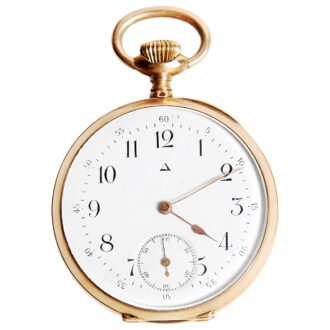
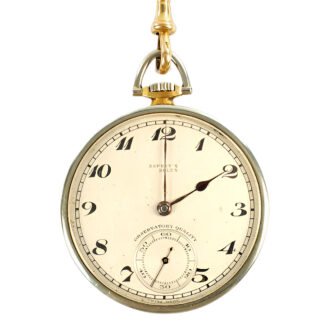
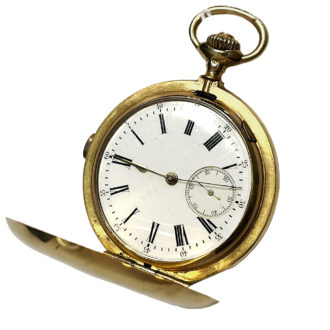
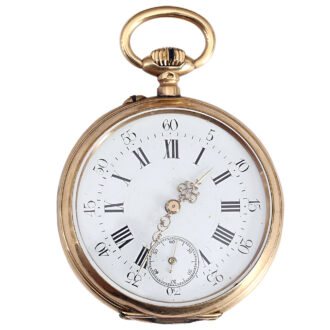
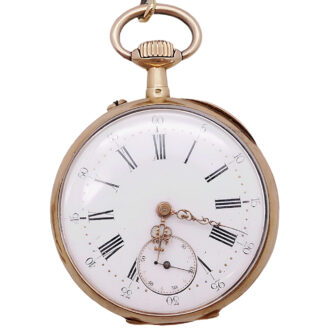
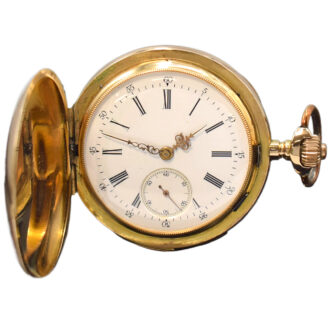
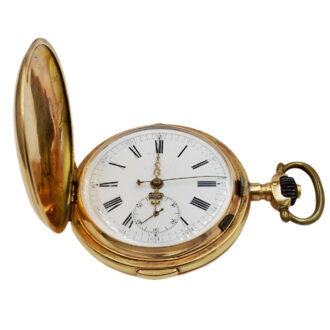
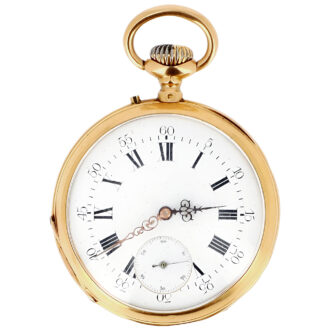
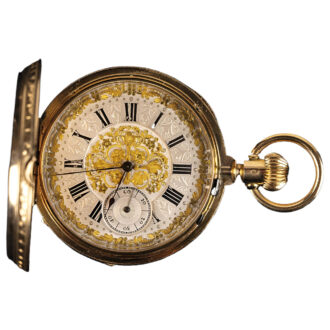
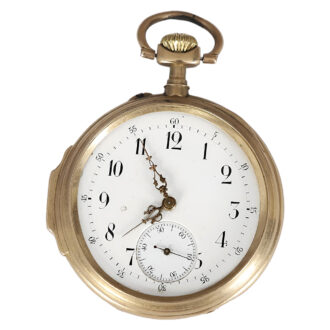
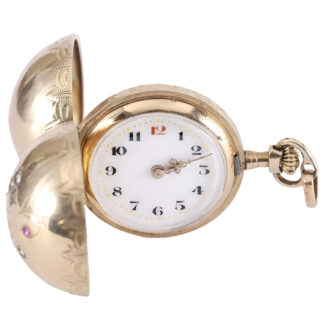
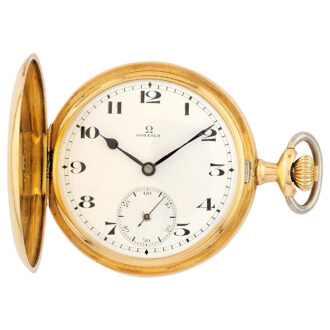
Swiss 18K gold minute repeating carillon pocket watch Circa 1900
- Kenmerk
- TA5288
- Diameter
- 54 mm
- Estimate
- € 25.000 - 50.000
- Price sold
- -
Gold watch made for Paul Meille as a Christmas present
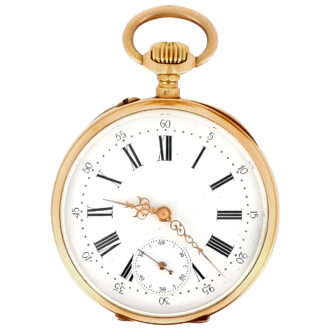
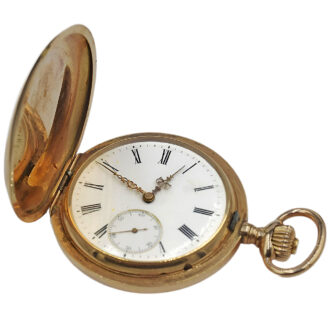
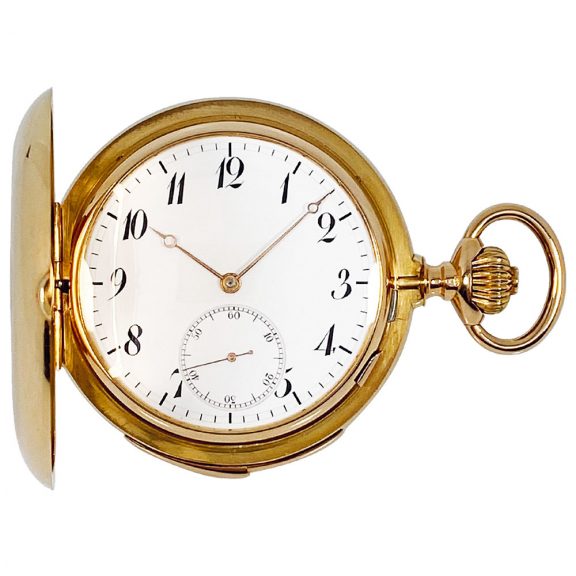
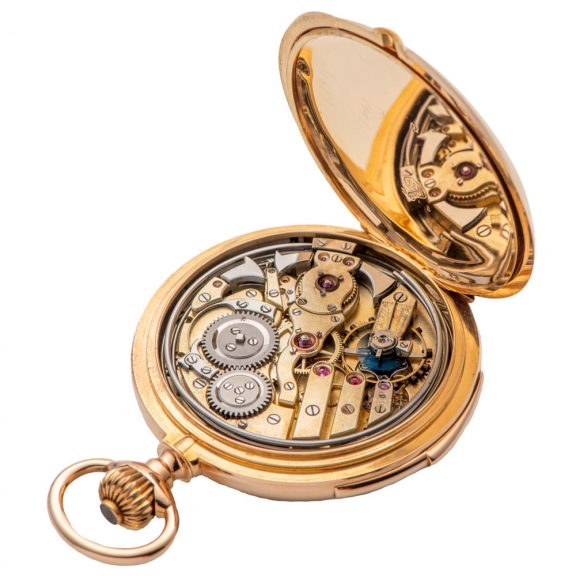
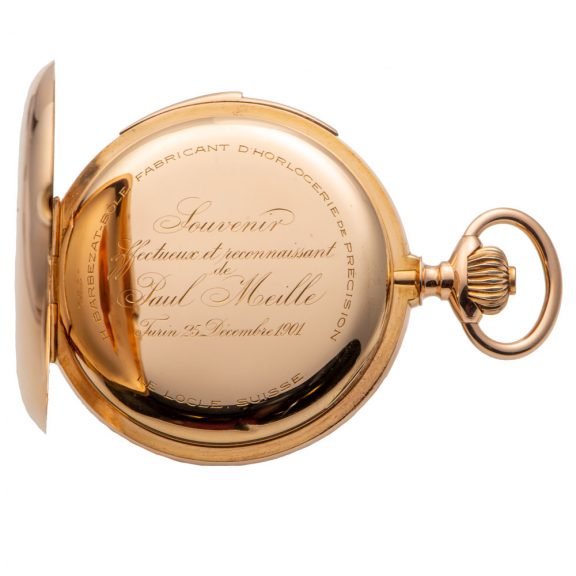
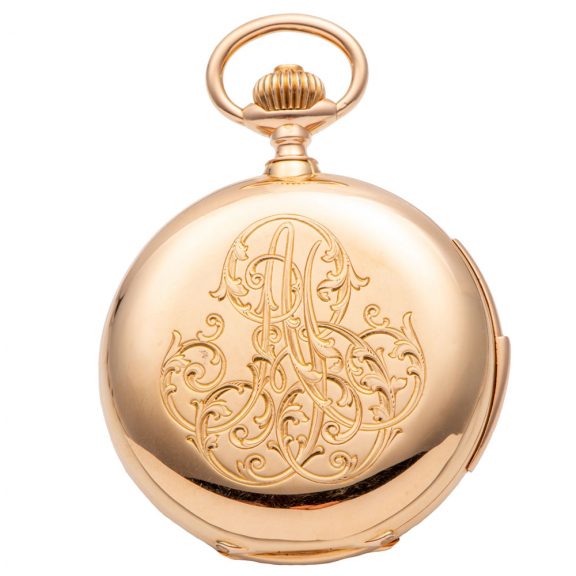
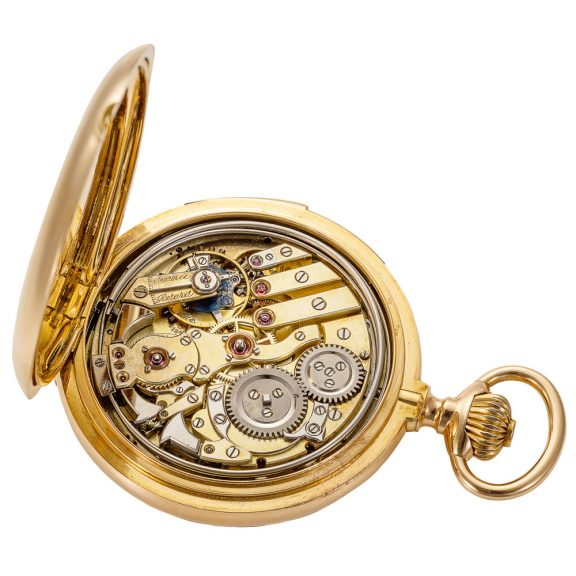
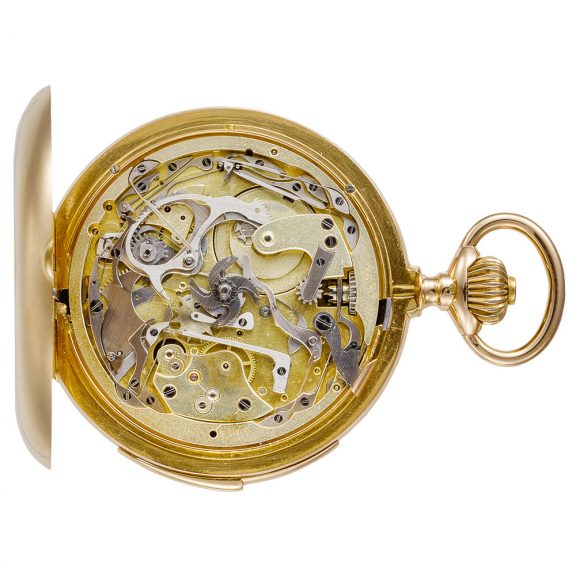
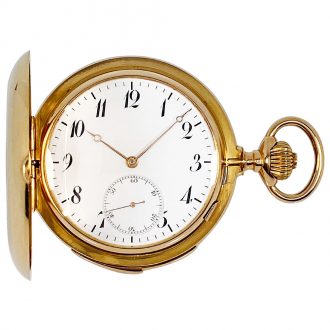
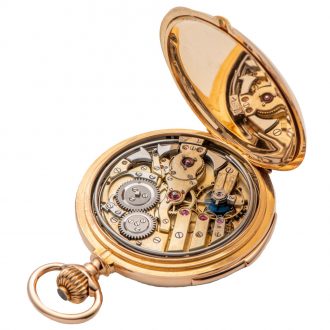
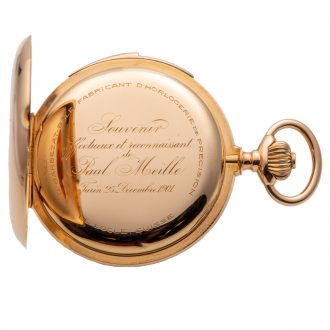
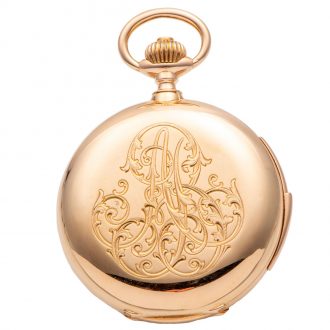
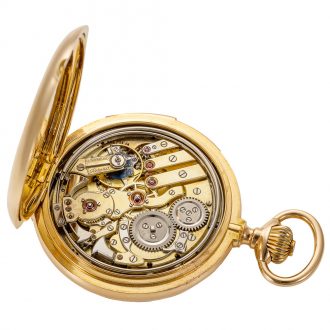
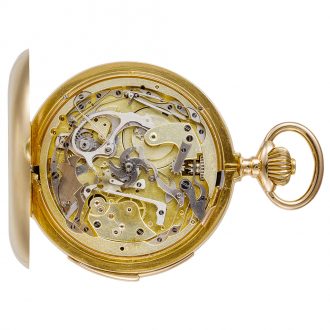
A Swiss 18 carat pink gold minute repeating carillon keyless pocket watch, circa 1900. The cover is engraved in taille–douce, monogram A B, and the cuvette is engraved with the mention Souvenir affectueux et reconnaissant de Paul Meille, Turin 25 décembre 1901. Minute repeater on four steel gongs by four hammers, activated by the slide at 6 o’clock. Enamel dial with Breguet radial hours, outer minutes track, subsidiary dial for the seconds, and gold Breguet hands. A gilded brass movement (ebauche by LeCoultre & Cie, Le Sentier, Vallée de Joux), going barrel, gold screwed chaton setting on the central wheel, straight line equilibrated lever escapement, compensated balance and blued steel hairspring with terminal curve, polished steel index regulator.
The cuvette is signed.
–
Diameter: 54 mm
–
Weight: 117 g
–
Signed: H. Barbezat-Bôle Le Locle
–
Accompanied by a copy of the invention patent.
–
This magnificent watch impresses the viewer with the excellent condition of its case, dial and movement. Four hammers strike four different gongs for the minute repeater, a so called carillon chime. This is a rare and very sophisticated construction designed according to a patent by César Racine; he specialised in this kind of complication and received a Médaille d’Or during the Exposition Nationale Suisse in 1896. The cuvette is engraved with a dedication that tells us that the watch was a Christmas present given as a sign of appreciation to Paul Meille in Turin: Souvenir affectueux et reconnaissant de Paul Meille, Turin 25. Décembre 1901.
–
Barbezat-Bôle, Henri (1851-1921)
The company H. Barbezat-Bôle S.A., Le Locle, was founded by Henri Barbezat-Bôle (1851-1921). He was the younger brother of Charles Barbezat-Baillot (1847-1938), the founder of Le Phare, Dixi, etc. In 1897, the company registered the “hammer” trademark (three hammers crossed) for watches and watch parts. The company made complicated pieces. It took over Paul Buhré, Le Locle; the corporate name became Paul Buhré & H. Barbezat-Bôle. Both companies were listed circa 1920-1925. H. Barbazat-Bôle was listed in 1924 for marine chronometers, pocket chronometers, 8-day watches, plus a large ad for pocket watches and navigational chronometers, 8-day quality watches, Westminster chime repeaters, other repeaters and form-watches. In 1923, H. Barbezat-Bôle won the International Chronometer Competition Group Prize, five individual prizes, a Series Prize and First Prize. He made watches for the Indian market with portraits of dignitaries painted by John Graff (1836-1902) of Geneva.
–
Paul Meille (1851-1902) was a banker and philanthropist, a member of the Waldensians and one of the founders of the Société d’Histoire Vaudoise.
He was born in Turin as the son of pastor Giovanni Pietro Meille and Swiss Sylvie Ruchet; in 1880, he married French Emilie Gaufres (1858-1928), and the couple had four children. After inheriting a fortune in 1879, he dedicated large sums of his money to charity, mostly to the Waldensians and other social facilities. He was elected as a member of the Turin Chamber of Trade several times, and the board honoured him with the title Knight-Commander of the Order of the Crown of Italy. From 1897 until he died in 1902, he was Consul of the Netherlands in Turin. Meille died on August 13, 1902, in Affoltern (near Zurich), where he had been staying for reasons of ill health.
Signed: H. Barbezat Bôle, Le Locle
Share this page: