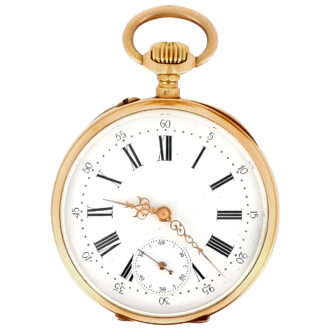
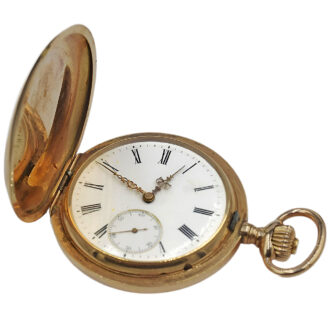
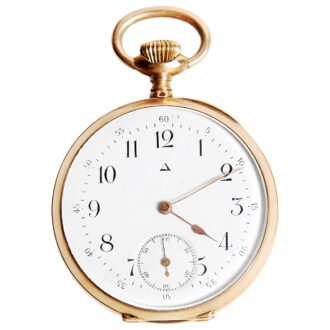
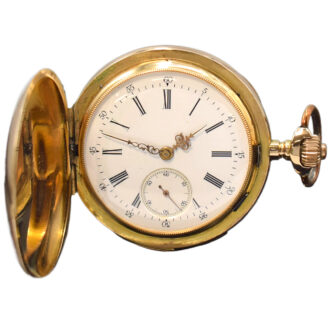
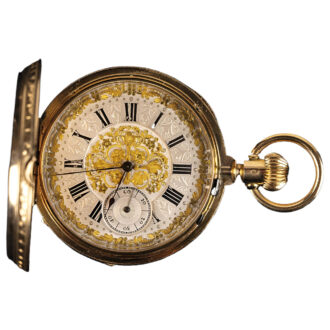
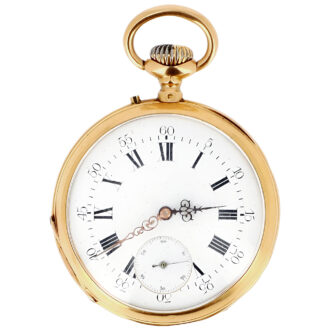
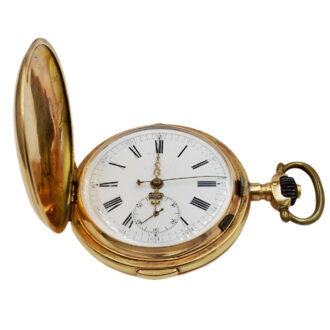
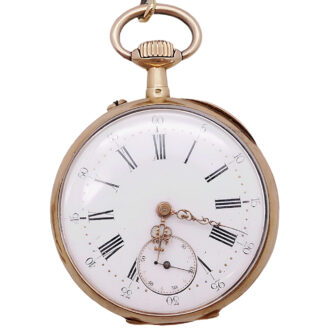
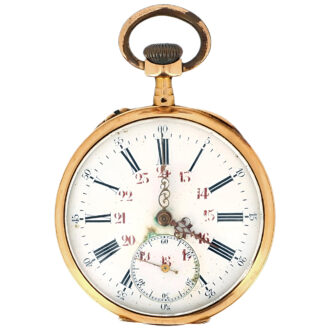
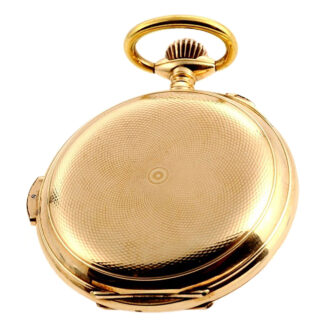
Swiss repeating chronograph with moon phase Circa 1900
- Kenmerk
- AD1498
- Diameter
- 59 mm
- Estimate
- € 4.500 - 7.000
- Price sold
- € 5.650
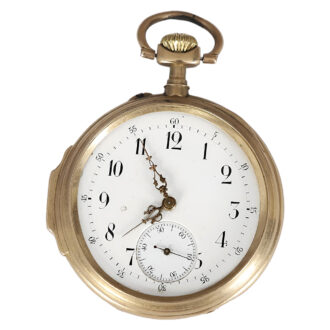
Gold astronomical hunting cased pocket watch by Invicta
–
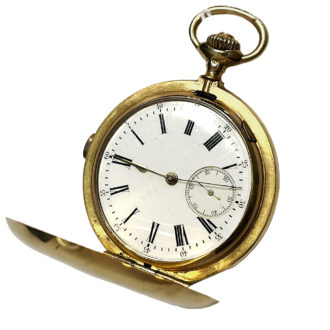
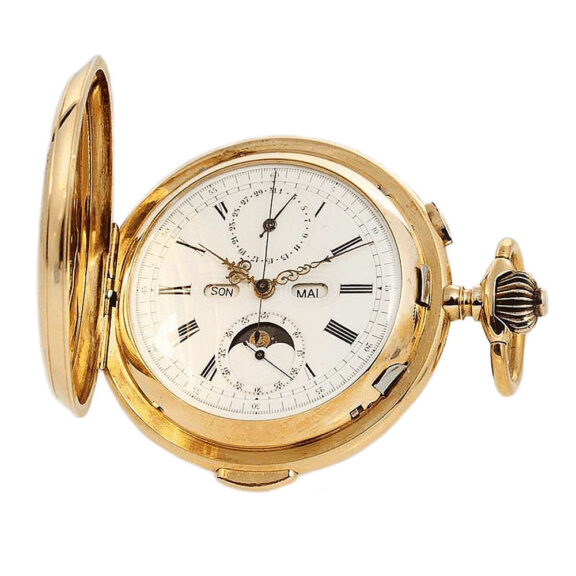
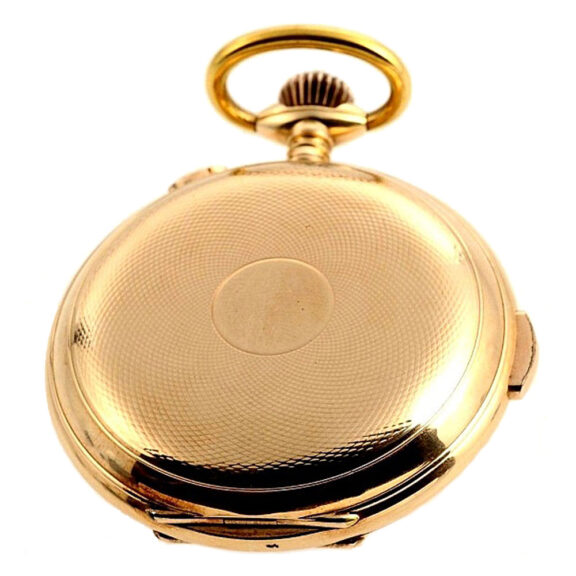
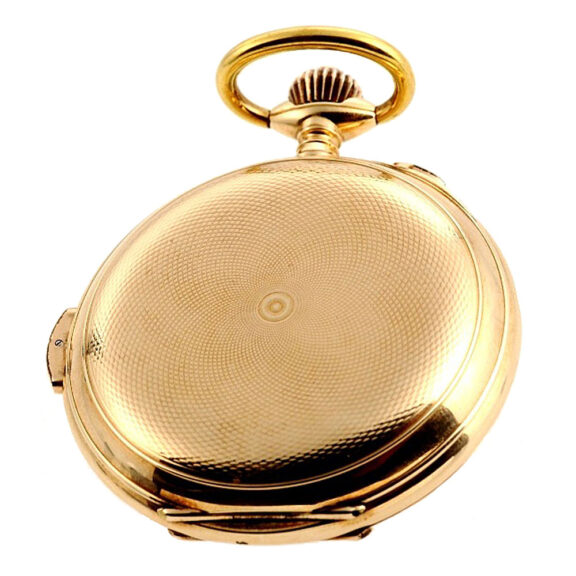
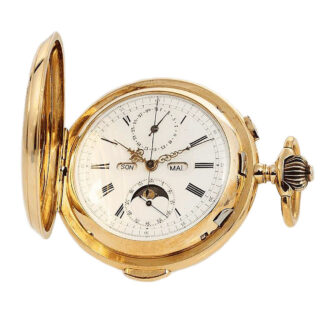
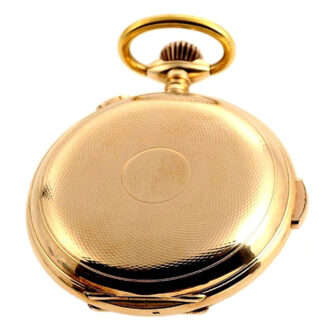
A fine Swiss astronomical quarter repeating hunting cased pocket watch with chronograph, calendar and moon phase, circa 1900. This watch features an engine turned 14 carat pink gold case with a signed gold dome and a glazed movement. It includes a pusher for the repetition function at 6 o’clock, a chronograph pusher at 2 o’clock, and the case maker’s punch mark: FRP. The white enamel dial showcases radial Roman numerals and has a sunk subsidiary dial for seconds, along with an aperture for the moon phase. There is also a window indicating the day and month, as well as a date indication, all complemented by Louis XV hands.
–
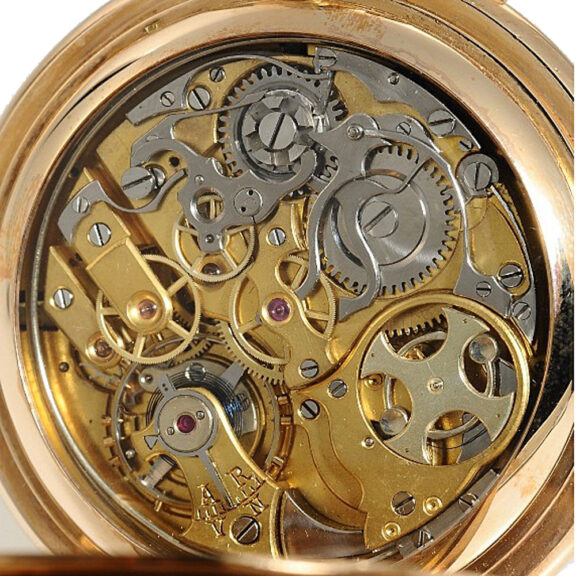
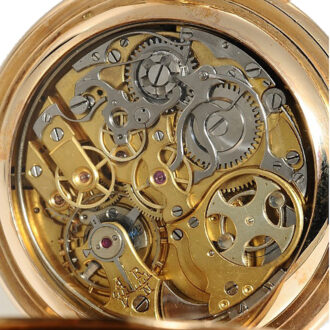
The movement features a divided 3/4 plate that is both frosted and gilt. It includes ground, bevelled chronograph steel components, a ratchet wheel, two hammers, two gongs, and a governor for the chiming function. Additionally, it is equipped with a screw compensation balance and a blued balance spring.
–
Diameter: 59 mm
–
Weight: 139 g
–
Signed: Invicta
–
Invicta was founded by Raphaël Picard (1810-1884) in 1837 as R. Picard in La Chaux-de-Fonds, Switzerland. Around 1890 the company was renamed Les Fils de R. Picard, Armand Picard (1856-1926) Gabriel Picard (1865-1935) was the successor. In 1895 Picard won a gold medal at the National Exhibition in Bordeaux. The name Invicta was derived from Latin, translated invincible. Picard’s motto was to offer high quality Swiss watches at affordable prices. In addition to normal pocket watches, the company also supplied clocks with striking mechanisms, calendar mechanisms, moon phase displays, and chronographs with movements by Charles-Ami Barbezat-Baillot. In 1896, the brand name Invicta was introduced in addition to Telescope. In 1906, there were 26 employees at the company. In 1922it was 30. During the First World War, Invicta was active in the production of ammunition with, for example, Mirum SA; Zeno, Eigeldinger & Co (34 employees in 1912; 40 in 1922); and the Ebel factory of the Blum family (23 employees in 1912 25 in 1922). The factory was located in Léopold-Robert 109 shortly after 1906 in the new building based on a project by the architect Eugène Schaltbrand. From about 1913, worked closely with the Seeland Watch Co. It was only in the time of quartz watches in the 1970s that watch sales fell so sharply that production had to be discontinued.
–
In 1991, an American investment company from the United States bought the company run by the Picard family. Since then, Invicta Watch Group’s headquarters have been in Hollywood, Florida.
Signed: Invicta
Share this page: