Swiss watch for the revolutionary French market Circa 1793
- Kenmerk
- SA2727
- Diameter
- 64 mm
- Estimate
- € 10.000 - 20.000
- Price sold
- € 14.000
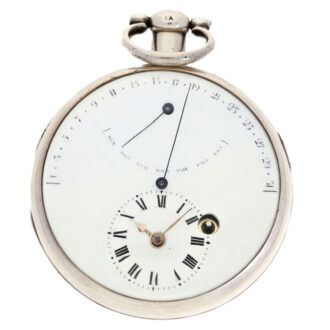
Extremely rare and complicated revolutionary open faced silver pocket watch
–
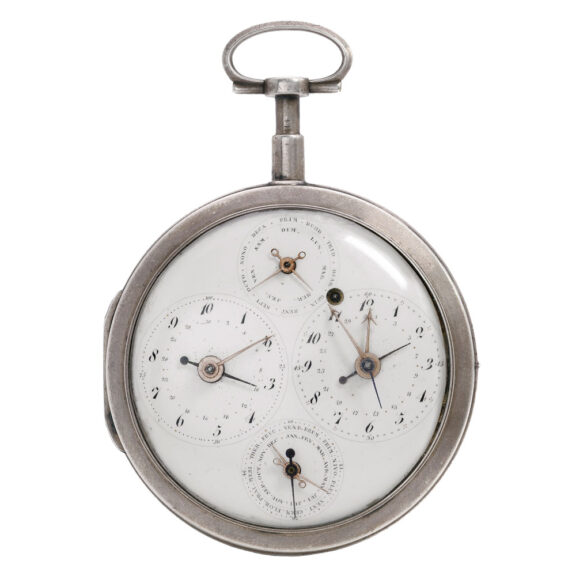
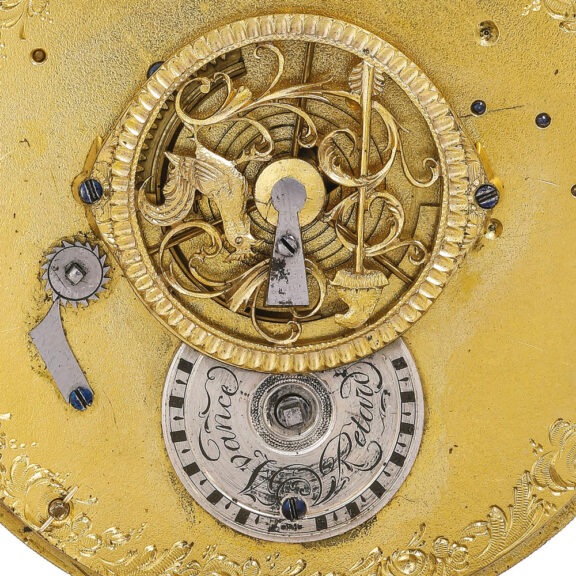
A Swiss watch for the revolutionary French market, fine and extremely rare and complicated revolutionary open faced silver pocket watch for the conversion of the time, calendar and revolutionary day, circa 1793, gilt brass movement with verge escapement, fusee and chain chased balance-cock figuring a cock and Phrygian cap symbol of the French revolution.
Enamel dial with four different dials: the first at 12 with the days of the week and the revolutionary days of the week indication with two hands, the second at 9 with the revolutionary hours on base 10 and the minutes on base 100 plus the revolutionary day of the month in base 30 indicated with four hands, the third at 3 with the normal hours in base 12 and the normal minutes in base 60 plus the day of the month in base 31 indicated with four hands and the last one at 6 with the months compared to the revolutionary months and an outer second track indicated with three hands, gold and blued steel hands, polished silver case, stamped with the hallmarks ‘TWR’ of the case maker and number.
–
Diameter: 64 mm
–
Signed: No name
–
This watch was made to compare the French revolution Calendar or Calandrier republicain to the Gregorian calendar (the one we use) it also compares the decimal time or revolutionary time to the normal time or duodecimal time.
The French revolution calendar was a calendar created and implemented during the French Revolution, and used by the French government for about 12 years from late 1793 to 1805, and for 18 days by the Paris Commune in 1871. The revolutionary system was designed in part to remove all religious and royalist influences from the calendar, and was part of a larger attempt at decimalisation in France (which also included decimal time of day, decimalisation of currency, and metrication).
Decimal time is the representation of the time of day using units which are decimally related. This term is often used specifically to refer to French Revolutionary Time, which divided the day into 10 decimal hours, each decimal hour into 100 decimal minutes and each decimal minute into 100 decimal seconds, as opposed to the more familiar standard time, which divides the day into 24 hours, each hour into 60 minutes and each minute into 60 seconds.
The main advantage of a decimal time system is that, since the base used to divide the time is the same as the one used to represent it, the whole time representation can be handled as a single string. Therefore, it becomes simpler to interpret a time stamp and to perform conversions. For instance, 1:23:00 is 1 decimal hour and 23 decimal minutes, or 1.23 hours, or 123 minutes; 3 hours is 300 minutes or 30,000 seconds. This property also makes it straightforward to represent a time stamp as a fractional day, so that 2015-09-21.534 can be interpreted as five decimal hours and 34 decimal minutes after the start of that day, or 0.534 (53.4%) of a day through that day. It also adjusts well to digital time representation using epochs, in that the internal time representation can be used directly both for computation and for user-facing display.
The French revolutionary watches were only produced for a very short period of time and this watch is the most complicated known type for this period, it is also very rare to find this type of watch with an intact enamel dial.
Share this page: