Unique Swiss watch with unusual lever escapement Circa 1887
- Kenmerk
- AS2046
- Diameter
- 49 mm
- Estimate
- € 25.000 - 50.000
- Price sold
- € 37.900
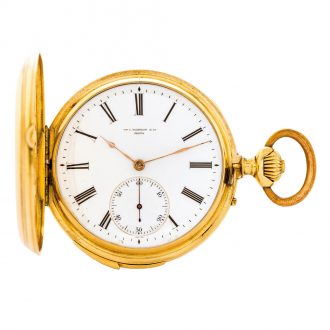
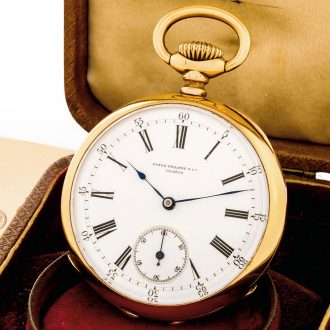
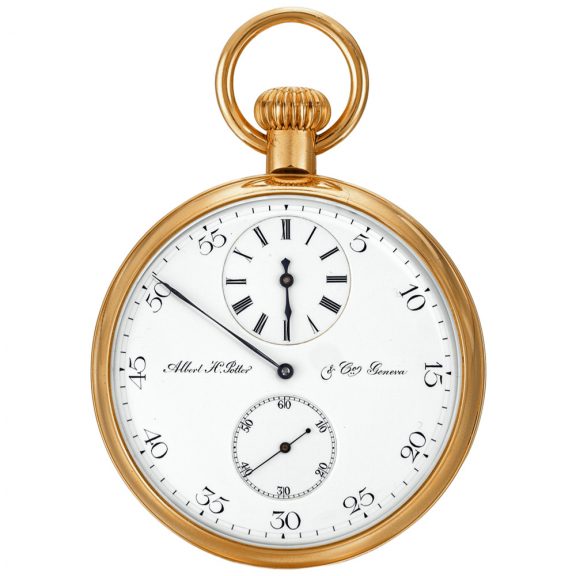
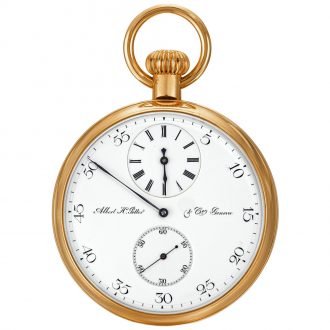
Gold open faced pocket watch by Albert H. Potter & Co.
–
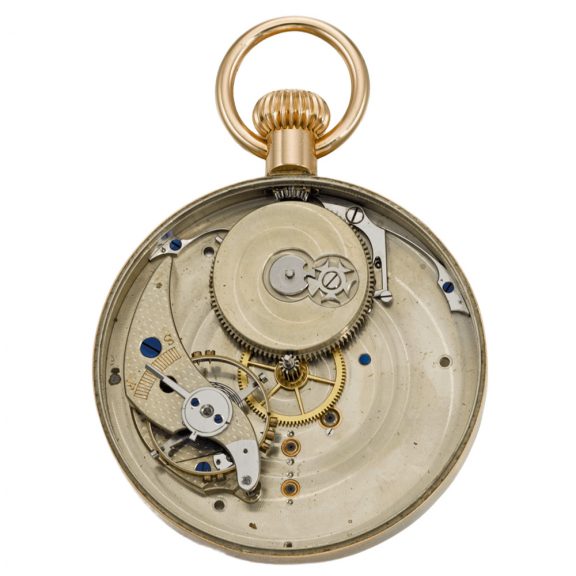
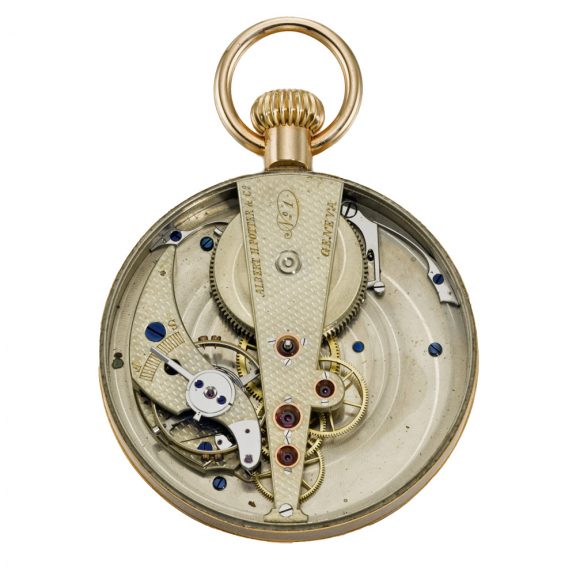
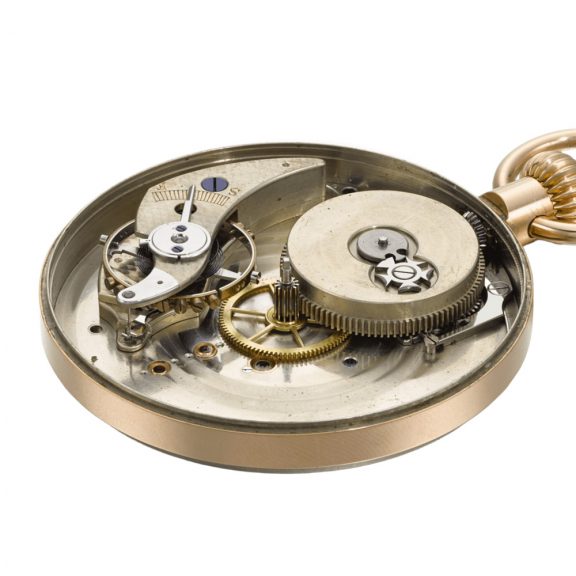
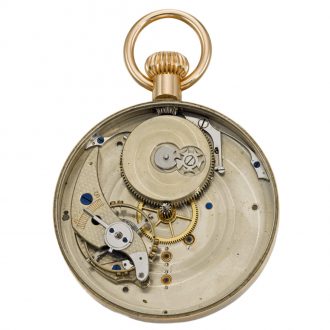
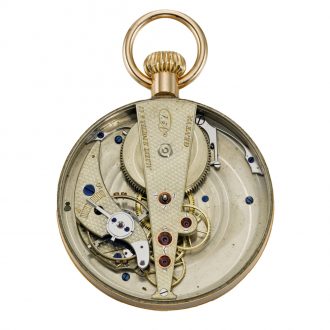
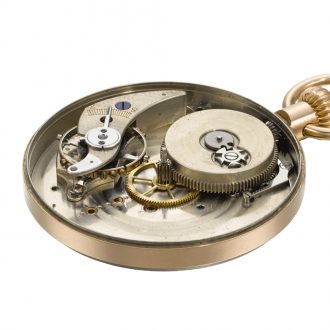
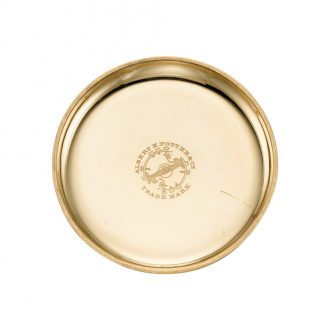
An important and possibly unique gold open faced keyless pocket watch with unusual lever escapement and single rubytooth escape wheel, circa 1887. The movement features a distinctive V-shaped central bridge adorned with pearled machined decoration and gold chaton jewels secured by screws. It includes a similarly decorated S-shaped balance cock with an index regulator and lever escapement. The patented escape wheel boasts a single ruby tooth. Additionally, it has a bimetallic compensation balance and a going barrel with Maltese cross stop work. It is signed: Albert Potter & Co., Geneva, No. 1, and displays his trademark logo.
–
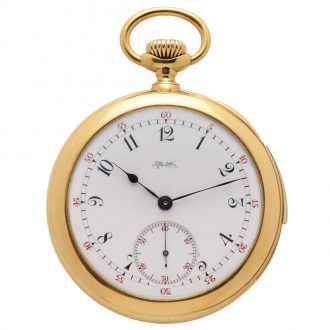
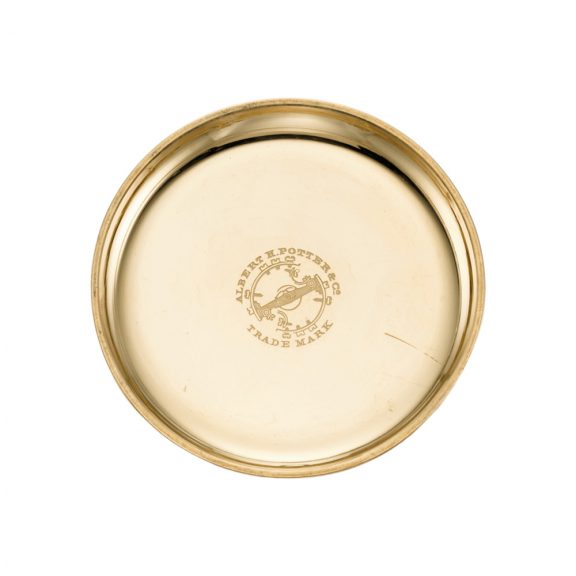
The white enamel regulator dial, signed Albert H. Potter & Co., Geneva, showcases an outer Arabic minute ring and two subdials: one for hours marked with Roman numerals and another for seconds marked with Arabic numerals. The 18 carat gold case has a plain polished band, a case back, and rounded bezels. The hands can be adjusted by folding the bow forward toward the case. The centre of the inner case back is stamped with Albert H. Potter & Co.
–
Diameter: 49 mm
–
Signed: Albert H. Potter & Co., Geneva
–
The movement is operational, and the surfaces and screw heads are generally in good condition. There are some signs of dirt and a few minor scuffs, suggesting it might benefit from servicing. The dial has a few very light scratches and slight chipping at the edge near the 5 minute marker, mostly hidden by the bezel. The case shows signs of light polishing, with some wear on the inner edge of the bow at its peak.
–
This watch represents Potter at his most inventive and is likely a truly unique piece. After gaining recognition for patenting innovative designs for a lever escapement and a pivoted detent escapement, Potter moved to Switzerland in 1875 to refine these concepts, culminating in this creation in 1887.
–
Probably a prototype, it reflects Potter’s ambition to produce a high quality, affordable timepiece that is easy to clean, read, and set. He ingeniously designed the pillar plate to integrate the band into which the bezel and back snap, eliminating the need for an additional case band. The train of the watch is arranged in a straight line, requiring only a single bridge. Notably, this piece features Potter’s patented singletooth lever escapement, crafted from a ruby pin mounted on a steel plate attached to the pinion. This design was patented on April 5, 1887.
–
Potter made the movement’s back plate a fundamental part of the case, allowing the case body and back plate to be stamped from a sheet block in one stroke, eliminating the need for additional machinery.
–
Albert H. Potter (1836-1908) was born in Mechanicville, N.Y. in 1836. He completed a three year apprenticeship with Wood & Foley in Albany in 1855 and subsequently opened a repair shop in New York. In addition to the repair work, he built some thirty five gold cased three quarter plate movements, some of them with lever and some with detent escapements, which he sold for $225 to $350.
–
In 1861 Potter went to Cuba where he stayed for five years and continued with much the same kind of work, adding to his designs a quarter repeater and a form of the duplex escapement. After getting back to New York he obtained his first escapement patent in 1868 and moved to the West soon afterwards. He stayed in Minneapolis and possibly Milwaukee for a little while but settled in Chicago around 1870. In 1872 he started the company Potter Brothers together with his brother William Cleveland Potter; the firm was dissolved in 1875 but W.C. Potter continued the business until his death.
–
Before leaving the United States in 1875 for Geneva where he would spend the remaining 33 years of his life, Albert took out several patents on compensation balances and improvements in watch escapements, assigning one half of his rights to John H. McMillan of Chicago (who may have been Potter’s partner in his early ventures in Switzerland). During his time in Chicago Potter had designed and built a pocket chronometer which may be considered his masterpiece. It was the prototype for several pieces he produced in Geneva, where he obtained his Permis d’Etablissement on February 11, 1876. In an article in the Horological Journal of May 1882, Potter stated that he had invented and made drawings and working models of fourteen different escapements. One of these was a tourbillon lever escapement which had a stationary escape wheel with the anker moving around with the cage five times per minute – unfortunately the reversals of the momentum were too rapid for good performance. As a consequence this model never sold and no examples were made. Wanting to improve his design, Potter took a patent in 1886 for an escapement without the escape wheel, first invented by Deshay in 1825 and presented again by MacDowell at the London Exhibition of 1855. This patent, with others pertaining to the Charmilles watch, was assigned to the New Haven Watch Company for a reputed fifty thousand dollars. The Charmilles watch was produced in a factory in Charmilles outside Geneva – hence the name of the watch – and was an attempt to create reliable timekeeping movements at low prices.
Albert H. Potter died on January 25, 1908, in Geneva.
Signed: Albert H. Potter & Co. Geneva
Share this page: