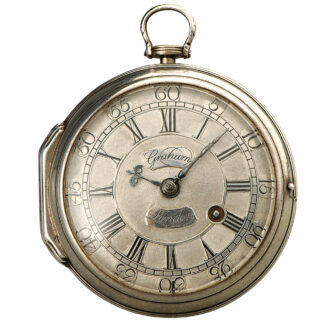
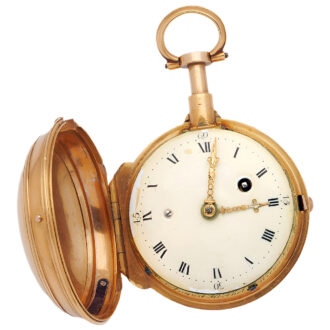
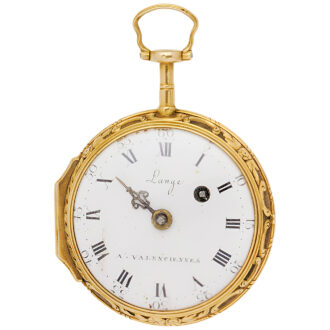
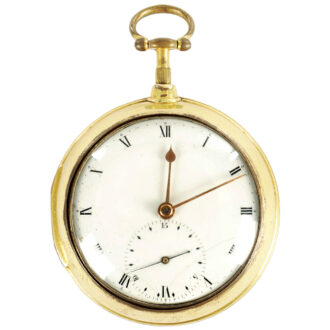
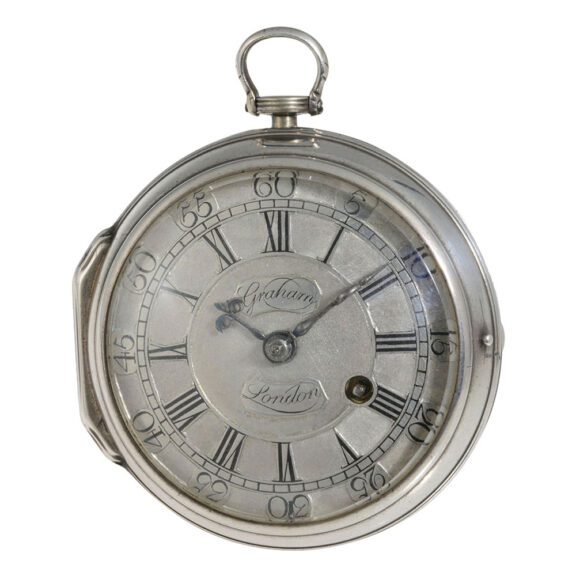
English silver open faced cylinder pocket watch Circa 1744
- Kenmerk
- DB0119
- Diameter
- 49 mm
- Estimate
- € 5.500 - 11.000
- Price sold
- € 11.900
Silver cylinder watch by George Graham
–
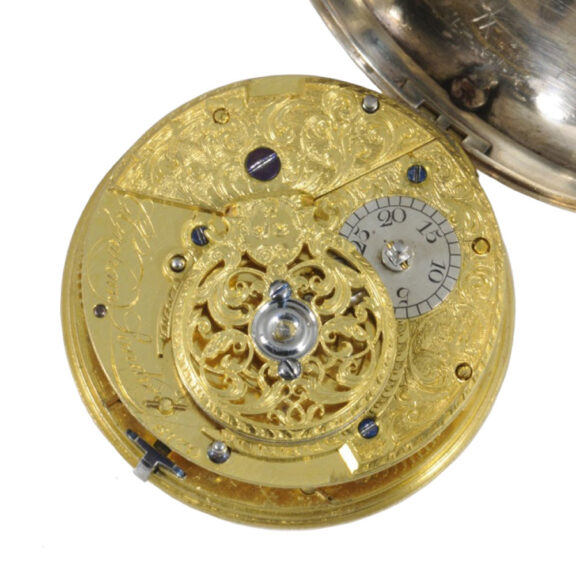
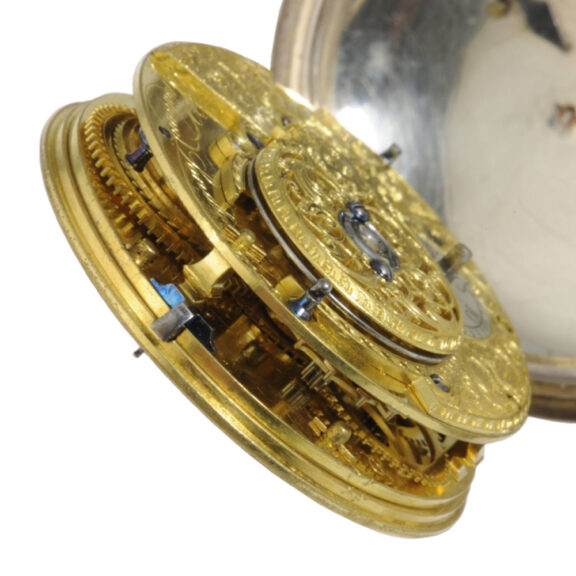
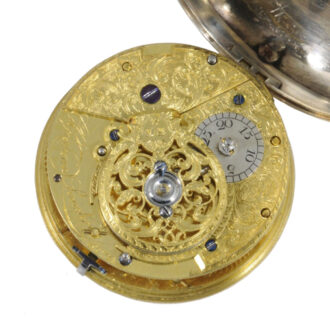
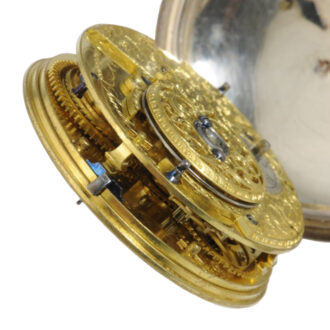
An English silver open faced cylinder pocket watch, circa 1744. Full plate movement, chain and fusee, three-arm steel balance, fine florally engraved and pierced balance cock. Silver dial with Roman hours and Arabic five-minute numerals. Plain case, maker’s mark IW for John Ward. Dial signed, case numbered, movement signed and numbered.
–
Diameter: 49 mm
–
Weight: 98 g
–
Signed: Graham London
–
The escapement in the present watch is in original condition and retains the original Graham banking which is through a small pin mounted in the bottom of the cylinder which banks on a projection on the potence. Most often, when cylinders are later repaired or replaced, other means of banking were applied, the fitting of which can deface the watch. At this period in Graham’s output, the winding square of any single-cased watch, which meant winding through the dial, protrudes through the dial in such a way that it would catch on the minute hand. This meant that all the original hands were specially shaped to clear the square. Most such ‘cranked’ hands do not survive and later repairers would file the winding square down in order to fit non-cranked hands. The hands on this watch are a rare survival.
–
George Graham was born on July 7th, 1673, maybe 1675 in Kirkliston, Cumberland and he died on November 16th, 1751. He was an English clockmaker, inventor and geophysicist, and a Fellow of the Royal Society. Further a Quaker like his mentor Thomas Tompion, Graham left Cumberland in 1688 for London to work with Tompion. He later married Tompion’s niece, Elizabeth Tompion. Graham is credited with inventing several design improvements to the pendulum clock, inventing the mercury pendulum and also the orrery, a mechanical model of the Solar system that illustrates or predicts the relative positions and motions of the planets and moons. He was made Master of the Worshipful Company of Clockmakers in 1722. Between 1730 and 1738, Graham had as an apprentice Thomas Mudge who went on to be an eminent watchmaker in his own right and invented the lever escapement, an important development for pocket watches. Graham was introduced to John Harisson on the latter’s arrival in London and became a long-time advisor and supporter of Harrison’s work on a marine chronometer. He was also widely acquainted with practical astronomy, invented many valuable astronomical instruments, and improved others.
Signed: Graham London
Share this page: