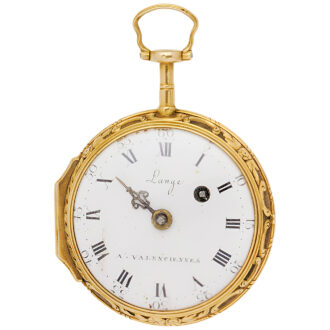
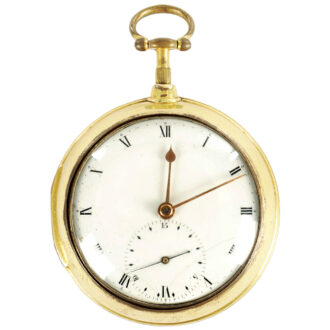
English gold and enamel neoclassical cylinder watch Circa 1772
- Kenmerk
- DB0123
- Diameter
- 51 mm
- Estimate
- € 4.500 - 10.000
- Price sold
- € 7.600
Gold and enamel watch with protective case by John Ellicott
–
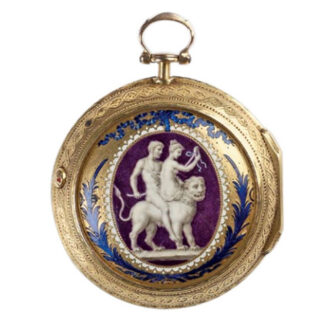
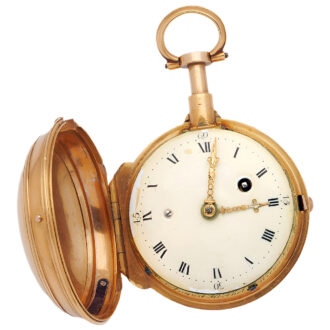
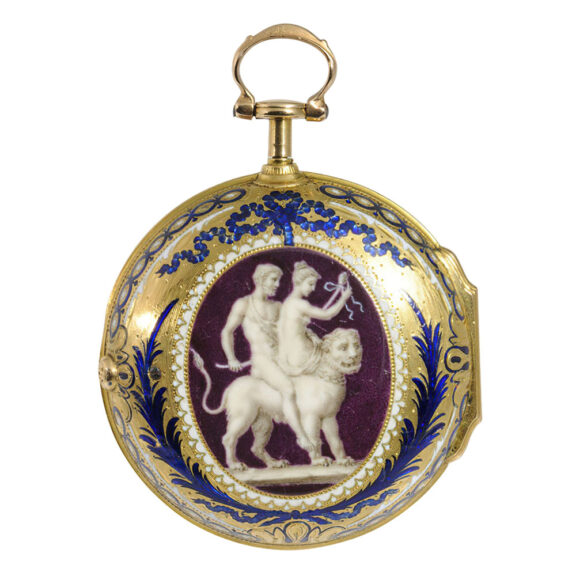
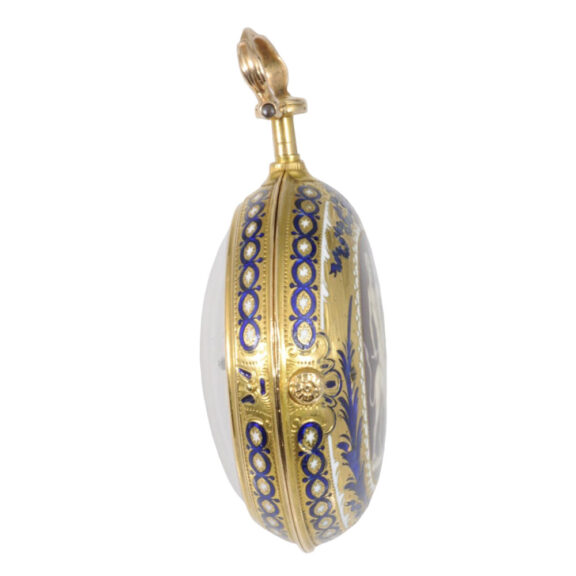
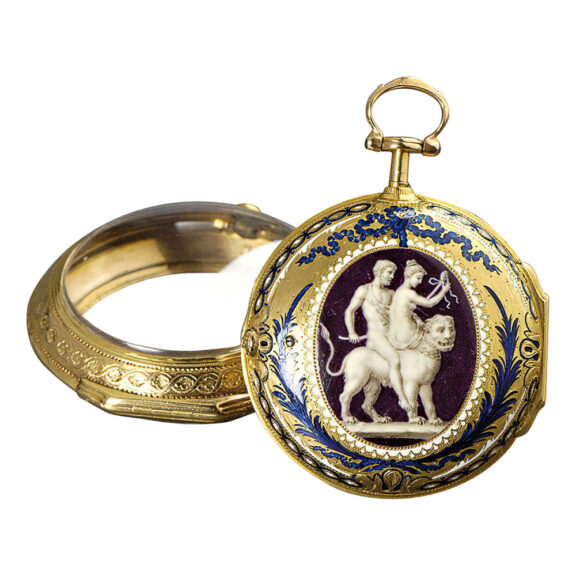
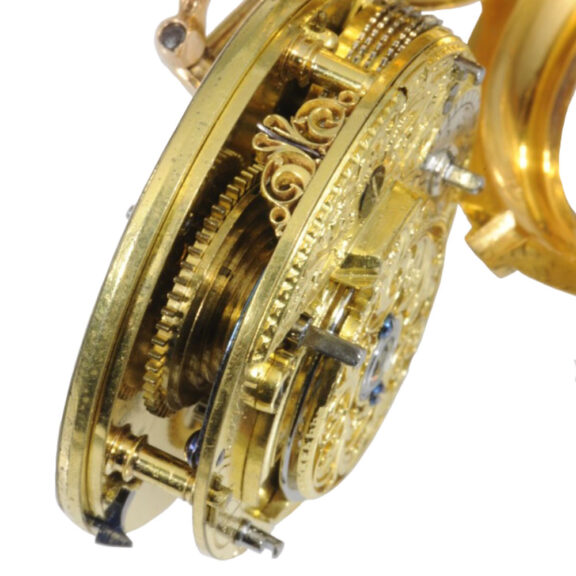
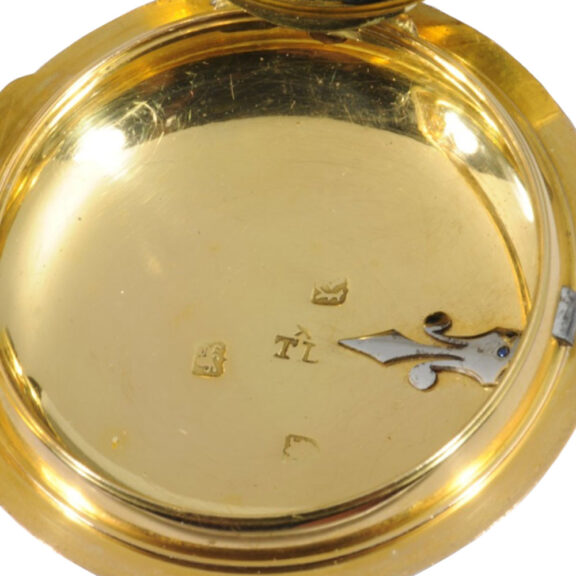
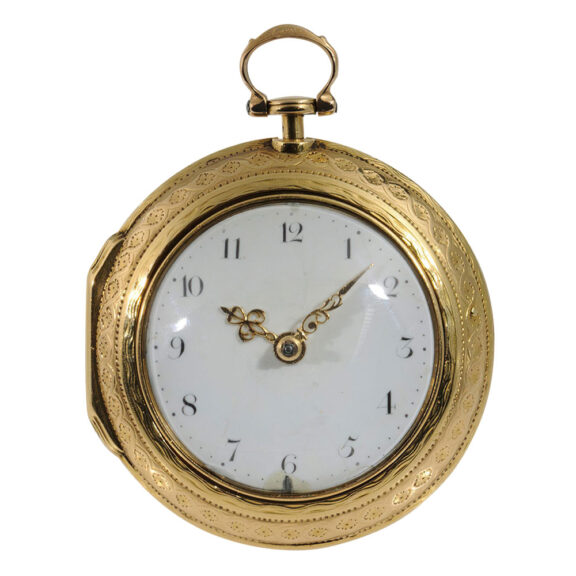
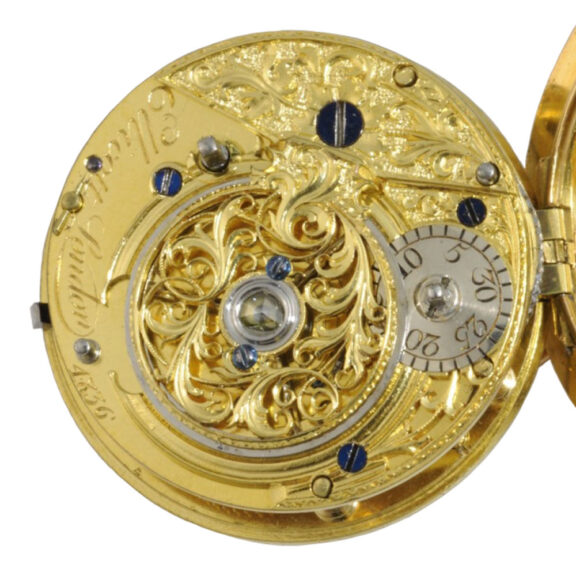
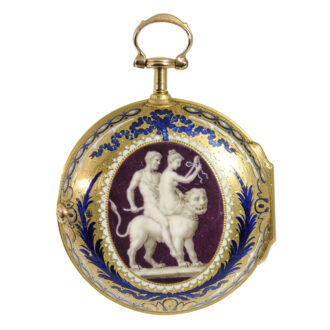
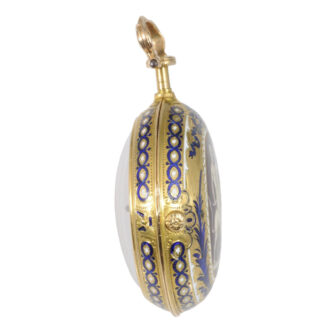
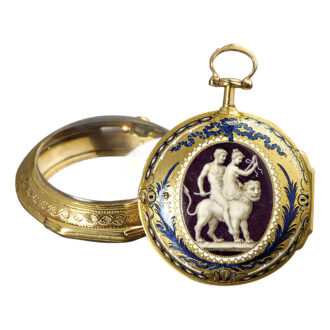
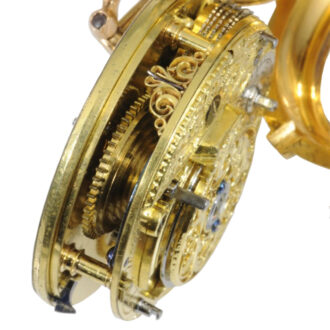
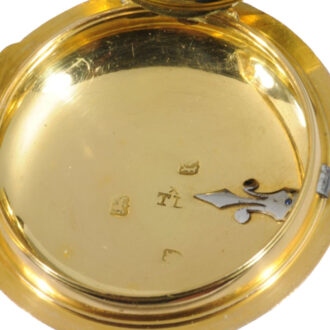
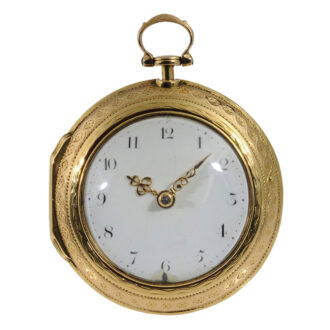
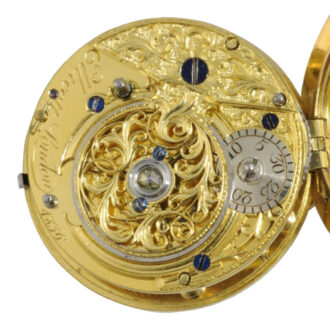
A rare English 18 carat gold and enamel open faced neoclassical cylinder pocket watch with protective case, circa 1772. Fire gilt full plate movement, chain and fusee, a brass cylinder wheel, three arm steel balance. White enamel dial with Arabic hours and outer minute dots. The protective case with a glazed back, the front bezel pierced and engraved, the back of the inner case is elaborately engraved and decorated with translucent cobalt blue enamel palm leaves and festoons on an engine turned ground, a white and blue champlevé border frames an en grisaille painting in the centre dedicated to Louis Toussaint depicting Hercules and Omphale riding on a lion, the front bezel decorated to match, case maker’s punch mark TL, movement protection cap.
Movement and cuvette signed and numbered.
–
Diameter: 51 mm
–
Weight: 135 g
–
Signed: Ellicott London
–
The neoclassical grisaille enamel decoration on a brown ground was particularly popular in late 18th century London.
–
A grisaille (en grisaille), or grey painting, is a painting in which one does not apply natural colours but restricts oneself to depicting things in all possible shades of the same colour, usually grey or brown.
–
Hercules is the Roman name for Heracles, a ‘heros’ from Greek mythology. A brave and great man who was worshipped as a god. As the son of the upper god Zeus and Alkmene, a princess who was married to Amphitryon, a demigod. Zeus seduced Alkmene by disguising himself as Amphitryon, after which she gave birth to twins, Heracles, the son of Zeus and Iphikles, the son of Amphitryon. Hercules became famous for the twelve difficult labours he performed at the behest of King Eurystheus. He was a real hero, who could perform mighty deeds through the combination of enormous strength and a good dose of cleverness.
–
Omphale was a mythical queen of Lydia, a part of present Turkey. She was the daughter of King Lardanus and the widow of King Tmolus. Omphale bought the hero Heracles, not to use him as a slave, but to act as a lover. She bore three sons from their relationship, Agelaus, Tyrsenus and Alcaeus. The reason Herakles allowed himself to be sold into slavery was that he had to do penance for the murder of his twin brother Iphitus by order of the oracle of Delphi. He was humiliated as a slave, made to dress like a woman and perform women’s tasks, such as spinning yarn. Moreover, the fact that he became a woman’s slave was humiliating in itself. Nevertheless, he also performed a number of heroic deeds during this period. When Omphale discovered that he was really the hero Heracles, she released him and they became true lovers. Omphale thus became the second wife of Heracles.
–
John Ellicott was born in 1706 and died in 1791. He was one of the most eminent English watch and clockmakers. Ellicott established himself in business in about 1728 and became a Fellow of the Royal Society in 1738. He was the inventor of a compensation pendulum and pushed forward the use of the cylinder escapement only a few years after its improvement by Graham. In some of his later pieces, the cylinders were made of ruby.
–
Louis Toussaint was a London based jeweller and enameller. In 1768 his son Augustin was apprenticed as enamel painter to the renowned enameller and gold chaser George Michael Moser for the enormous fee of 200 Guineas.
Signed: Ellicott London
Share this page: