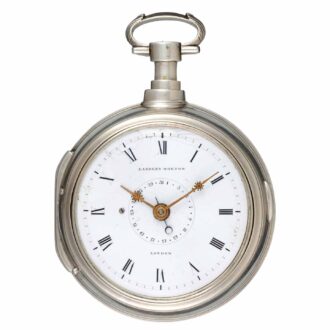
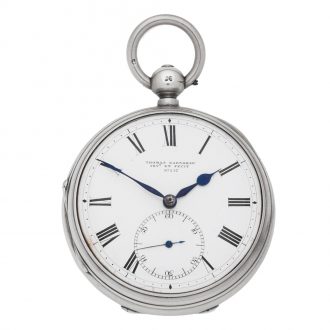
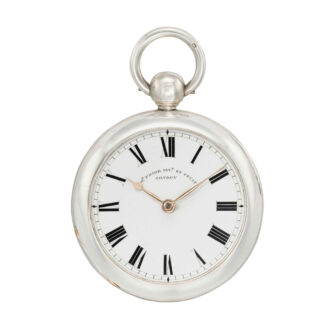
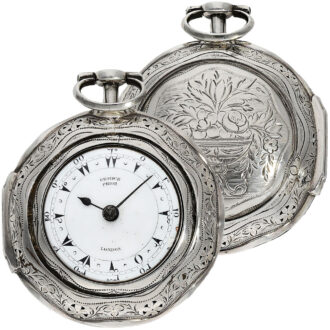
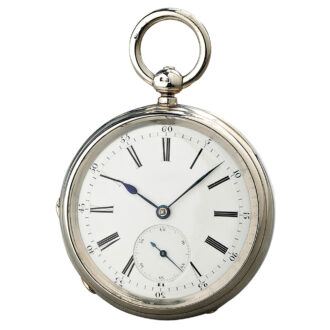
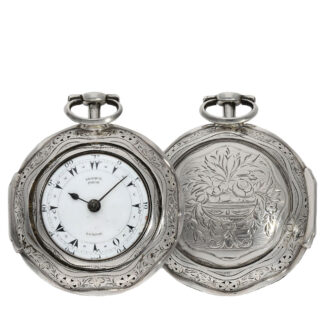
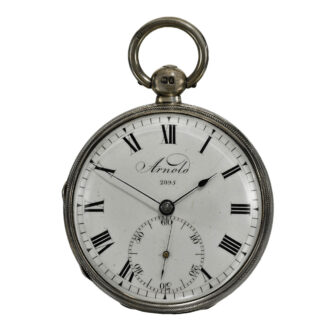
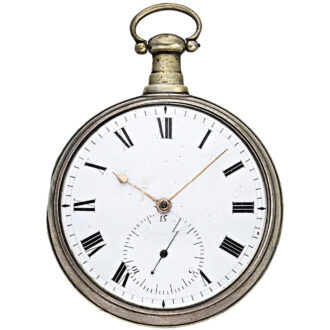
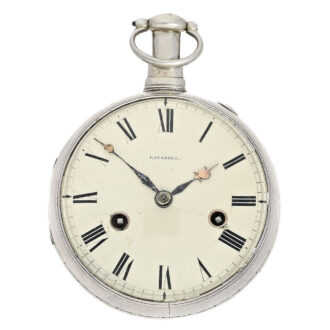
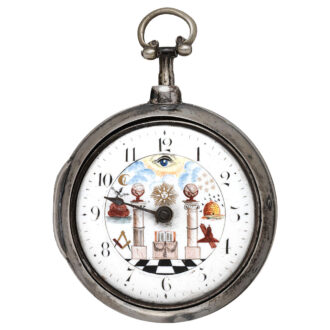
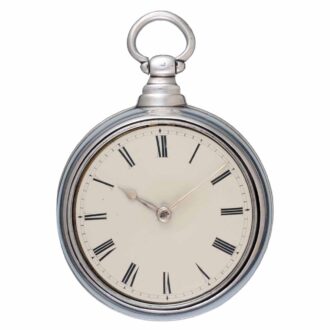
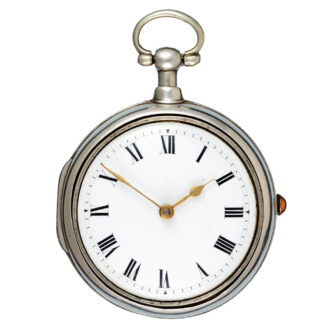
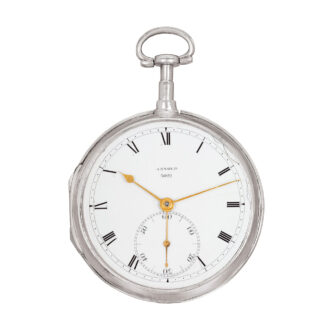
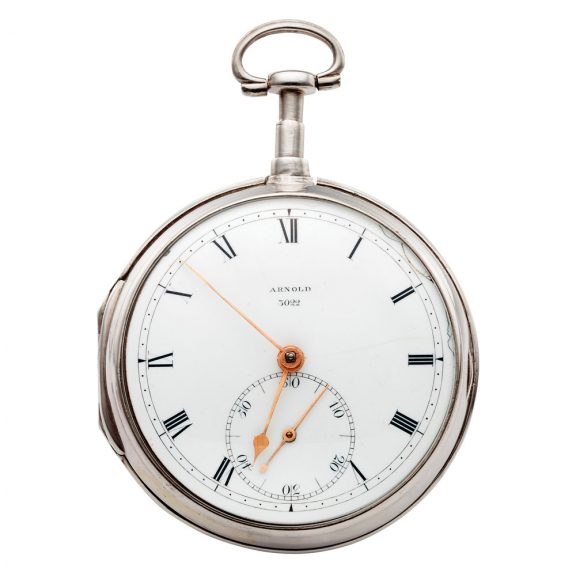
Important English silver open faced chronometer Circa 1810
- Kenmerk
- CH1923
- Diameter
- 58 mm
- Estimate
- € 3.000 - 6.000
- Price sold
- € 3.100
–
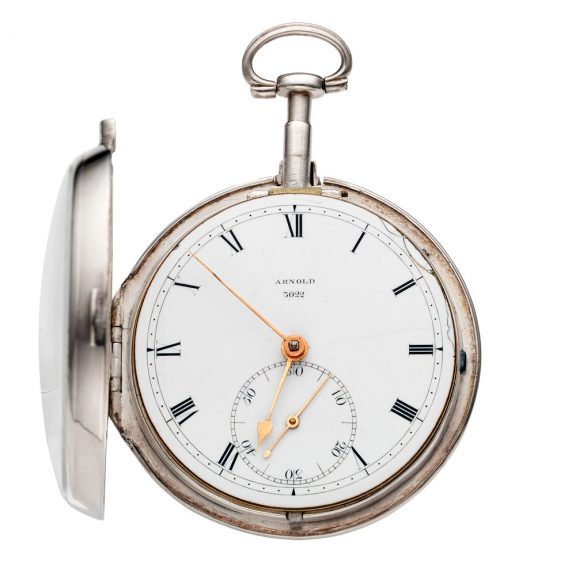
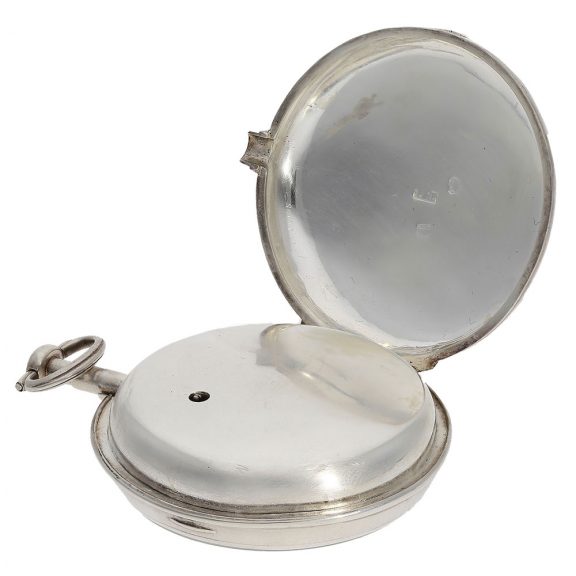
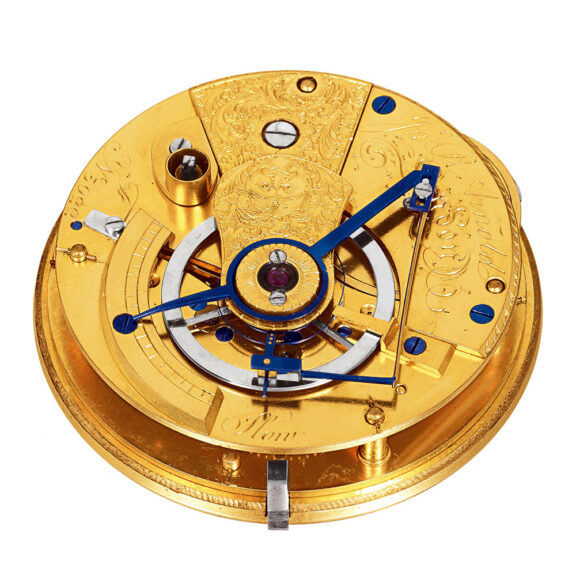
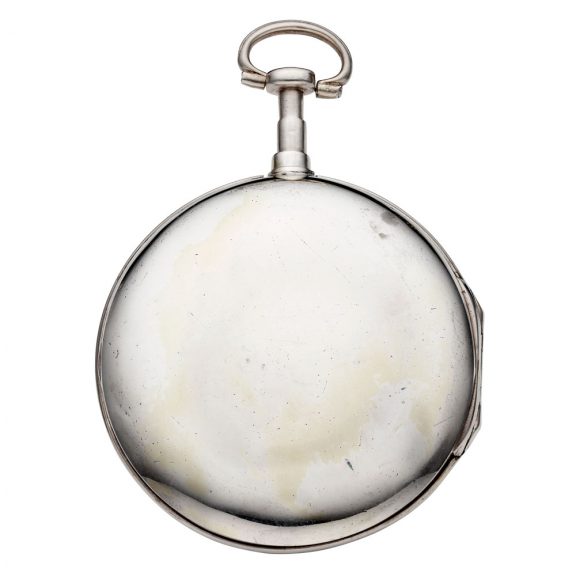
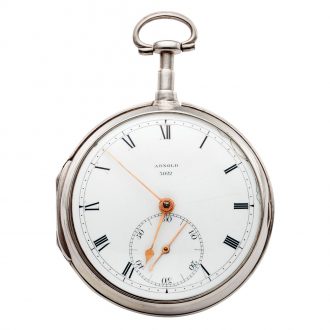
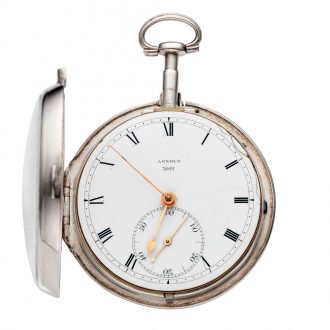
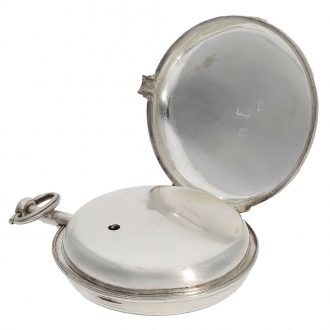
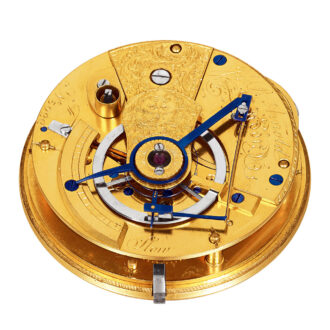
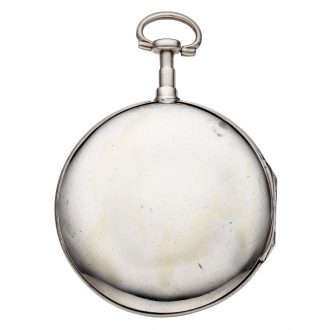
An important English silver open faced pocket chronometer, circa 1810. Gilt full plate movement with cylindrical pillars, jewelled to the fourth, fusee and chain, maintaining power, an Arnold spring detent escapement, a plain polished three arm steel balance, single footed, decoratively engraved cock with diamond endstone, blued steel flat balance spring, Arnold’s adjustable right angle compensation curb and an index regulator. White enamel dial with Roman hours, an outer minute track, subsidiary seconds at 6 o’clock and gold spade hands. The plain consular case is hinged on both sides and stamped with maker’s mark TH for Thomas Hardy. Dial and movement signed and numbered, case numbered.
–
Diameter: 58 mm
Signed: Jn R Arnold London
–
It is rare to find an unconverted Arnold escapement. It is even rarer to find one with such unusual compensation. In a regular compensation curb, all parts are fixed and are installed as such, they cannot be adjusted, so they either work correctly or not. In this watch, the compensation can be adjusted by changing the point at which it acts on the regulator pin: the closer to the center, the greater the compensation, the farther away, the lesser the compensation. It seems that the present compensation was Arnold’s answer to Earnshaw’s sugar tong compensation.
–
John Roger Arnold was born in 1769. He was the son of renowned British horologist John Arnold. He served an apprenticeship with both his father in 1783 and the eminent French watchmaker Abraham-Louis Breguet in Paris in 1792. In 1787, John Roger and his father founded the company, Arnold & Son. The younger Arnold became a member of the Clockmakers’ Company in 1796 and became a master in 1817. After his father died in 1799, he continued the business, taking up a partnership with E.J. Dent in 1830. The two craftsmen experimented heavily during their work together, in particular, they concentrated on the effects of magnetism on chronometers. Dent left Arnold in 1840, whereupon Arnold continued working on his own but died only three years later. Charles Frodsham bought the business after Arnold’s death in February 1843 and it flourished until 1858 under the name Arnold & Frodsham.
–
Arnold Senior’s inventions include the helical balance spring for chronometers and a detent escapement similar to the modern chronometer escapement. To this day he is considered one of the leading chronometer makers of all time.
Signed: Arnold
Share this page: