Unique Swiss 18K white gold complicated lever watch Circa 1972
- Kenmerk
- VB0023
- Diameter
- 51 mm
- Estimate
- € 250.000 - 500.000
- Price sold
- € 322.000
White gold complicated watch by Patek Philippe
–
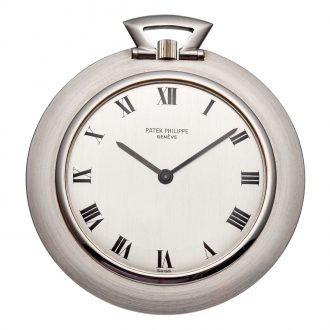
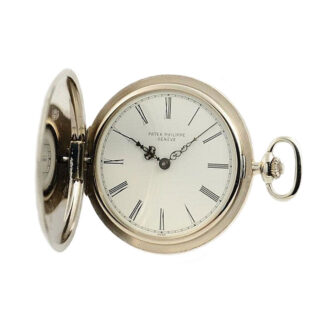
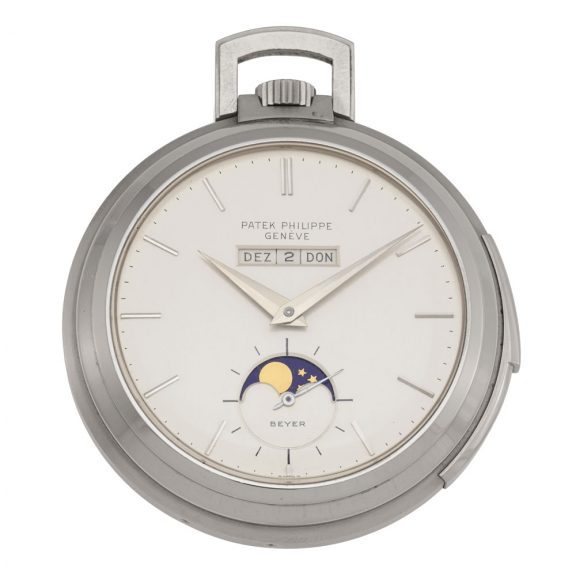
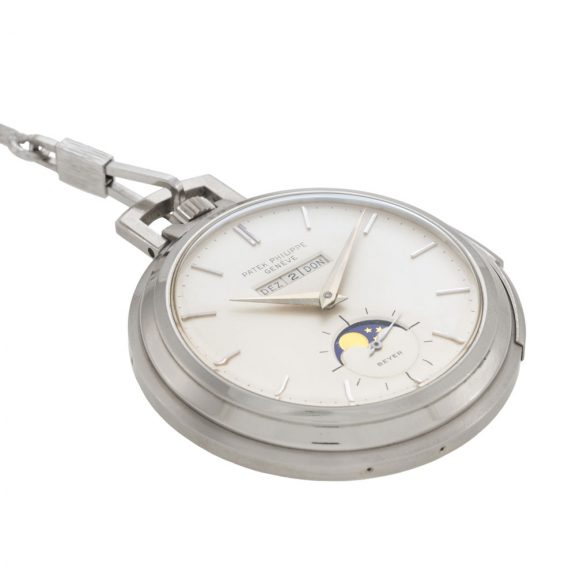
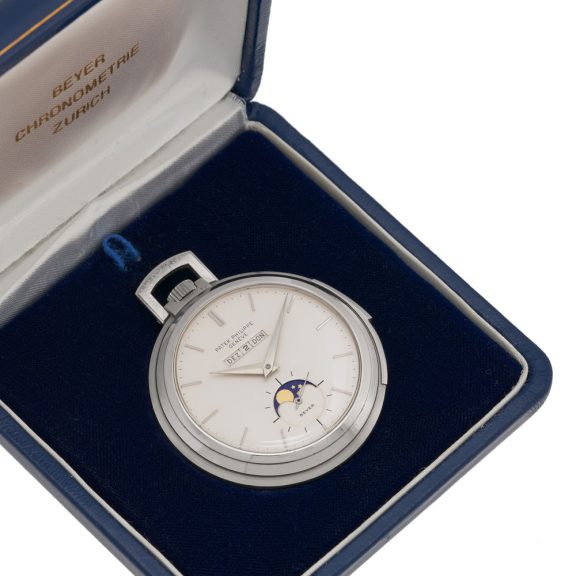
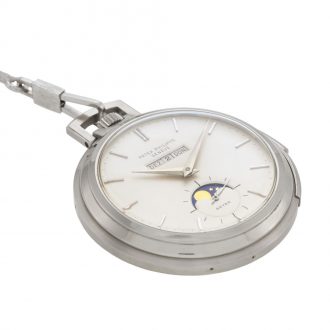
This is a unique, made-to-order Swiss pocket watch from around 1972, in 18-carat white gold with an open face. It is a minute repeater with a lever escapement, a calendar shown in a row and moon phases. It was sold by the Zurich retailer Beyer.
–
Movement
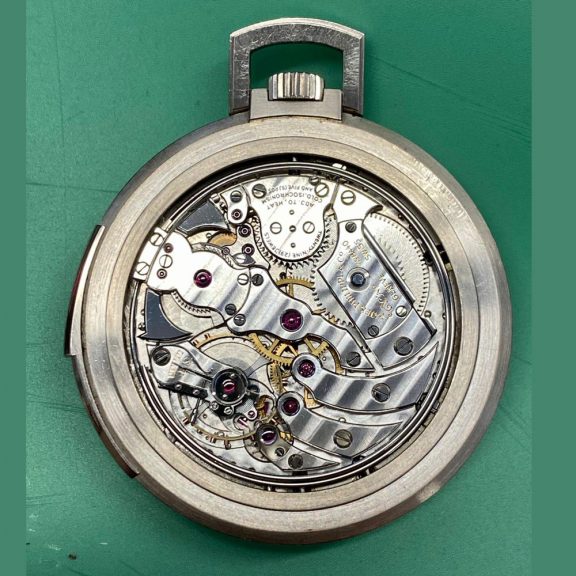
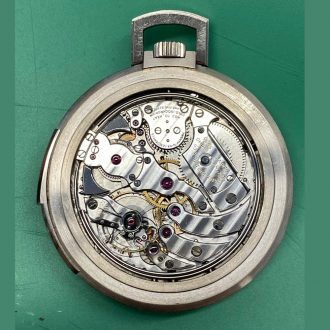
The precision movement is rhodium-plated, built with bridges and decorated with Geneva stripes. It has 29 jewels and a Swiss lever escapement with a compensation balance and a Breguet balance spring. The escape wheel has an endstone, and there is a swan-neck regulator for fine adjustment and wolf-tooth winding wheels. Two hammers chime the minutes on two gongs. A slide on the right side of the case starts the chiming, and an all-or-nothing system makes sure the watch only chimes once the slide has been pushed fully.
–
Dial
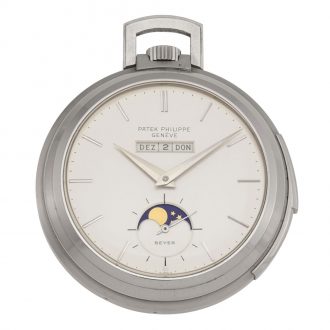
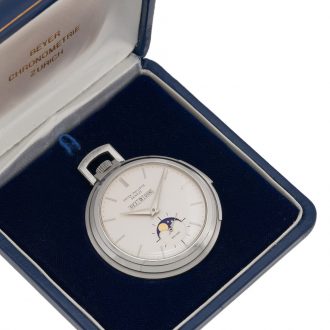
The silvered dial has applied hour markers and minute divisions. A window at 12 o’clock shows the day, date and month in a row. At 6 o’clock, a small seconds dial has the moon phases in a ring around it. The hands are dauphine style.
–
Case
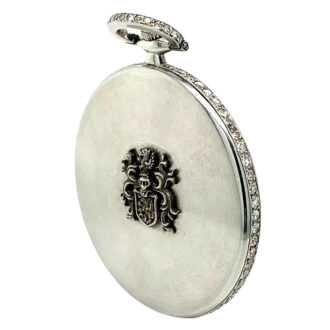
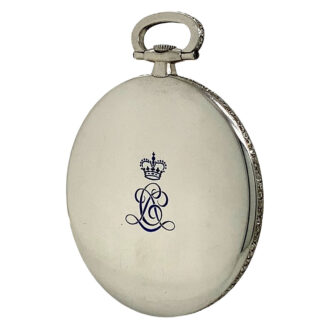
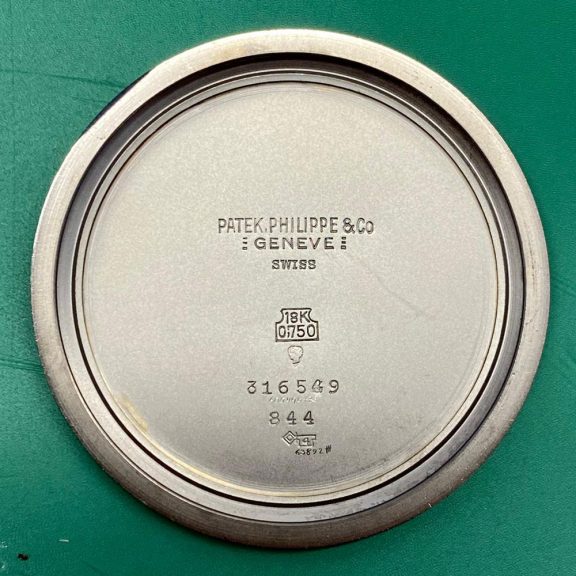
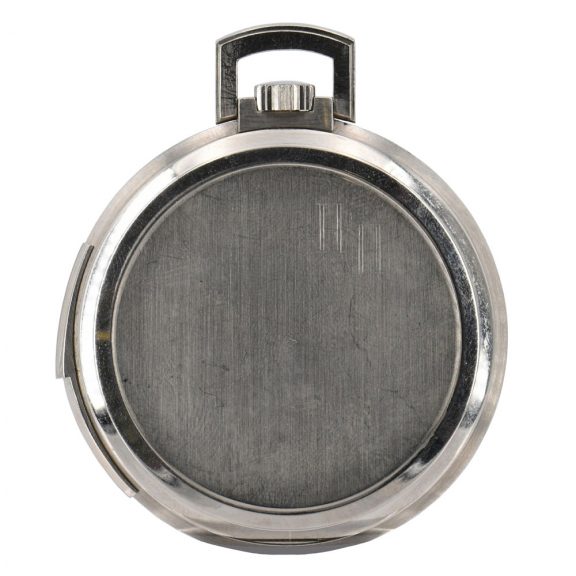
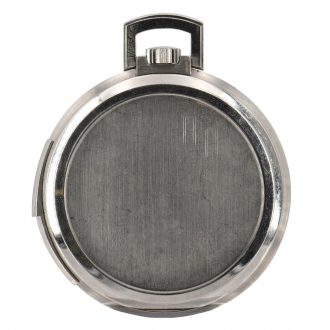
The flat, brushed case has elaborate steps. It was made by the well-known Geneva casemaker Antoine Gerlach and is engraved with the monogram “HH” on the back.
–
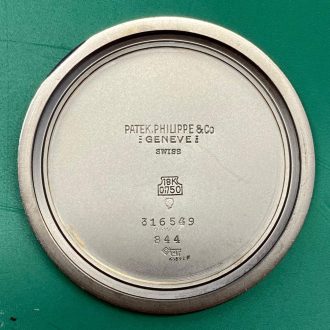
The dial is signed by the watchmaker and the retailer. The case and movement are signed by the watchmaker and numbered. The watch comes with a certificate, an instruction manual, the original purchase invoice, a report from the retailer dated 1974, its original white gold chain and a presentation box.
–
Diameter: 51 mm
–
Total weight: 123 g
–
Signed: Patek, Philippe & Co Genève Swiss
–
Beyer Chronometrie in Zurich, the oldest specialist watch shop in Switzerland, had this watch made in 1972 at a customer’s request. The days and months are shown in German, which makes it truly unique. It is one of only two of this model in white gold. The other known example sold at Sotheby’s Geneva in May 2016 for €424,800.
–
The linear calendar
A linear calendar, sometimes called an American calendar, shows the day, date and month side by side in a single window, so the dial can be read at a glance. This display was invented in the early Art Deco period and appears mostly on watches made for the British and American markets. It became popular again after the Second World War.
–
Czapek & Cie
The company began in Geneva in 1839 as Patek, Czapek & Cie, founded by Antoine Norbert de Patek and François Czapek. Czapek had lived in Switzerland since 1832 and took the name François when he became a Swiss citizen. The business did well, but in 1844 the partners went their separate ways. Czapek founded Czapek & Cie, which lasted until 1869, and Patek founded Patek & Cie.
–
Patek Philippe
In 1844, at the Paris Exhibition, Patek met the French watchmaker Jean-Adrien Philippe. Philippe had already made one of the most important inventions in watch history: winding by the crown. Watches no longer needed a separate key, because the crown could now both wind the watch and set the hands. On 15 May 1845, Philippe and Vincent Gostkowski joined the company, and that same year a patent was filed for a watch wound and set by the crown. The company also made its first minute repeater. On 1 January 1851 the name changed to Patek, Philippe & Cie, and in 1881 Philippe filed a patent for a precision regulator.
–
On 1 February 1901 the firm became a public company under the name Ancienne Manufacture d’Horlogerie Patek, Philippe & Cie S.A., and in 1902 it patented a split-seconds chronograph. Its many important inventions kept earning it high regard. In 1932 the brothers Charles and Jean Stern took over the company, which later became Patek Philippe S.A. Thierry Stern, the fourth generation of the family, became president in 2009. The company holds around 70 patents and makes all of its movements in-house.
–
Because of their quality, Patek Philippe watches often set auction records. A pocket watch completed in 1933 for the American banker Henry Graves Jr. sold for $11 million in 1999, a world record at the time. It sold again on 11 November 2014 for 23.2 million Swiss francs, about €19 million.
–
For its 150th anniversary in 1989, the company presented the famous Calibre 89, which took nine years to develop. It has 33 complications and 1,728 parts. Across its two faces it has 24 hands, a grande and petite sonnerie with carillon, an alarm, a tourbillon, a perpetual calendar, a split-seconds chronograph and more than 20 other complications. For many years it was the most complicated pocket watch ever made.
–
Patek Philippe is seen as one of the “big four” of watchmaking, along with Audemars Piguet (1875), Vacheron Constantin (1755) and A. Lange & Söhne (1845). It is also one of the few watch companies that are still independent. For many years, every mechanical movement it made carried the Geneva Seal. Since 2009 it has used its own, stricter Patek Philippe Seal instead.
Signed: Patek, Philippe & Co Genève Swiss
Share this page: