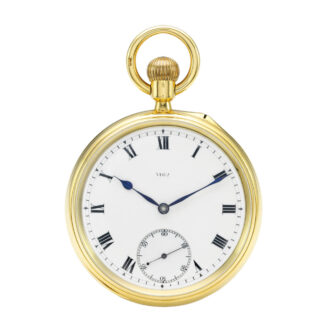
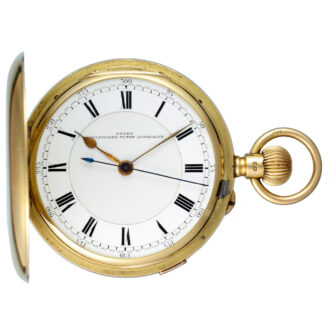
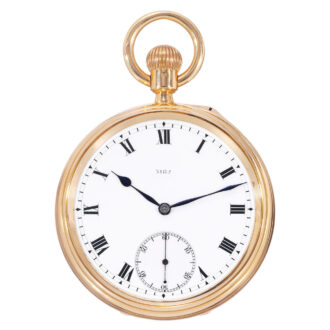
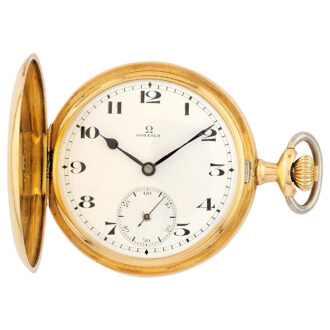
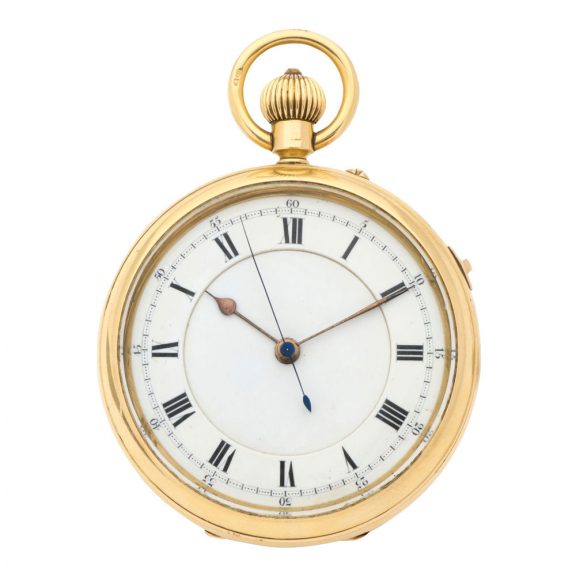
English gold lever watch with stoppable seconds Circa 1914
- Kenmerk
- BB1087
- Diameter
- 54 mm
- Estimate
- € 3.500 - 6.000
- Price sold
- € 3.300
Gold keyless pocket watch
–
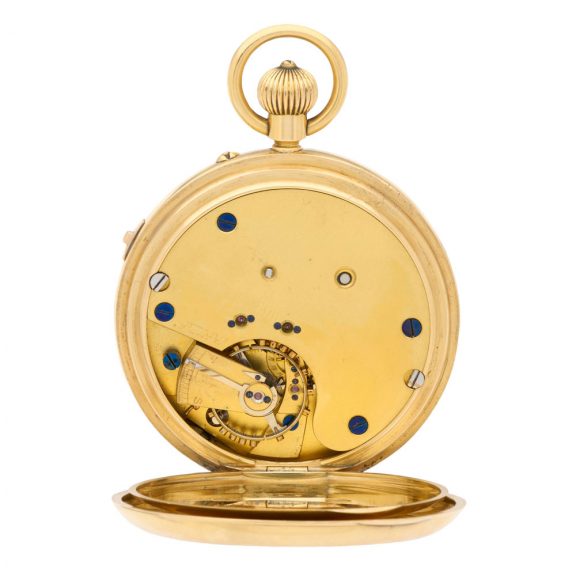
An English 18 carat gold open faced keyless pocket watch with stoppable seconds made by Rotherham & Sons in Coventry, London Hallmarked for 1914. The gilt ¾ plate English lever movement with a cut and compensated bimetallic balance. White enamel dial with Roman hours, an outer minute track with fifth of a second divisions and Arabic five minute numerals, a sunk center, gilt spade hands, and a blued hand for the center seconds. A polished case. Case stamped R&S for Rotherham & Sons, case and movement with matching numbers.
–
An English 18 carat gold open faced keyless pocket watch with stoppable seconds made by Rotherham & Sons in Coventry, London Hallmarked for 1914. The gilt ¾ plate English lever movement with a cut and compensated bimetallic balance. White enamel dial with Roman hours, an outer minute track with fifth of a second divisions and Arabic five minute numerals, a sunk center, gilt spade hands, and a blued hand for the center seconds. A polished case. Case stamped R&S for Rotherham & Sons, case and movement with matching numbers.
–
Diameter: 54 mm
–
Diameter: 54 mm
–
Signed: No name
–
The history of the Rotherham watchmaking company dates back to 1754, when William Vale, a watchmaker from Coventry, founded a workshop with George Howlette and John Carr. Kevin Rotherham, who apprenticed with Samuel Vale in 1747, became a partner in 1790, and the company was subsequently renamed Vale & Rotherham.
–
The history of the Rotherham watchmaking company dates back to 1754, when William Vale, a watchmaker from Coventry, founded a workshop with George Howlette and John Carr. Kevin Rotherham, who apprenticed with Samuel Vale in 1747, became a partner in 1790, and the company was subsequently renamed Vale & Rotherham.
–
In 1842, the company, then based in Spon Street, Coventry, Warwickshire, was renamed again to Richard Kevitt Rotherham & Sons. From around 1870, the company had a sales office in London at 1, 2 and 3 Holborn Circus, from where they offered large clocks for sale.
–
In 1843, their factory system (though not mechanical) attempted to produce 6.000 movements a year. However, this attempt was met with little success. Later, in 1867, the company, since 1850 known as Rotherham & Sons, made another attempt, this time successfully using John Wycherley’s manufacturing system.
–
In 1843, their factory system (though not mechanical) attempted to produce 6.000 movements a year. However, this attempt was met with little success. Later, in 1867, the company, since 1850 known as Rotherham & Sons, made another attempt, this time successfully using John Wycherley’s manufacturing system.
Signed: No name
Share this page: