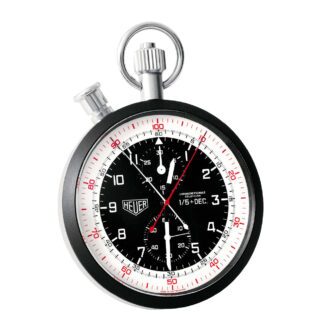
Swiss stainless steel split seconds chronograph Circa 1970
- Kenmerk
- BB1163
- Diameter
- 65 mm
- Estimate
- € 1.250 - 2.500
- Price sold
- € 1.900
Stainless steel keyless lever watch
–
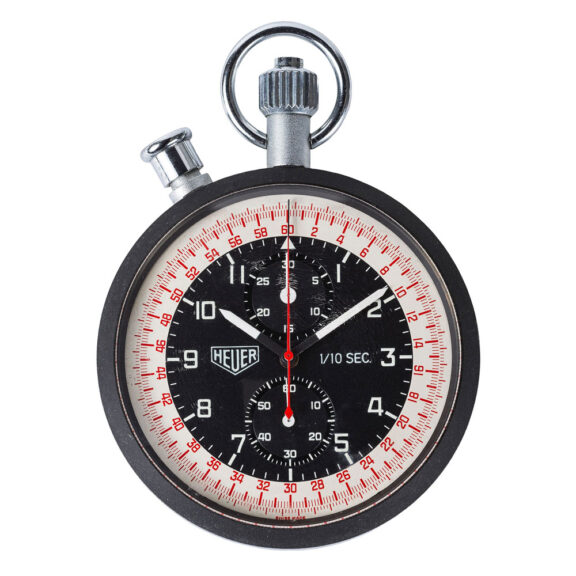
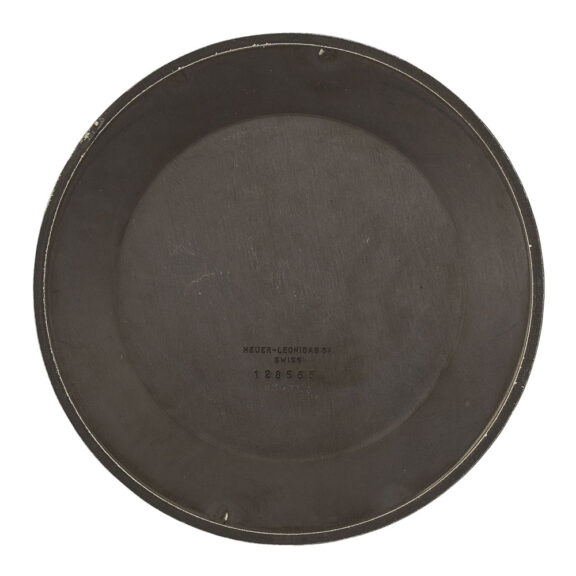
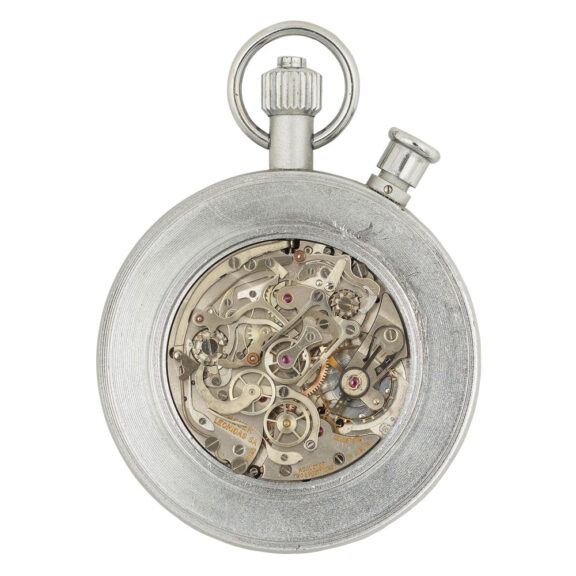
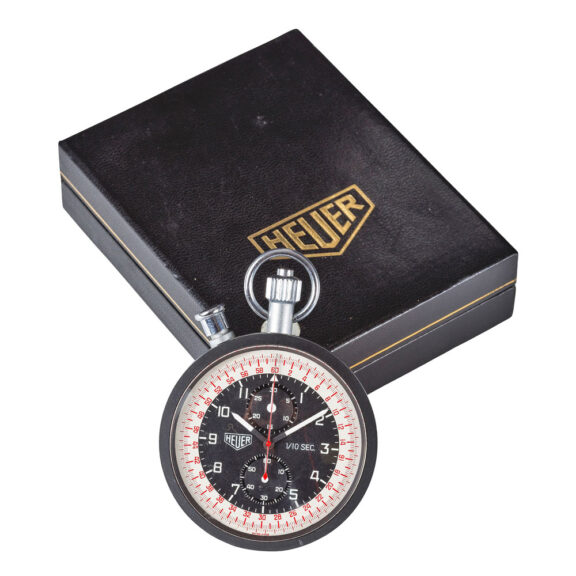
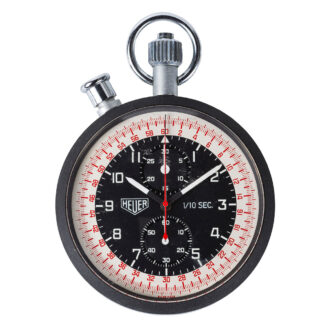
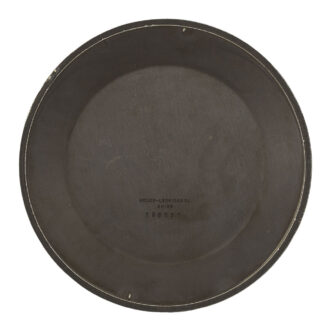
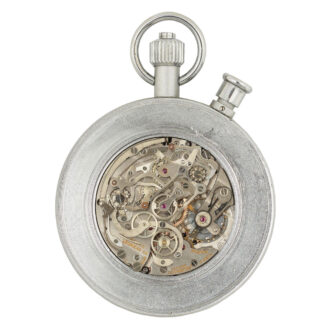
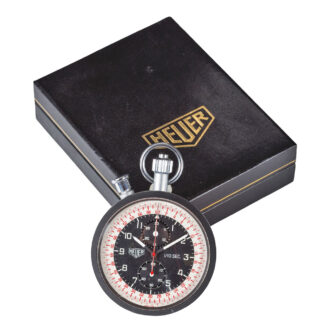
A Swiss stainless steel open faced keyless split second chronograph pocket watch made by Uhrenmanufaktur Heuer AG in La Chaux-de-Fonds, circa 1970. The manual wind movement with 17 jewels and adjusted to two positions. Black enamel dial with white Arabic hours, white outer minute track, outermost red 10th of a second divisions, sunk subsidiary seconds at 6 o’clock, a 30 minute register at 12, black and white pointed baton hands, and red and white center chronograph hands. The brushed and polished case with a black coated snap-on back and split second pusher to the band at 11 o’clock. Dial and movement signed, case signed and numbered. Comes with the original presentation box.
–
–
A Swiss stainless steel open faced keyless split second chronograph pocket watch made by Uhrenmanufaktur Heuer AG in La Chaux-de-Fonds, circa 1970. The manual wind movement with 17 jewels and adjusted to two positions. Black enamel dial with white Arabic hours, white outer minute track, outermost red 10th of a second divisions, sunk subsidiary seconds at 6 o’clock, a 30 minute register at 12, black and white pointed baton hands, and red and white center chronograph hands. The brushed and polished case with a black coated snap-on back and split second pusher to the band at 11 o’clock. Dial and movement signed, case signed and numbered. Comes with the original presentation box.
–
Diameter: 65 mm
–
Signed: Heuer Swiss made
–
Uhrenmanufaktur Heuer AG was founded in 1860 by Edouard Heuer in Saint-Imier, Switzerland. In 1985, Techniques d’Avant Garde (TAG) purchased a majority stake in the company, forming TAG Heur S.A. In 1999, French luxury goods conglomerate Moet Hennessy Louis Vuitton SE (LVMH) bought nearly 100 per cent of the Swiss company. Although best known for its chronographs, the company also manufactured stopwatches.
–
Edouard Heuer patented his first chronograph in 1882. In 1887, he patented an oscillating pinion still used by major watchmakers of mechanical chronographs. In 1911, Heuer further received a patent for the ‘Time of Trip’, the first dashboard chronograph. Designed for use in automobiles and aircraft.
–
The company introduced its first wrist chronograph in 1914. In 1916, Edouard’s son, Charles-Auguste, introduced the ‘Mikrograph’, the first stopwatch accurate to 1/100 of a second. This model was soon followed by the ‘Semikrograph’, a stopwatch that offered 1/50 of a second timing, as well as a split second function, which allowed the user to determine the interval between two contestants or events.
–
In 1933, Heuer introduced the ‘Autavia’, a dashboard timer used in automobiles and aviation, whence its name, from ‘AUTos’ and ‘AVIAtion’. The companion ‘Hervue’ was a clock that could run for eight days without being wound. From 1935 to the early 1940s, Heuer manufactured chronographs for pilots in the Luftwaffe, known as ‘Flieger (pilot) chronographs’. In the mid 1940s, the company expanded its line of chronographs to include two and three register models and a three register chronograph with a full (triple) calendar function (day, date and month).
–
In the early 1950s, Heuer made watches for the American retailer Abercrombie & Fitch. The chronographs ‘Seafarer’ and ‘Auto-Graph’. The ‘Seafarers’ had special dials with blue, green and yellow patterns that showed high and low tides, and phases of the moon. The ‘Auto-Graph’ was produced in 1953 and 1954, which featured a tachymeter scale on the dial and a hand that could be preset to a specific point on the scale. This complication allowed a rally driver or navigator to determine whether the car achieved the desired pace over a measured mile.
–
From 1911, Heuer manufactured dashboard timepieces for automobiles, aircraft and boats. These clocks and timers included a variety of models designed to address the specific needs of racers and rallyists. In 1958, they introduced a new line of dashboard timepieces, which included the Master Time (an eight day clock), the Monte Carlo (a 1 hour stopwatch), the Super Autavia (a full chronograph), Sebring (a 60 minute, split second timer) and Auto-Rallye (a 60 minute stopwatch). Heuer also introduced timing devices for ski and motor racing events, including Formula One. Based on the volume of its sales, Heuer was a leading maker of stopwatches and timing equipment, so it was only natural that racers, their crews and event sponsors began to wear Heuer chronographs.
–
In 1962, Heuer became the first Swiss watchmaker in space. John Glenn wore a Heuer stopwatch when he piloted the Mercury Atlas 6 spacecraft on the first US crewed space flight to orbit the Earth. Furthermore, the Autavia chronograph was introduced in 1962. It featured a rotating bezel, marked in either hours, minutes, decimal minutes or with a tachymeter scale. In 1963, they introduced the Carrera chronograph, designed by Jack Heuer, the great-grandson of Edouard. Most of Heuer chronographs from this period used movements manufactured by Valjoux.
–
Heuer acquired the ‘Leonidas’ brand in the early 1960s. One of the designs that they acquired from Leonidas was the ‘Bundeswehr chronograph’, used by the German air force.
–
In the mid 1960s, Heuer partnered with Breitling and Hamilton, and in competition with Seiko and Zenith, to introduce an automatic chronograph. Heuer-Breitling-Hamilton held press conferences in Geneva and New York on March 3, 1969, to show their new lines of chronographs.
–
The ‘Heuer Monaco’ 40th Anniversary re-edition with the 2009 calibre 11 is a limited edition, a contemporary replica of the original 1969 Heuer Monaco.
–
In 1975, Heuer introduced the Chronosplit, a digital chronograph with dual LED and LCD displays. Later versions featured two LCDs.
–
Today, TAG Heuer is a leading Swiss luxury watch brand known for its strong connection to motorsport, precision and innovation. It combines a rich historical heritage with modern technologies. It is based in La Chaux-de-Fonds and is led by CEO Frédéric Arnault. Jack Heuer, great-grandson of the founder, is the honorary chairman. The company maintains a watchmaking workshop in Cornol and a watchmaking factory in La Chaux-de-Fonds.
–
Signed: Heuer Swiss made
–
Uhrenmanufaktur Heuer AG was founded in 1860 by Edouard Heuer in Saint-Imier, Switzerland. In 1985, Techniques d’Avant Garde (TAG) purchased a majority stake in the company, forming TAG Heur S.A. In 1999, French luxury goods conglomerate Moet Hennessy Louis Vuitton SE (LVMH) bought nearly 100 per cent of the Swiss company. Although best known for its chronographs, the company also manufactured stopwatches.
–
Edouard Heuer patented his first chronograph in 1882. In 1887, he patented an oscillating pinion still used by major watchmakers of mechanical chronographs. In 1911, Heuer further received a patent for the ‘Time of Trip’, the first dashboard chronograph. Designed for use in automobiles and aircraft.
–
The company introduced its first wrist chronograph in 1914. In 1916, Edouard’s son, Charles-Auguste, introduced the ‘Mikrograph’, the first stopwatch accurate to 1/100 of a second. This model was soon followed by the ‘Semikrograph’, a stopwatch that offered 1/50 of a second timing, as well as a split second function, which allowed the user to determine the interval between two contestants or events.
–
In 1933, Heuer introduced the ‘Autavia’, a dashboard timer used in automobiles and aviation, whence its name, from ‘AUTos’ and ‘AVIAtion’. The companion ‘Hervue’ was a clock that could run for eight days without being wound. From 1935 to the early 1940s, Heuer manufactured chronographs for pilots in the Luftwaffe, known as ‘Flieger (pilot) chronographs’. In the mid 1940s, the company expanded its line of chronographs to include two and three register models and a three register chronograph with a full (triple) calendar function (day, date and month).
–
In the early 1950s, Heuer made watches for the American retailer Abercrombie & Fitch. The chronographs ‘Seafarer’ and ‘Auto-Graph’. The ‘Seafarers’ had special dials with blue, green and yellow patterns that showed high and low tides, and phases of the moon. The ‘Auto-Graph’ was produced in 1953 and 1954, which featured a tachymeter scale on the dial and a hand that could be preset to a specific point on the scale. This complication allowed a rally driver or navigator to determine whether the car achieved the desired pace over a measured mile.
–
From 1911, Heuer manufactured dashboard timepieces for automobiles, aircraft and boats. These clocks and timers included a variety of models designed to address the specific needs of racers and rallyists. In 1958, they introduced a new line of dashboard timepieces, which included the Master Time (an eight day clock), the Monte Carlo (a 1 hour stopwatch), the Super Autavia (a full chronograph), Sebring (a 60 minute, split second timer) and Auto-Rallye (a 60 minute stopwatch). Heuer also introduced timing devices for ski and motor racing events, including Formula One. Based on the volume of its sales, Heuer was a leading maker of stopwatches and timing equipment, so it was only natural that racers, their crews and event sponsors began to wear Heuer chronographs.
–
In 1962, Heuer became the first Swiss watchmaker in space. John Glenn wore a Heuer stopwatch when he piloted the Mercury Atlas 6 spacecraft on the first US crewed space flight to orbit the Earth. Furthermore, the Autavia chronograph was introduced in 1962. It featured a rotating bezel, marked in either hours, minutes, decimal minutes or with a tachymeter scale. In 1963, they introduced the Carrera chronograph, designed by Jack Heuer, the great-grandson of Edouard. Most of Heuer chronographs from this period used movements manufactured by Valjoux.
–
Heuer acquired the ‘Leonidas’ brand in the early 1960s. One of the designs that they acquired from Leonidas was the ‘Bundeswehr chronograph’, used by the German air force.
–
In the mid 1960s, Heuer partnered with Breitling and Hamilton, and in competition with Seiko and Zenith, to introduce an automatic chronograph. Heuer-Breitling-Hamilton held press conferences in Geneva and New York on March 3, 1969, to show their new lines of chronographs.
–
The ‘Heuer Monaco’ 40th Anniversary re-edition with the 2009 calibre 11 is a limited edition, a contemporary replica of the original 1969 Heuer Monaco.
–
In 1975, Heuer introduced the Chronosplit, a digital chronograph with dual LED and LCD displays. Later versions featured two LCDs.
–
Today, TAG Heuer is a leading Swiss luxury watch brand known for its strong connection to motorsport, precision and innovation. It combines a rich historical heritage with modern technologies. It is based in La Chaux-de-Fonds and is led by CEO Frédéric Arnault. Jack Heuer, great-grandson of the founder, is the honorary chairman. The company maintains a watchmaking workshop in Cornol and a watchmaking factory in La Chaux-de-Fonds.
Signed: Heuer Swiss made
Share this page: