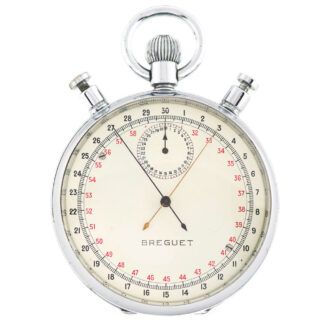
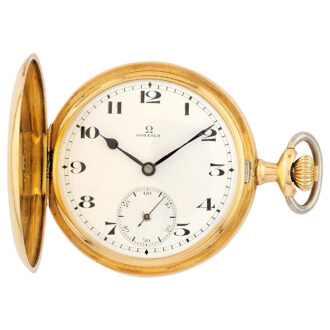
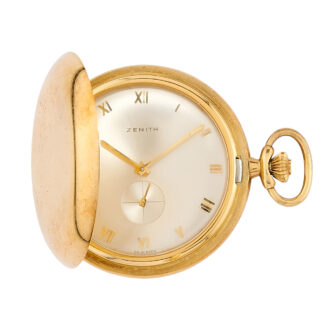
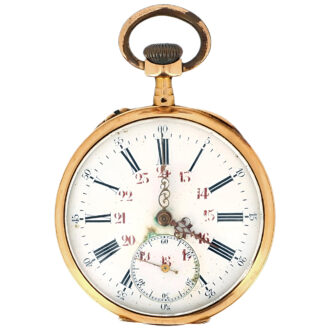
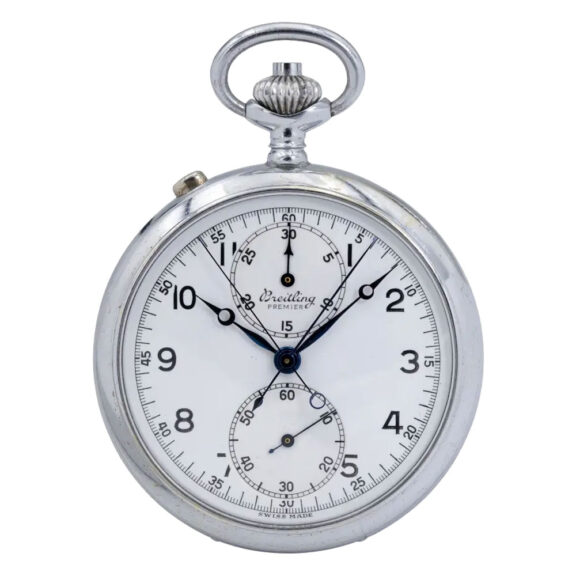
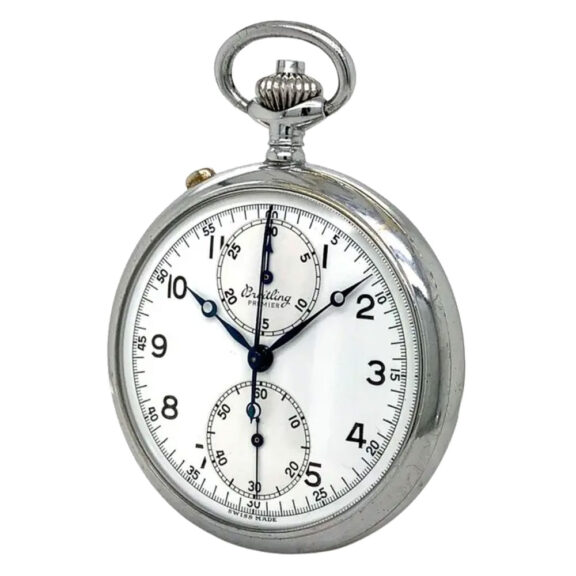
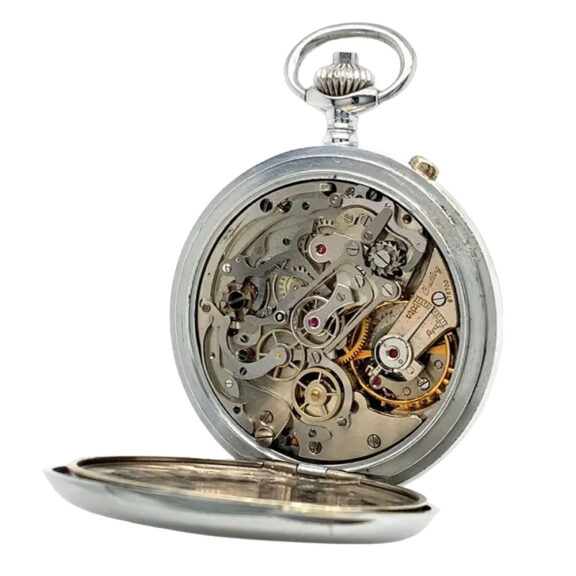
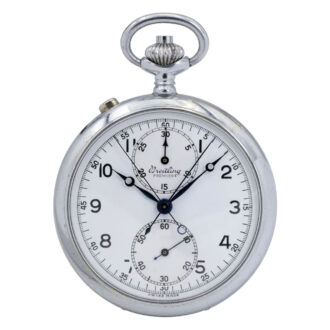
Fine Swiss chromed lever chronograph pocket watch Circa 1950
- Kenmerk
- DB1031
- Diameter
- 52 mm
- Estimate
- € 2.000 - 4.000
- Price sold
- € 2.750
Chromed anker chronometer
–
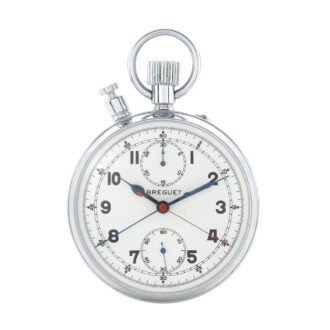
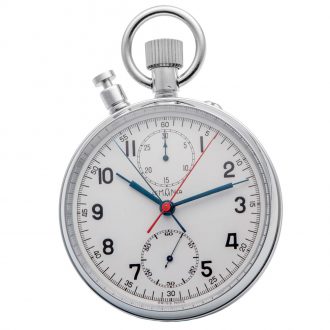
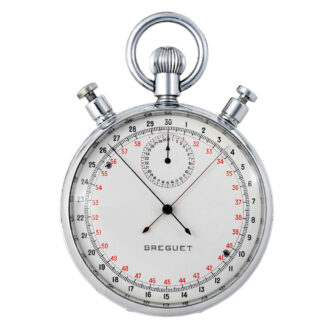
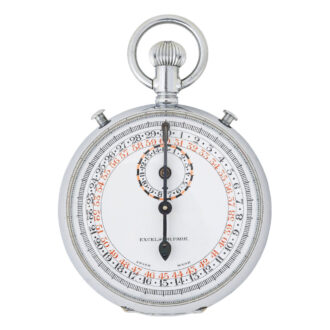
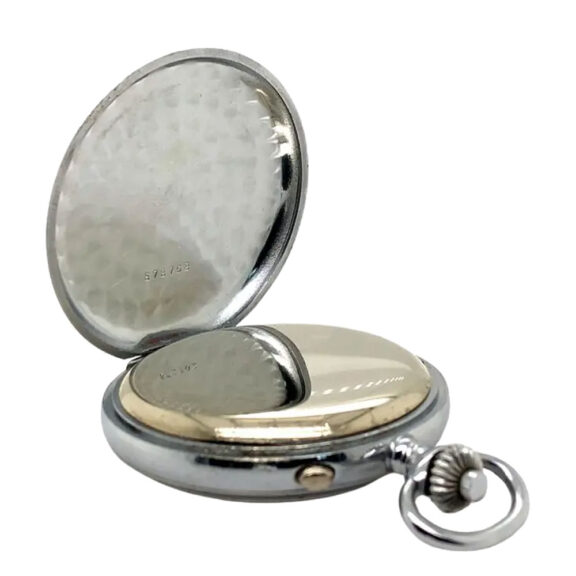
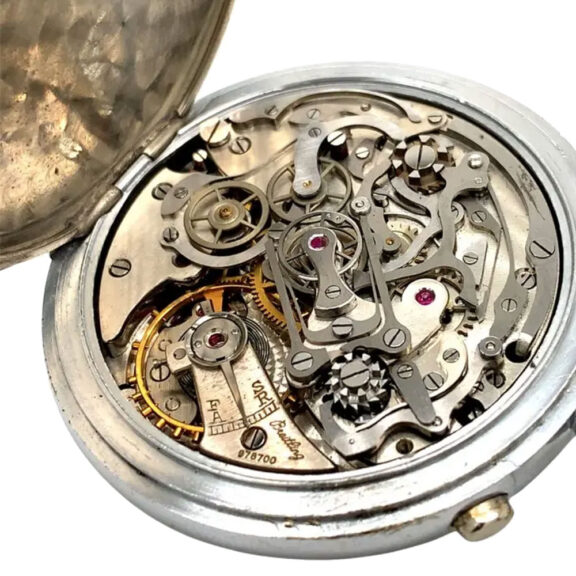
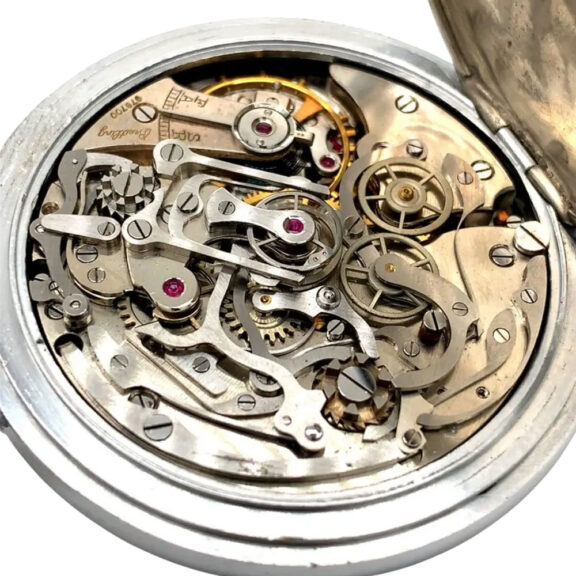
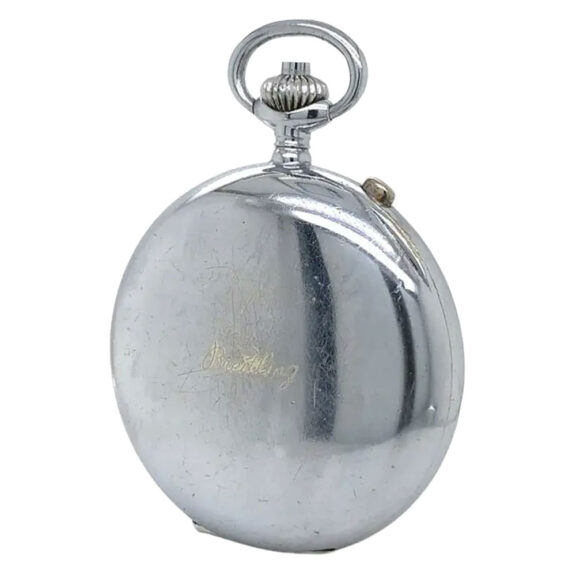
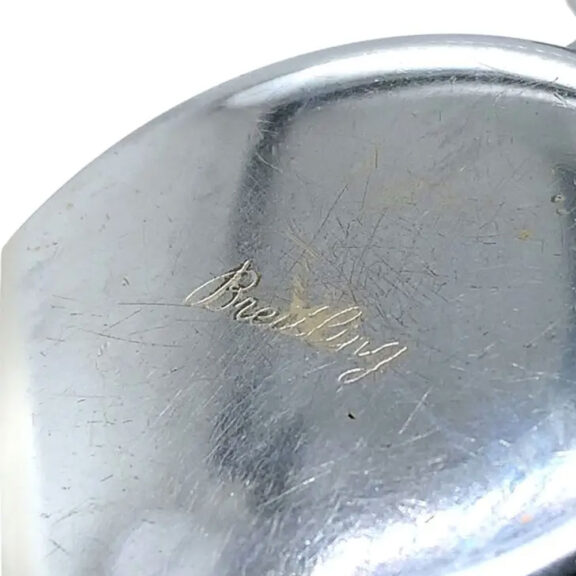
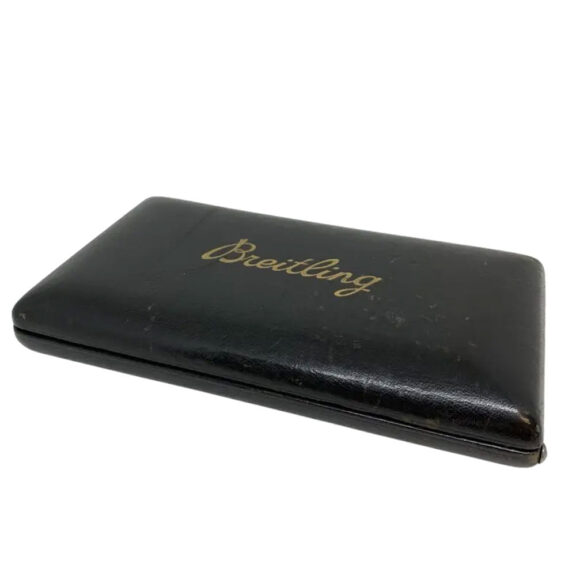
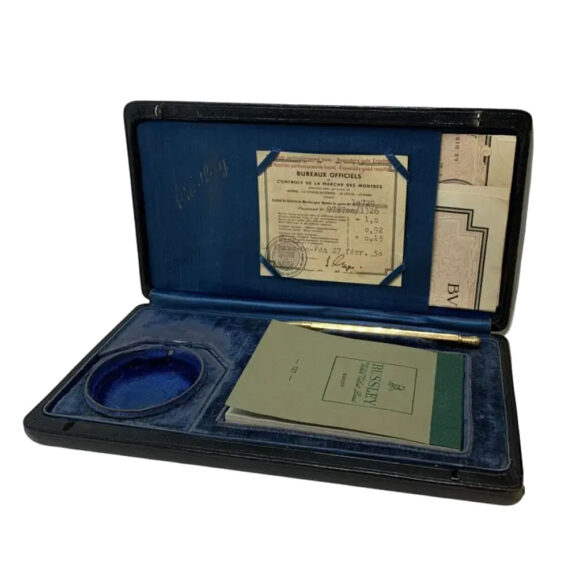
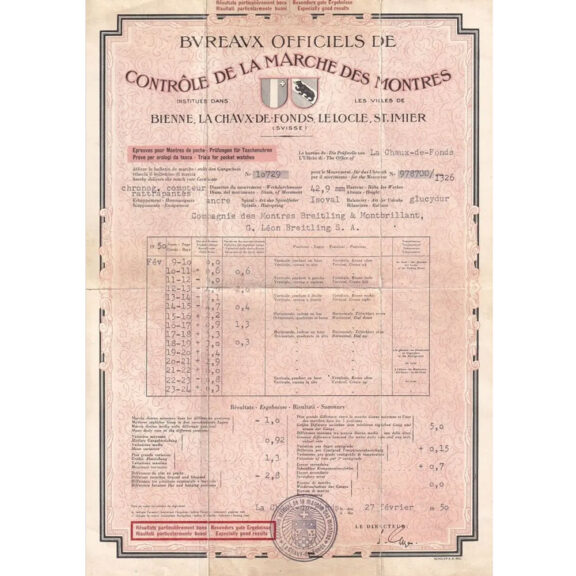
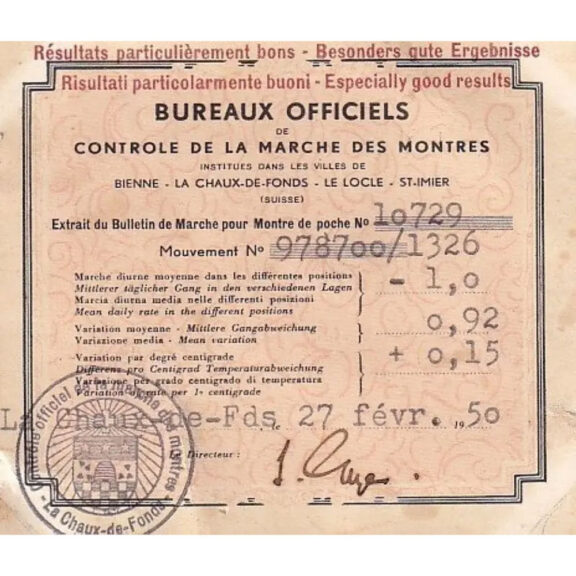
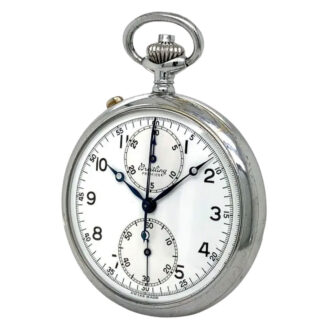
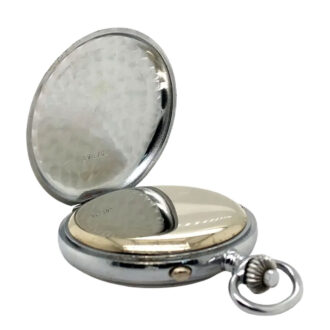
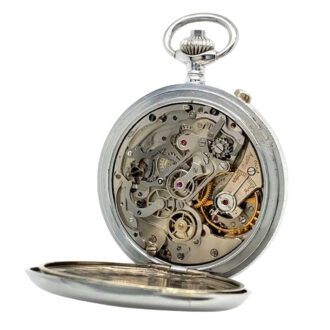
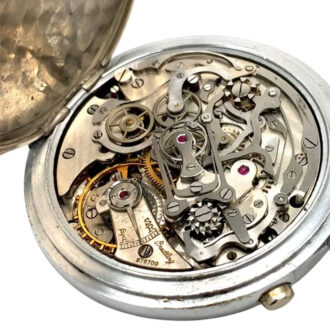
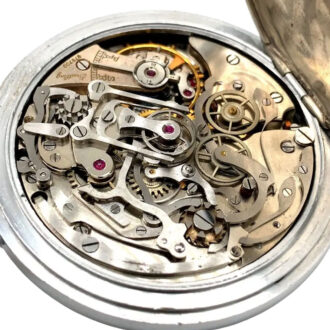
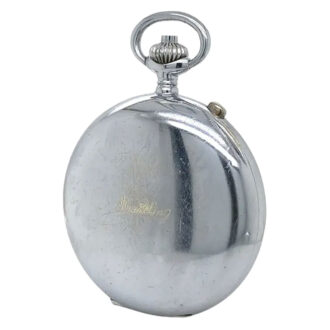
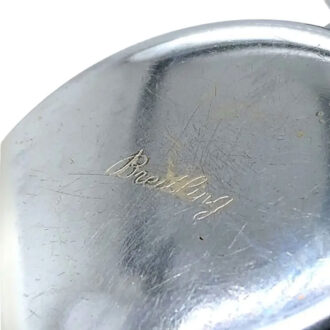
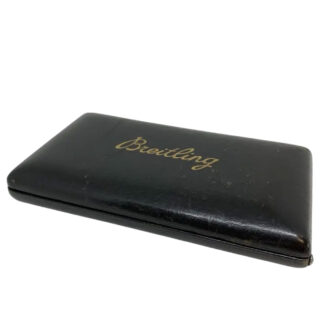
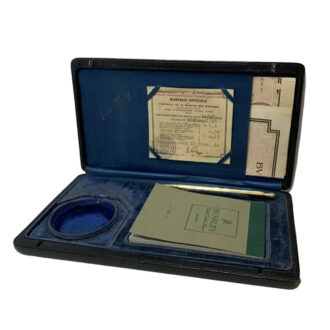
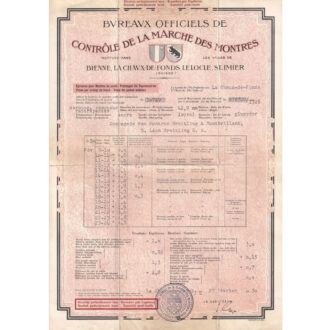
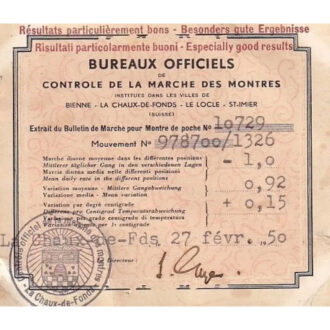
A fine and rare Swiss chromed open faced anker chronometer pocket watch with chronograph made by Breitling in, circa 1950. The ½ plate movement with a piston tooth lever escapement and Glucydur screw balance. White enamel dial with Arabic hours, an outer minute track with fifth of a second divisions and Arabic five minute numerals, a 30 minute counter at 12 o’clock, subsidiary seconds at 6 and blued heavy moon hands. A plain case. Dial signed, case signed on the reverse and numbered, movement signed and numbered. Comes with its original presentation box and the Bulletin de Marche from the La Chaux-de-Fonds testing center dated February 27th, 1950. The test showed particularly good results.
–
Diameter: 52 mm
–
Weight: 99 g
–
Signed: Breitling Premier Swiss made
–
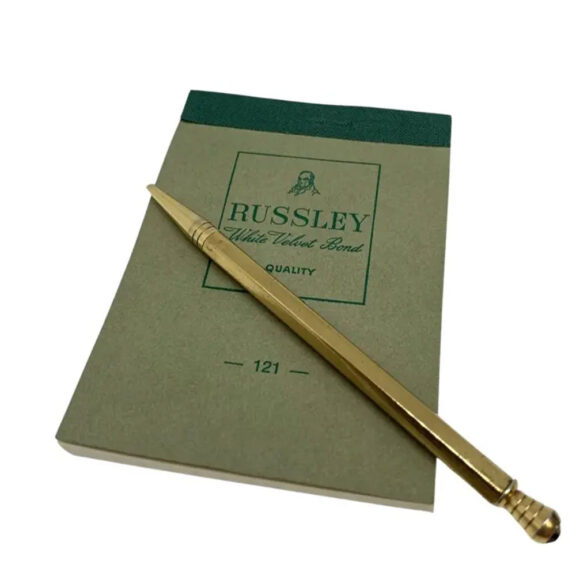
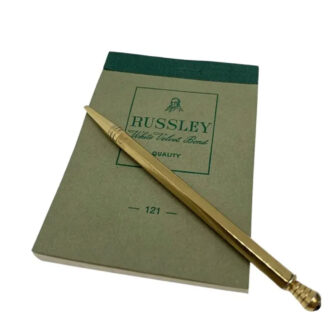
An exceptionally complete set consisting of a high quality pocket watch, chronometer certificate and presentation box with accessories.
–
Breitling was founded in 1884 in Saint-Imier by Léon Breitling, probably born in Les Ponts-de-Martel in 1860, but the company was not officially registered until 1890.
–
In the 19th century, many members of the Breitling family settled in the canton of Neuchâtel, Switzerland, from Germany. As early as 1841, a Breitling-Läderich watchmaker in La Chaux-de-Fonds was mentioned.
–
At that time, Saint-Imier was the chronograph capital. Factories like Schwab-Loeillet, Droz & Cie, Jules Frédéric Jeanneret, Albert Jeanneret & Frères, Ferdinand Bourquin, and Ernest Francillon with his Fabrique des Longines produced this type of watch, which was met with growing success all over the world. Léon Breitling had an innovative spirit, and in 1889, he patented a simplified mechanism with a vertical clutch, enabling him to make more economical chronographs.
–
In 1892, Léon decided to move to the region’s most active watchmaking metropolis, La Chaux-de-Fonds, at Boulevard du Petit Château. This move was facilitated by the fact that he assembled parts made by other companies in his workshops.
–
Although chronographs remained the company’s speciality, several new watches appeared. An eight-day caliber for clocks in 1896 and a simple watch with the balance visible on the dial in 1902.
–
In 1899, Boulevard du Petit Château was renamed Chemin de Montbrillant, and L. Breitling became L. Breitling, Montbrillant Watch Manufactory.
–
In 1905, Breitling launched a new speedometer called ” Vitesse “, with a central hand that completed one revolution in four minutes, providing a tachometric scale indicating speeds of up to 15 km/h, consistent with vehicles of the time. The company also supplied a patented metal watch holder, which by an ingenious combination fits onto the steering wheel of an automobile and thus enables the driver to have his tachometer constantly to hand.
–
Léon Breitling died in 1914, and his son Gaston-Léon took over. The company thus became known as G. Léon Breitling, Montbrillant Watch Manufactory.
–
Gaston-Léon inherited a flourishing company, but World War I was starting. However, it was not a period of crisis for the Swiss watchmaking industry, because it had to meet numerous demands for timepieces and ammunition. In 1915, Breitling launched a wrist chronograph with a push button at 2 o’clock, which was not the first wrist chronograph with a pusher independent of the crown, but its judicious positioning at 2 o’clock made it easier to use when the watch was on the wrist. After the war, the company continued to innovate, and several patents were registered.
–
Gaston-Léon died in 1927, just 43 years old, at a time when the Swiss watchmaking industry was going through a difficult crisis. His son, Willy, was only 13 and therefore too young to manage the company. The company became a “société anonyme” with a board of directors consisting of Berthe Breitling-Flajoulot, Gaston-Léon’s widow, and Paul-Ulysse Huguenin, a watchmaker from Le Locle.
–
In 1929, Paul-Ulysse Huguenin left the company to found the Huga company in 1933, a factory that also specialized in chronographs and counters. He was replaced by Louis Hêche, director of the well-known Le Phare factory in Le Locle, which was in great difficulty at the time. From this date, the Breitling became involved in sporting competitions to promote its chronographs and counters.
–
In 1931, Breitling launched a chronograph model for aeroplanes and cars that could be mounted on a dashboard. It was Breitling’s first step into aviation. That same year, the company introduced a new 14 line (31.5 mm) chronograph caliber, smaller than the first 16 line caliber of 1915. This enabled the launch of a range of wrist chronographs, including a rare version with a jumping hour in 1932.
–
In 1933, Willy Breitling finally took over the business, representing the third generation of the family. He understood that it was a time for sports and strengthened his chronograph and counter ranges, with increasingly complete wrist chronograph ranges. In 1933, Breitling also offered some pretty singing bird boxes. The same year, the company registered two patents on a chronograph movement with two pushers enabling timing to be resumed after stopping.
–
From 1935, the economic situation improved, and Breitling redoubled its activities by becoming a specialist in timing sporting events, developing an aviation watch division, which became known as Breitling 8 Aviation at the start of World War II and by developing an impressive number of new chronograph models, in particular wrist chronographs.
–
In 1944, Willy launched an elegant square water resistant watch. Therefore, he contacted a specialist in the field, Hoeter & Cie, in La Chaux-de-Fonds. Max Hoeter was an engineer who already had worked on the water resistance of watches. Breitling took control of Hoeter in 1944, when the company became Compagnie des Montres Brémon Hoeter SA.
–
The Second World War had little impact on the Swiss watchmaking industry, which had to respond to the strong demand for timepieces. After the war, non-chronograph watches, such as ladies’ watches, calendar watches, and the first automatic watches, became common. The Brémon brand is now used as Breitling’s second brand. It was also during this period that Breitling strengthened its presence in the United States by creating the Breitling Watch Corporation of America on 5th Avenue in New York.
–
In 1949, the company decided to move to Geneva. This decision was linked to the city’s prestige, its international exhibition, as well as to the much more advantageous tax conditions. To this end, Willy Breitling created the “Société Anonyme pour la vente de montres et chronographes Breitling à Genève”. The company was located on Rue du Rhône, where a new chapter in the Breitling saga began.
–
Breitling is a major company in the history of Swiss chronograph making. Think of legendary models such as the Chronomat and Navitimer, which are still in production today, and of which there have been many versions.
Signed: Breitling Premier Swiss made
Share this page: