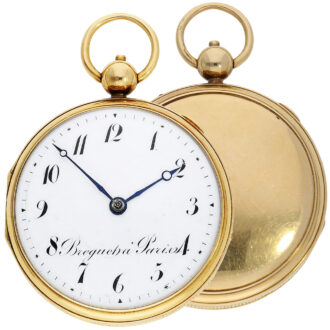
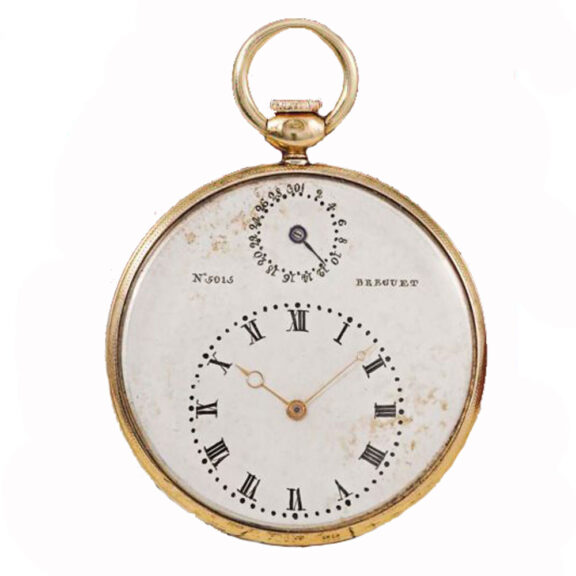
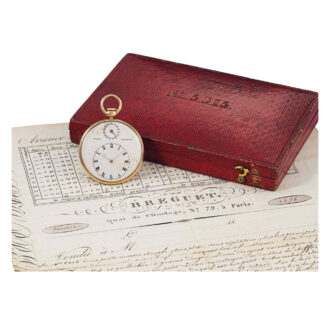
Important French gold open faced lever with date Circa 1833
- Kenmerk
- CH1366
- Diameter
- 34 mm
- Estimate
- € 20.000 - 40.000
- Price sold
- € 38.500
Lever watch with keyless winding hand setting and date by Breguet
–
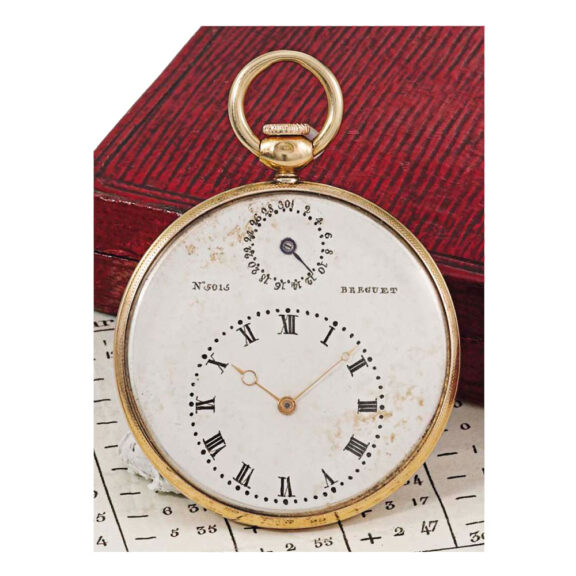
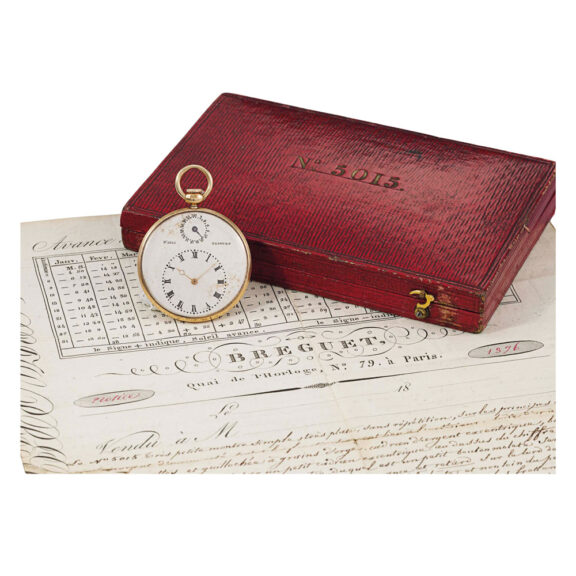
An extremely rare, early and important French 18 Carat gold open faced lever watch with keyless winding, hand setting and date, circa 1833. Très petite motre simple sur les principes des chronomètres, petit bouton moleté servant à remonter la montre et à mettres les aiguilles à l’heure. Sold on 3 July 1833 to the Marquis d’Abercorn for the sum of 3,870 francs. Gilded brass jewelled lever movement, index regulator, bi metallic compensation balance with two wedge shaped weights. White matte silver dial, eccentric hour dial with Roman numerals, gold Breguet hands, small date dial above 12 o’clock with Arabic numerals and blued steel hand. Small engine turned slim case, engine turned snap on back, movement advance/retard slide and date corrector button in the band, movement wound and hands set through the button in the olive shaped pendant. Case by Louis Joly, dial signed and numbered. Comes with original certificate and red Morocco fitted box.
–
Diameter: 34 mm
–
Signed: Breguet
–
James Hamilton, 1st Duke of Abercorn, KG, PC (21 January 1811 – 31 October 1885) styled Viscount Hamilton from 1814 to 1818 and the Marquess of Abercorn from 1818 to 1868, was a British conservative politician and statesman who twice served as Lord Lieutenant of Ireland, the British monarch’s official representative and head of the Irish executive. Abercorn was the son of James Hamilton, Viscount Hamilton, who died when his son was only three. His mother was Harriet Douglas, second daughter of the Hon, John Douglas. Abercorn married Lady Louisa, second daughter of John Russell, 6th Duke of Bedford, in 1832. They had fourteen children, thirteen of whom survived infancy. In 1844, Lord Abercorn was made a Knight of the Garter at the relatively young age of 33, becoming that same year Lord Lieutenant of Donegal. Two years later he was appointed a Privy Counsellor and Groom of the Stole to Prince Albert and remained a prominent figure in the royal court for the next two decades. In 1860, The Times noted that Hamilton was one of only three to hold peerages in all three Kingdoms of England, Scotland and Ireland. In 1866, he was appointed Viceroy of Ireland, and two years later was created Marquess of Hamilton (in the Peerage of the United Kingdom) and Duke of Abercorn (in the Peerage of Ireland), resigning shortly after Gladstone won the 1868 general election. In 1874, he was chosen Grand Master of the Grand Lodge of Ireland, a post he held until his death. Abercorn was Envoy-Extraordinary for the investiture of King Umberto I of Italy with the Order of the Garter on 2 March 1878. He was elected Chancellor of the University of Ireland in 1881, and died four years later at his home of Baronscourt, County Tyrone.
–
This piece, watch No. 5015, is one of the earliest watches ever made with keyless winding and hour setting furthermore fitted with a very early date change system.
–
A masterpiece from the workshop of Abraham-Louis Breguet. Abraham-Louis Breguet (1747-1823), ‘Watchmaker of the Kings, King of Watchmakers’ and his descendants Antoine-Louis and Louis-Clément. Witnesses of often tumultuous historical and political times, the technical, innovative and decorative characteristics of this watch pays tribute to Breguet’s genius in all areas of finest watchmaking.
–
A.L. Breguet is widely acknowledged for having set the standard by which all fine watchmaking has been judged ever since. He was born in Neuchâtel, Switzerland, but it was in Paris that he spent most of his productive life. No aspect of watchmaking escaped his study and his inventions were as fundamental to horology as they were varied. His career started with a series of breakthroughs. The development of the successful self winding perpétuelle watches, the introduction of the gongs for repeating watches and the first shock protection for balance pivots.
–
Louis XVI and his Queen, Marie-Antoinette, were early enthusiasts of Breguet’s watchmaking. Each watch from his workshops demonstrated the latest horological improvements in an original movement, mostly fitted with lever or ruby cylinder escapements that he perfected. Breguet took refuge in Switzerland from the excesses of the French Revolution. He returned to Paris overflowing with the ideas that produced the Breguet balance spring, his first carriage clock (sold to Bonaparte), the ‘sympathique’ clock and its dependent watch, the tact watch and finally the tourbillon, patented in 1801.
–
Breguet became the indispensable watchmaker to the scientific, military, financial and diplomatic elites of the age. His timepieces ruled the courts of Europe. For his most celebrated clients, Breguet designed exceptional timepieces. For Caroline Murat, Queen of Naples, he conceived in 1810 the world’s very first wristwatch. Honours saluted his enormous contribution to horology. Appointed to the Board of Longitude and as chronometer maker to the navy, he entered the Academy of Sciences and received the Legion of Honour from the hands of Louis XVIII.
–
When he died in 1823, all mourned the architect of the greatest revolution in the science and art of time-keeping.
–
Antoine-Louis Breguet (1776-1858). Upon Abraham-Louis’ death in 1823, his only son and natural successor Antoine-Louis took over the reins of the firm. Trained with his father in Paris, John Arnold in London and with several Swiss watchmakers in the Le Locle region, he had been involved since around 1790 in the running of the house and in all innovations produced by it. Known and respected by the clientele, his only wish was to continue his father’s work. During his period at the helm of the house, production of marine watches and creation of complicated timepieces was increased. Worthy successor to his father, he constantly pushed back the limits of the possible and gave free reins to his highly developed artistic sense, some of his pieces surpassing in elegance and finesse everything produced by the firm so far. Breaking with some of the houses’ traditions, Antoine-Louis designed off center dials which were breath taking in their audacity. At the 1827 national exhibition he was awarded gold medals for his marine chronometers and his watches with complications. A highly talented watchmaker, Antoine-Louis’ interpersonal and business skills were however far from those of his father. Faced with the commercial decline, he transferred the business to his son Louis-Clément and Breguet, Neveu et Compagnie was set up on 20 May 1833.
–
Louis François Clément Breguet (1804-1883). Like his father and grandfather, Louis-Clément was a trained watchmaker but also a physicist and prolific inventor. He had taken over the reins of the firm from his father in 1833, steering the renamed Breguet, Neveu et Compagnie into a new direction. Between 1835 and 1840, while still maintaining a traditional workshop for the manufacture of one off pieces ‘à l’ancienne’, in the old style, he standardized the majority of the firms production, then making 350 watches per year and diversified into scientific instruments, electrical devices, recording instruments, an electric thermometer, telegraph instruments and electrically synchronized clocks. With Alphonse Foy, in 1842, he developed an electrical needle telegraph to replace the optical telegraph system then in use. Louis-Clément also manufactured the rotating mirror Fizeau-Foucault apparatus, used by Léon Foucault and Hippolyte Fizeau to measure the speed of light (1850). In 1856 he designed a public network of synchronized electric clocks for the center of Lyon. In 1866 he patented an electric clock controlled by a 100 Hz tuning fork.
–
In terms of honors, in 1843 he was appointed to the Bureau of Longitudes. In 1845 Breguet was awarded the Legion d’Honneur. He was made a member of the French Academy of Sciences in 1874 and was elevated to Officer of the Legion d’Honneur in 1877. He is one of the 72 French scientists whose names are written around the base of the Eiffel Tower.
–
Breguet was married and had one son Antoine (1851-1882) who also joined the family electrical business. Father and son met Alexander Graham Bell and obtained a license to manufacture Bell telephones for the French market. Antoine’s son was Louis Charles Breguet, aviation pioneer and aircraft manufacturer. In 1870, both Louis-Clément and his son Antoine had lost interest in traditional watchmaking. The branch was separated from the rest of the firm and handed over to Edward Brown who had been working at Breguet since 1845. Breguet then focused entirely on the telegraph and the nascent field of telecommunications. He collaborated in the development of an induction coil, later improved by Heinrich Ruhmkorff. He died in 1883, a little over a year after the sudden death of his son Antoine.
Signed: Breguet
Share this page: