English important gold quarter repeating verge Circa 1724
- Kenmerk
- SA0120
- Diameter
- 53 mm
- Estimate
- € 25.000 - 50.000
- Price sold
- € 55.000
Gold verge watch with repousse scene by Augustin Heckel
–
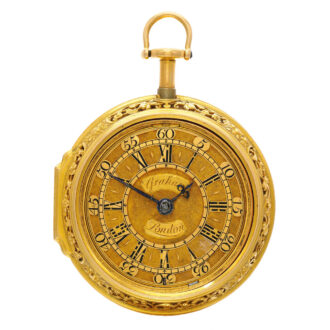
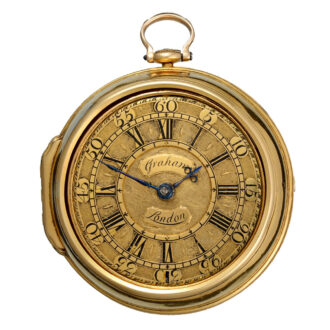
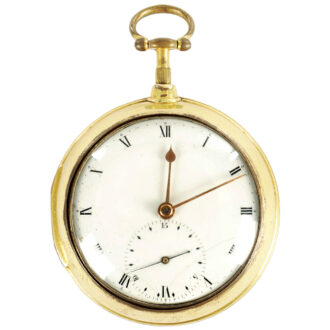
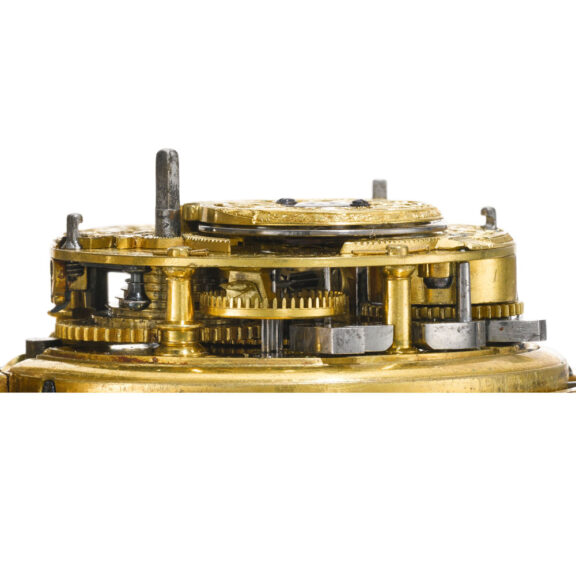
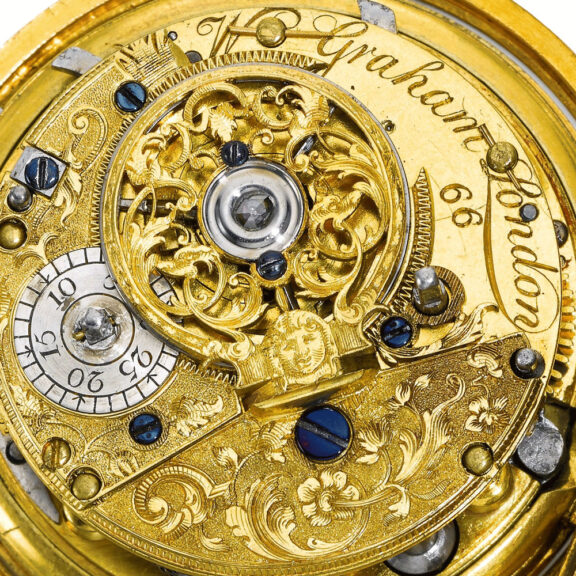
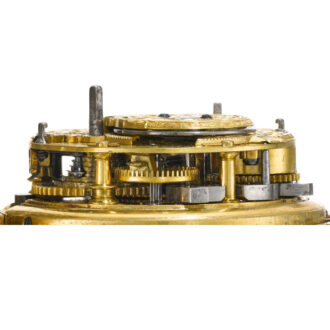
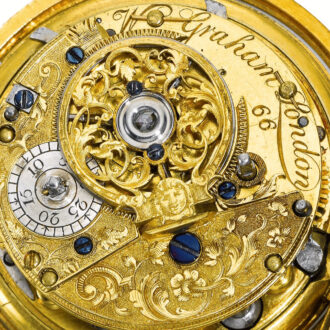
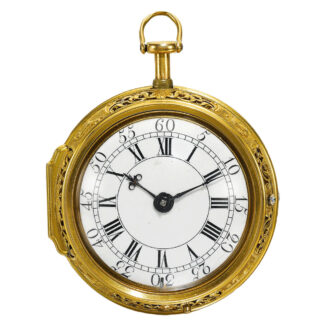
An English important gold pair cased quarter repeating verge watch with repousse scene by Augustin Heckel, circa 1724, gilded full plate movement, decoratively pierced and engraved winged masked balance cock, plain flat balance, diamond endstone, fusee and chain, repeating on a bell to the inside case back, round baluster pillars, gilt metal dust cap, W. Graham, London, bell scratch signed Wilham Wyh and scratch numbered.
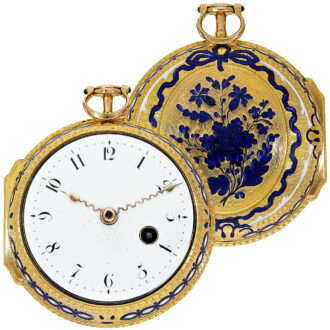
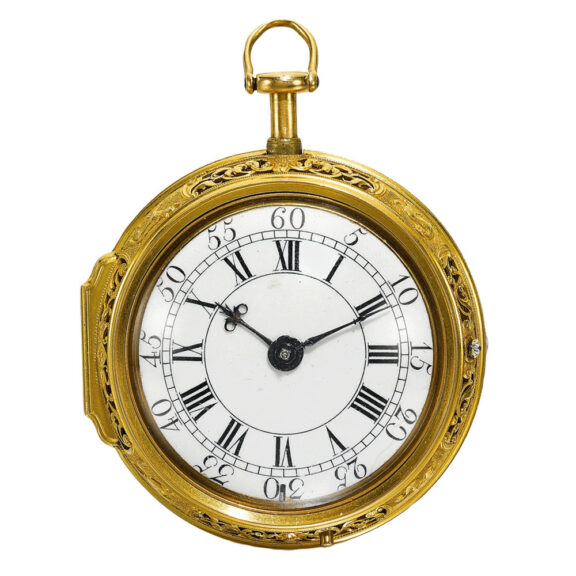
White enamel dial, Roman numerals, Arabic outer minute ring, blued steel beetle and poker hands.
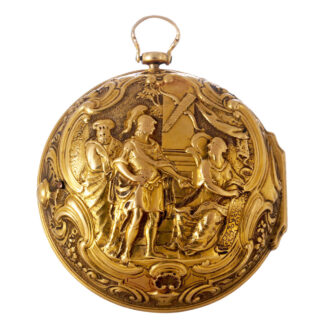
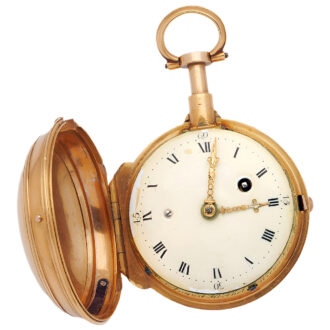
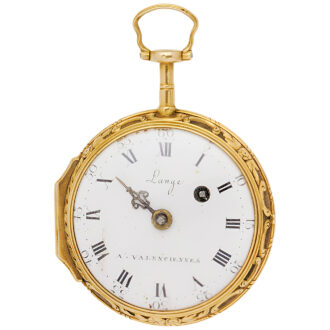
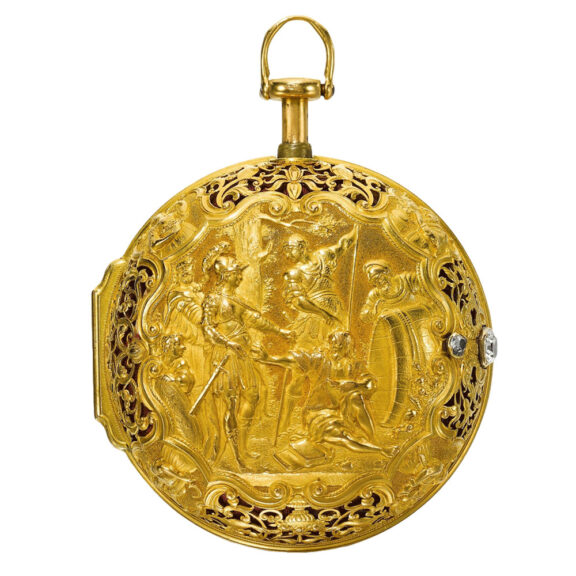
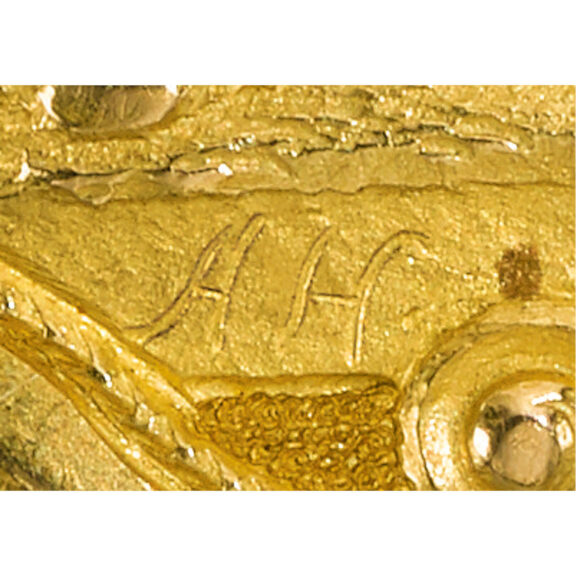
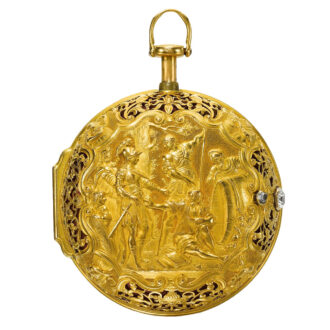
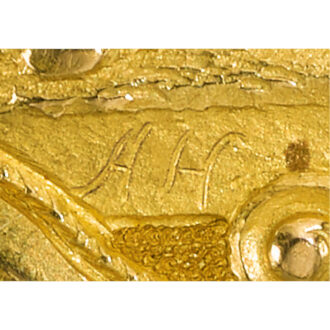
Gold inner case with a pierced band of scrolling foliage inhabited by birds, numbered below the pendant and with engraved townscape, mask to the base, centre of the back with engraved rosette, London hallmarks for 1724, case maker’s mark WS incuse for William Sherwood and numbered, the outer case chased with a repoussé scene depicting the hermit Diogenes and Alexander the Great, signed AH to the step for Augustin Heckel, the surround pierced and engraved with foliate scrolls and divided into personifications of the Four Seasons, the bezel pierced with scrolling foliage and interspersed with panels representing the elements: salamander (fire), bird (air), fish (water) rabbit (earth), pulse piece below 5 o’clock, diamond-set thumb-piece and catches above and below.
–
Diameter: 53 mm
–
Signed: W. Graham London
–
This is an important and previously unrecorded pair cased watch by William Graham, nephew of George Graham. The watch has one of the lowest numbers so far recorded by William Graham and has one of the earliest signed repoussé outer cases by Augustin Heckel. In his book, Thomas Tompion at the Dial and Three Crowns, Jeremy Evans records eight other watches by William Graham, five of which are numbered, the present watch is not recorded.
The movement is characteristic of the work of George Graham and the repeating work is a very early example of Matthew Stogden’s design which soon became the standard for all English watches. The enamel dial and hands are of the finest quality and the inner case is by William Sherwood, the same case maker that George Graham was using during this period.
William Graham initially worked in London but later emigrated to America. In his autobiography, The Infortunate, published in 1743, William Moraley writes of working for William Graham in Philadelphia for a ten week period during 1733. Interestingly. Moraley states that his reason for leaving this employment was due to Graham’s plan of settling in Antigua.
Augustin Heckel’s outer case is of exceptional quality and is in outstanding condition. The scene depicts Alexander the Great standing before Diogenes of Sinope, a 4th Century Cynic Philosopher. Diogenes led an ascetic life and in this scene is shown seated in front of the barrel in which he lived. The composition is adapted from one by Salvator Rosa (but possibly derived from a copy by Lorenzo Loli which, like the present chasing, has the figures reversed). The scene shows the moment immediately after Alexander has invited the philosopher to ask for a favour of his choice, Diogenes responds by asking the emperor to move aside as he is shading him from the sun. In the scene, Diogenes is seen making the associated gesture. The four surrounding cartouches have representations of the Four Seasons opposite the Four Elements to the bezel. Augustin Heckel, born in Augsburg, came to London sometime between 1715 and 1720. He set up a business as a watch case engraver, painter, and draughtsman. Heckel was considered one of the finest chasers of the period.
Signed: W. Graham London
Share this page: