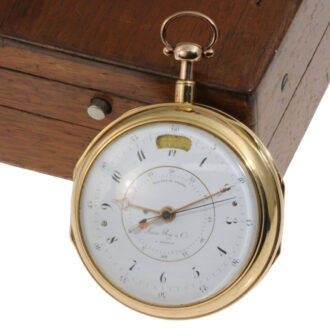
Swiss rose gold repeating centre seconds duplex Circa 1820
- Kenmerk
- DB0021
- Diameter
- -
- Estimate
- € 12.500 - 25.000
- Price sold
- € 15.700
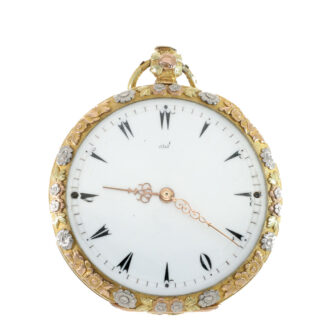
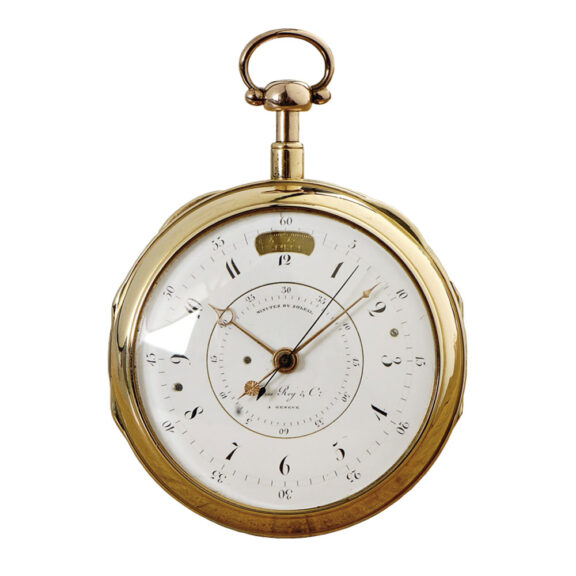
Rose gold repeater with calendar and equation of time
–
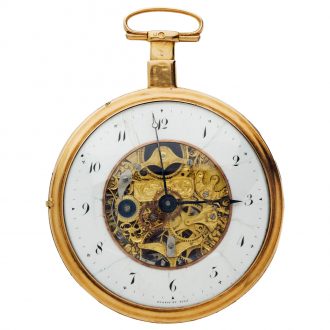
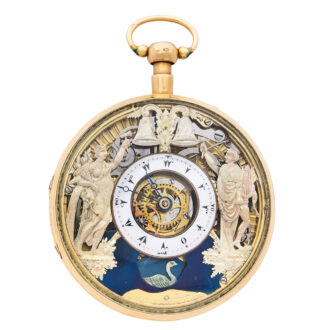
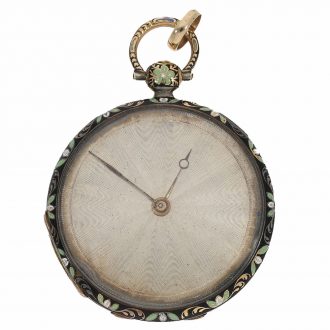
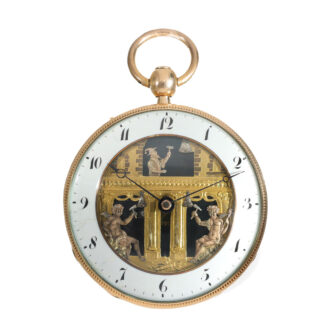
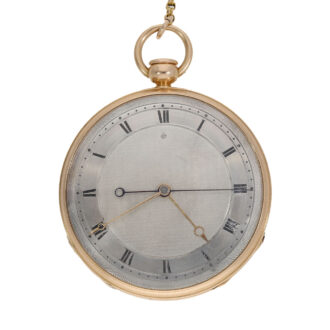
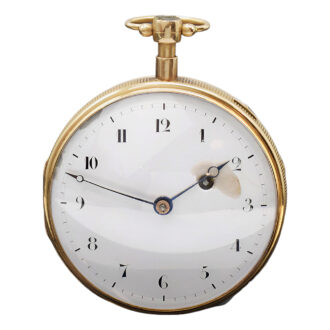
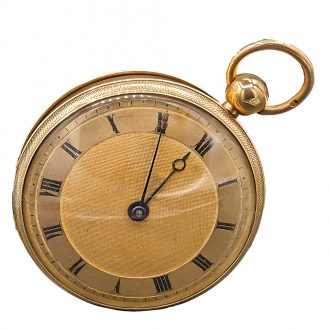
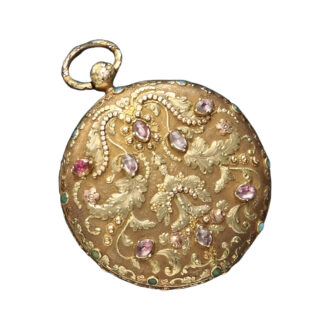
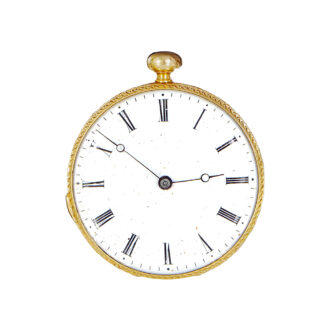
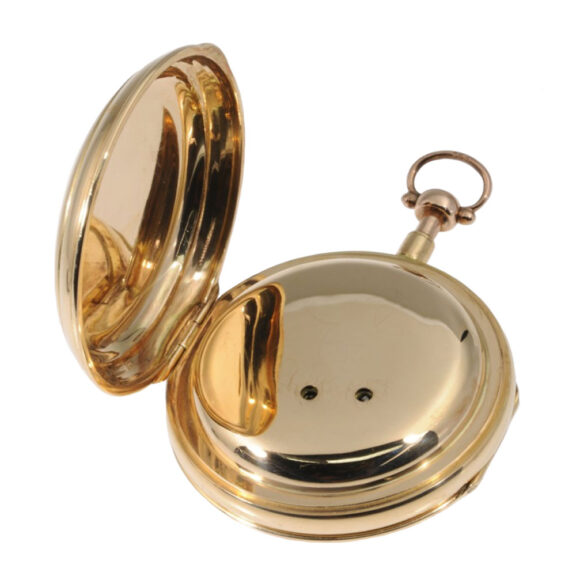
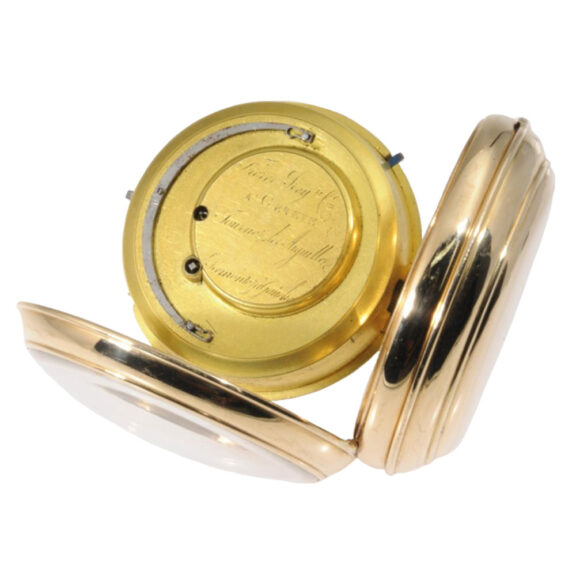
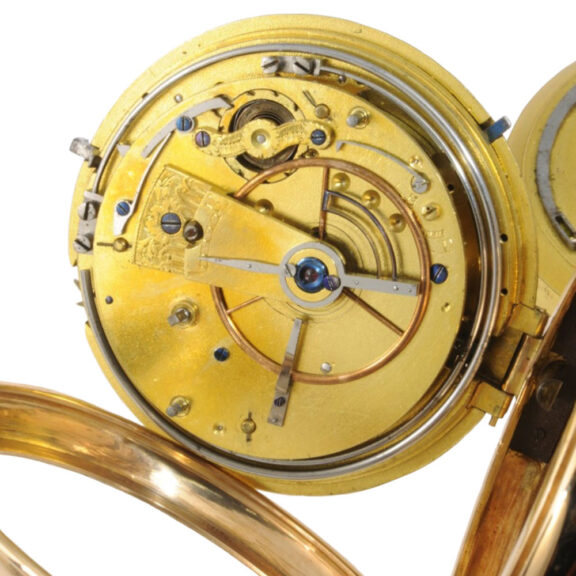
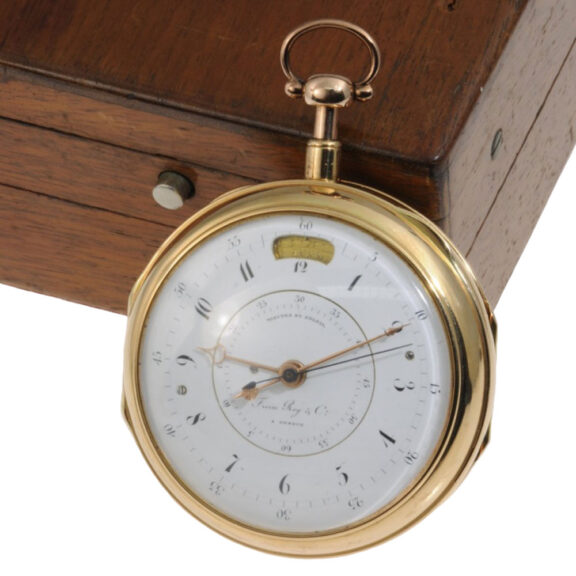
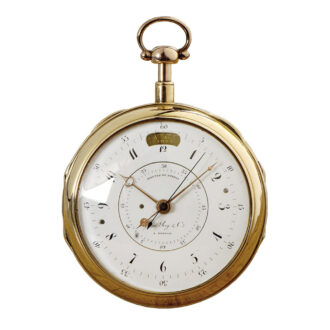
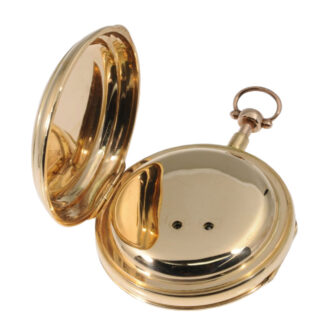
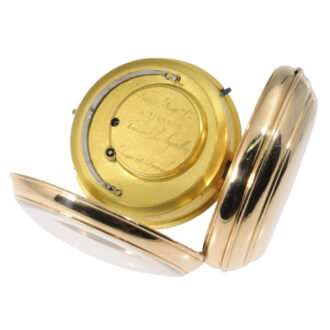
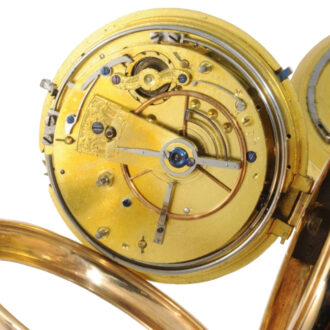
An important Swiss 18 carat rose gold open faced quarter repeating jumping centre seconds duplex pocket watch with calendar and equation of time, minutes du Soleil, circa 1820. Brass full plate movement, two hammers and two gongs, chain and fusee, open barrel for the striking train, double wheel duplex escapement, temperature-compensating balance spring, large three arm ring balance, balance stop device. White enamel dial with Arabic numerals, a window with the month and date at 12 o’clock, a revolving disc for the equation of time in the center, a rose gold minute, hour and sun hand for the equation of time. A later custom made plain case.
Dial and movement protection cap signed. Comes with the original wooden presentation box.
–
Weight: 258 g
–
Signed: Frères Rey & Cie à Genève
–
The brothers Rey were descendants of a renowned watch and clock-making family in Geneva, which already appeared in the records in the early 18th century. The brothers established their business in the early years of the 19th century with a workshop in Saint Gervais. On October 1, 1821, they filed for bankruptcy.
–
Equation of time. This complication turns the ‘Raeder Uhr’ into a sundial. The ‘Reader Uhr’ shows midday every 24 hours. The sundial on the other hand shows midday when the sun is at its highest point. Due to the inclination of the Earth’s axis and the ellipticity of its orbit, the sun is not always at its highest point at the same time. A clock with an equation shows the extent of this deviation. This construction includes a perpetual calendar with a kidney-shaped cam plate, where the radius of the disc mirrors the daily difference between local apparent and local mean time. A lever ‘reads’ the circumference of the disc and a toothed rack sitting on the same axis as the lever interacts with a moving gear wheel. In very basic systems, the axis of this wheel is a pointer or a disc which indicates the equation of time, in more complex mechanisms, the wheel is connected to a differential gear which controls an extra minute hand on the main dial. Calculation of the difference between local apparent and local mean time required the invention of the pendulum clock in 1656 by Christiaan Huygens. It was first described in 1672 by English astronomer John Flamsteed. In 1705 Daniel Quare (1649 – 1720) started designing and building longcase equation clocks, first in England and later in France; the clocks simultaneously displayed local apparent and local mean time, showing the equation of time or could be switched between the two settings.
Signed: Frères Rey & Cie à Genève
Share this page: