Swiss gold minute repeating perpetual calendar Circa 1990
- Kenmerk
- SA1333
- Diameter
- 58 mm
- Estimate
- € 100.000 - 200.000
- Price sold
- € 147.800
Complicated chronometer with Earnshaw type spring detent escapement
–
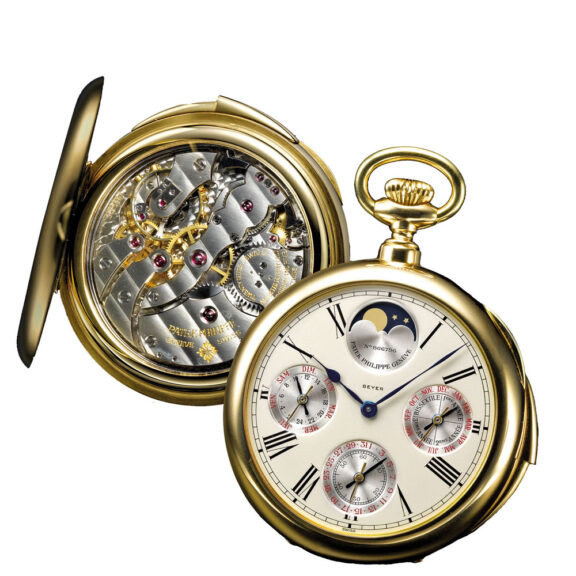
An exceptional Swiss yellow gold keyless open faced minute repeating perpetual calendar chronometer watch with moon phases, 24 hour indication and earnshaw type spring detent escapement circa 1990, retailed by Beyer. Damascened nickel movement with Earnshaw type spring detent escapement, 29 jewels, bimetallic compensation balance with recess for the blued steel freesprung helical balance spring, adjusted to heat, cold, isochronism and 5 positions, wolf’s tooth winding, minute repeating on 2 steel gongs.
White dial with Roman numerals, blued steel spade hands, four satin finished silvered subsidiary dials indicating date with constant seconds, day in French combined with 24 hour indication, month in French combined with leap year indication, fan form aperture for moon phases.
18 Carat yellow gold case, repeating slide to the band, transparent crystal dust cover, hinged back. Dial signed by retailer, case, dial and movement signed by maker.
–
Diameter: 58 mm
–
Signed: Patek Philippe Genève
–
Accompanied by a Patek Philippe Certificate of Origin in a leather folder and an Extract of the Archives confirming production in 1989 and sale in 1990. As one of the most complex movements created by Patek Philippe for a modern pocket watch, Ref. 961 was introduced in 1989. Only very few pieces are believed to have been made. In fact just 3 are currently known by the public. Chronometer pocket watches are amongst the most accurate mechanical timekeepers available and require tremendous skill and ingenuity to produce. The combination of perpetual calendar and minute repetition make this a highly desirable masterpiece of precision horology.
–
Patek Philippe first made chronometer watches with complications in the 1840s, almost 150 years before the introduction of the Ref. 961. Throughout the history of the company, complication watches with Earnshaw spring detent escapements have remained not only exceptionally rare but also most costly to manufacture. This complicated mechanism was developed by Thomas Earnshaw (1749 – 1829) in the mid 1780s. It is a spring detent type giving impulse to the balance in one direction during a short section of its arc. It has the advantage of not requiring oil on the escape wheel teeth. During the 19th century this escapement became the standard for marine chronometers and continued to be manufactured for use at sea until the advent of quartz controlled timekeepers.
–
An exceptional Swiss yellow gold keyless open faced minute repeating perpetual calendar chronometer watch with moon phases, 24 hour indication and earnshaw type spring detent escapement circa 1990, retailed by Beyer. Damascened nickel movement with Earnshaw type spring detent escapement, 29 jewels, bimetallic compensation balance with recess for the blued steel freesprung helical balance spring, adjusted to heat, cold, isochronism and 5 positions, wolf’s tooth winding, minute repeating on 2 steel gongs.
White dial with Roman numerals, blued steel spade hands, four satin finished silvered subsidiary dials indicating date with constant seconds, day in French combined with 24 hour indication, month in French combined with leap year indication, fan form aperture for moon phases.
18 Carat yellow gold case, repeating slide to the band, transparent crystal dust cover, hinged back. Dial signed by retailer, case, dial and movement signed by maker.
–
Diameter: 58 mm
–
Signed: Patek Philippe Genève
–
Accompanied by a Patek Philippe Certificate of Origin in a leather folder and an Extract of the Archives confirming production in 1989 and sale in 1990. As one of the most complex movements created by Patek Philippe for a modern pocket watch, Ref. 961 was introduced in 1989. Only very few pieces are believed to have been made. In fact just 3 are currently known by the public. Chronometer pocket watches are amongst the most accurate mechanical timekeepers available and require tremendous skill and ingenuity to produce. The combination of perpetual calendar and minute repetition make this a highly desirable masterpiece of precision horology.
–
Patek Philippe first made chronometer watches with complications in the 1840s, almost 150 years before the introduction of the Ref. 961. Throughout the history of the company, complication watches with Earnshaw spring detent escapements have remained not only exceptionally rare but also most costly to manufacture. This complicated mechanism was developed by Thomas Earnshaw (1749 – 1829) in the mid 1780s. It is a spring detent type giving impulse to the balance in one direction during a short section of its arc. It has the advantage of not requiring oil on the escape wheel teeth. During the 19th century this escapement became the standard for marine chronometers and continued to be manufactured for use at sea until the advent of quartz controlled timekeepers.
Signed: Patek Philippe Genève
Share this page: