Magnificent Swiss rose gold exhibition type watch Circa 1911
- Kenmerk
- BA2243
- Diameter
- 84 mm
- Estimate
- € 50.000 - 100.000
- Price sold
- € 81.200
Rose gold and cast silver repeating chronograph by Longines
–
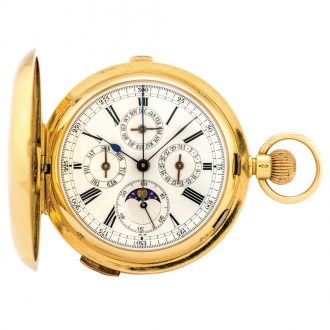
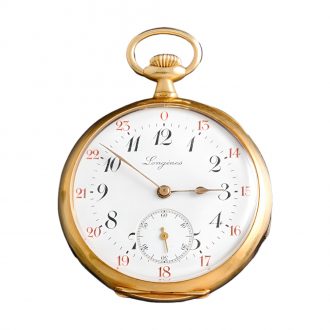
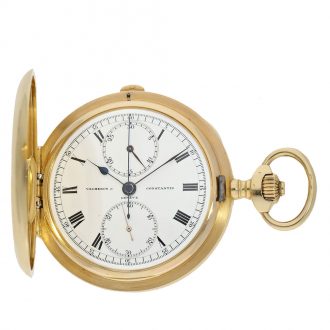
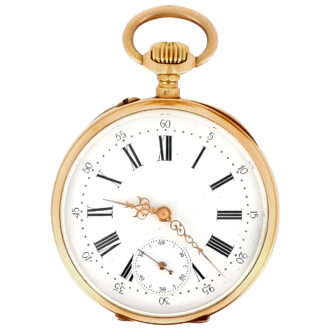
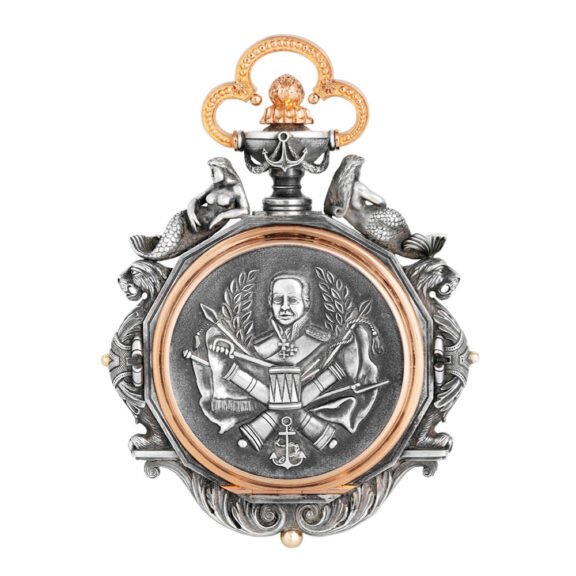
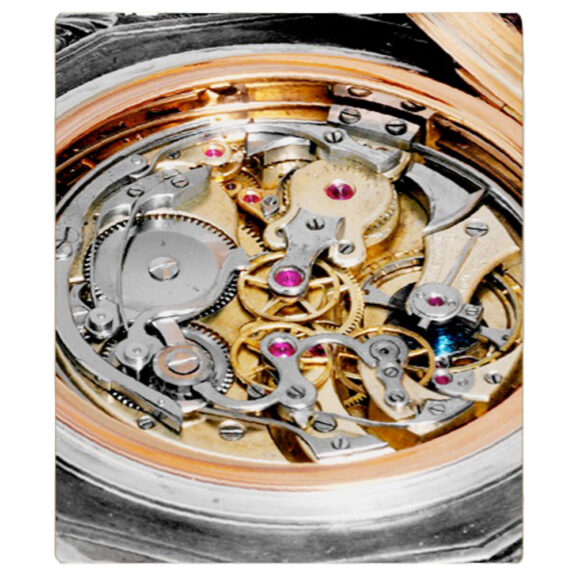
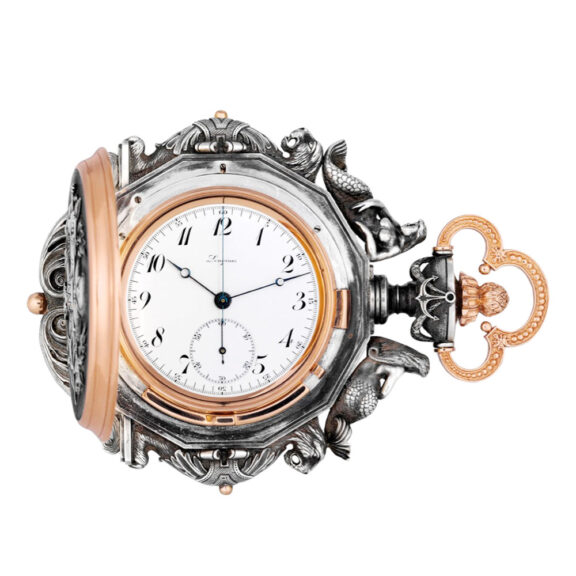
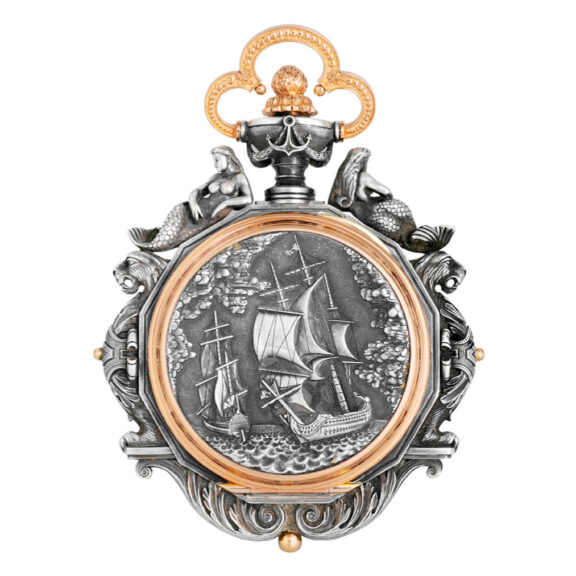
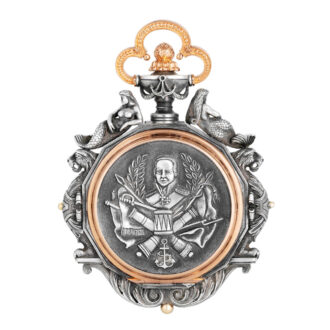
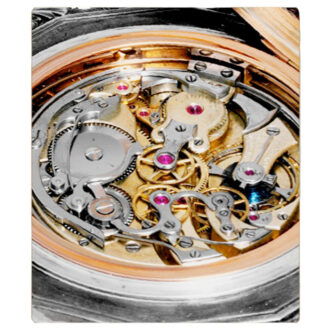
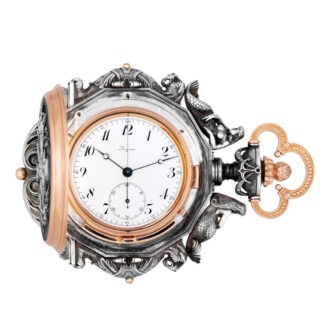
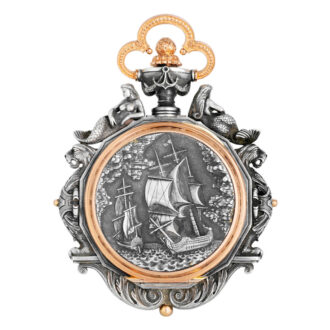
A magnificent, extremely fine and equally rare, very large Swiss 14 Carat rose gold and cast silver hunting cased minute repeating chronograph keyless lever exhibition type watch made for the Russian market in commemoration of Russia’s most illustrious naval commander Fyodor Fyodorovich Ushakov (1744-1817), circa 1911. Sold to Longines’ Russian agent Schwaub in 1911. Matte gilt movement, straight line lever escapement, 31 jewels, cut bi metallic compensation balance, blued steel Breguet balance spring with overcoil, index regulator, repeating with two polished steel hammers on two gongs activated by a curved slide beneath the dial. Silver hinged cuvette with engine turned border. White enamel dial with Breguet numerals, outer minute and fifths of a second divisions with Arabic five minute numerals, subsidiary seconds and original blued steel Breguet hands. Massive case, the front cover with a cast and chased high relief panel decorated with a bust of Fyodor Fyodorovich Ushakov surrounded by a military trophy, rose gold rim, the back cover with a cast and chased high relief panel of two warships at sea, rose gold rim, the three dimensional band cast and chased with chimera above a leaf scroll and surmounted by mermaids, the pendant in the form of a swagged urn with anchors, rose gold pine cone winding crown and rose gold trefoil bow.
Dial and movement signed. Cuvette signed W. Gabus.
–
Diameter: 84 mm
–
Signed: Longines Genève
–
The Longines Museum confirms the sale of this magnificent watch to their Russian agent, Schwaub, in 1911. It is probable that the watch was ordered in anticipation of the celebration of Ushakov’s centenary in 1917. The museum archives suggest that fewer than five pieces of this type were made. The other known example was decorated with panels depicting Labour and Industry and has cherubs in place of the mermaids of the present watch. That watch was shown at the Chicago Exhibition of 1893.
–
Fyodor Fyodorovich Ushakov (1744 – 1817) The most illustrious Russian naval commander and admiral of the 18th century, he was born in the village of Burnakovo in the Yaroslavl Gubernia, to a modest family of the minor nobility. On February 15, 1761, he joined the Russian Navy in Saint Petersburg. He served on a galley in the Baltic Fleet. In 1768 he was transferred to the Don Flotilla (Azov Sea Navy) in Taganrog and served in the Russo Turkish War. He commanded Catherine II’s own yacht and later defended Russian trade ships in the Mediterranean from the British pirate attacks. In 1799, Ushakov was promoted to full admiral and sent to the Mediterranean to support Suvorov’s Italian campaign. During this expedition, Ushakov single handedly carved out the Greek Republic of Seven Islands. He cleared the French from Corfu and all the Ionian Islands. His squadron then blocked the French bases in Italy, notably Genoa and Ancona, and successfully assaulted Naples and Rome. Emperor Paul, in his capacity as the Grand Master of the Order of St. John, ordered Ushakov to proceed to Malta, which had been besieged by the British to no effect. Admiral Nelson could not bear the idea that he would have to follow Ushakov’s orders (the Russian commander being his senior in naval rank) and suggested that the Russian squadron should be dispatched to Egypt instead. Open conflict between the commanders was forestalled by Ushakov’s being recalled to Russia in 1800, where the new Emperor, Alexander I, failed to appreciate his victories. Ushakov resigned command in 1807 and withdrew into the Sanaskar Abbey in modern day Mordovia. He was asked to command the local militia during the Patriotic War of 1812 but declined. In the course of 43 naval battles under his command, he did not lose a single ship.
Signed: Longines Genève
Share this page: