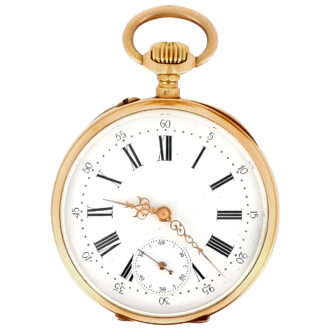
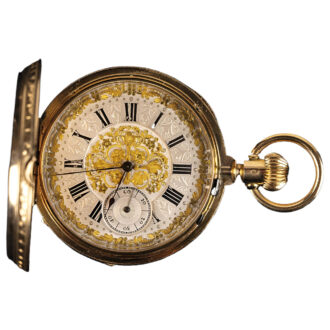
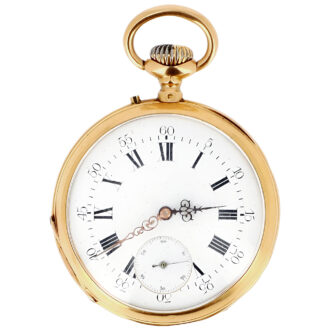
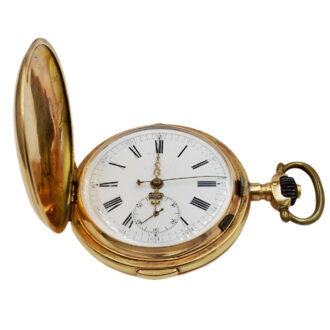
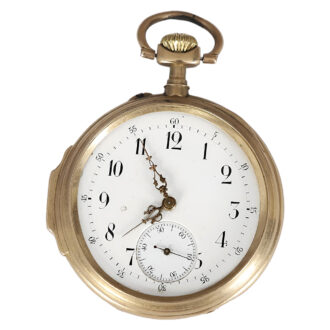
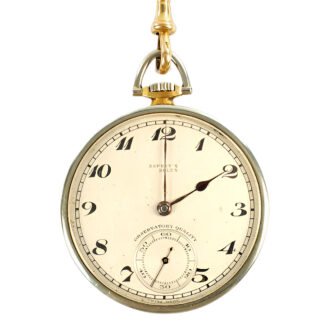
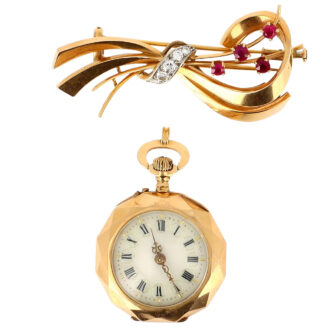
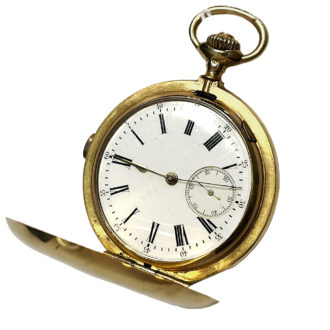
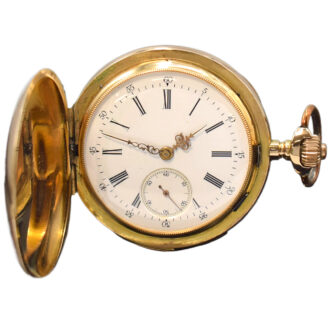
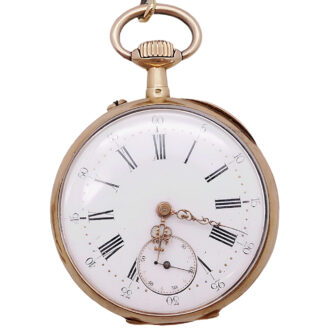
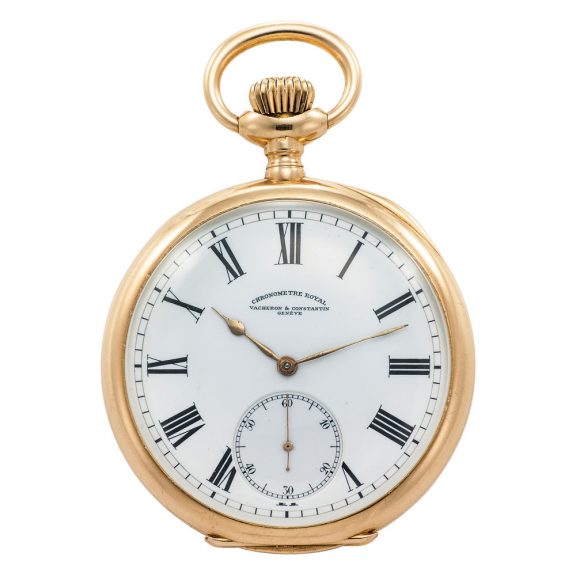
Swiss 18K gold keyless lever pocket chronometer Circa 1900
- Kenmerk
- BA2816
- Diameter
- 57 mm
- Estimate
- € 3.500 - 7.000
- Price sold
- € 3.850
Gold Chronomètre Royal by Vacheron & Constantin
–
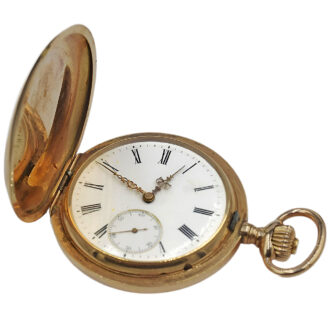
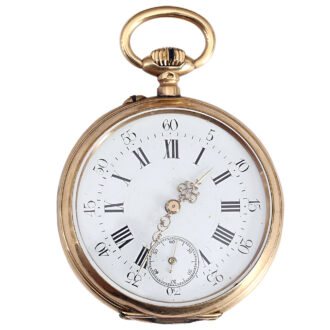
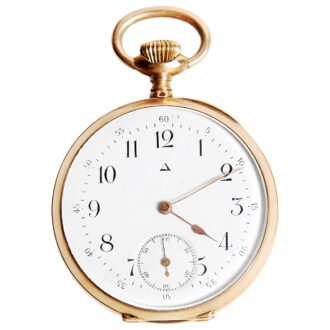
A very fine and rare, large-size Swiss 18 carat gold open faced keyless lever pocket chronometer, circa 1900. Frosted gilt movement, 18 jewels, wolf’s tooth winding, straight-line lever escapement, cut bimetallic compensation balance, blued steel Breguet balance spring, swan-neck micrometre regulator. A hinged gold cuvette. White enamel dial with bold Roman hours, outer minute divisions, large subsidiary seconds at 6 o’clock and partially replaced gold spade hands. The polished case with a sunray engine-turned back. Dial, case, cuvette and movement signed, case and movement numbered.
–
Diameter: 57 mm
–
Thickness: 17.5 mm
–
Signed: Chronomètre Royal Vacheron & Constantin Genève
–
The name Chronomètre Royal was registered on May 28, 1907, under the number 22193. Royal Chronometer, the name for the English-speaking market, was registered on May 8, 1908, under the number 23872. The first of these was a series of pocket watches delivered to Brazil. A. Campos, one of Vacheron & Constantin’s agents, had organized a lottery system in which subscribers would pay a monthly fee to take part in a series of draws. The holders of the winning tickets would be given a watch and the other subscribers would be entered into the next draw. This system proved to be so successful that Campos delivered a total of 3.022 watches between October 22, 1907 and December 31, 1911. An amazing 80% of the production of the Chronomètre Royal, utilizing the calibre RA22″‘ 73 made during this period. The Chronomètre Royal was made in several sizes, from 12 to 22 lines, it was housed mostly in gold cases and rarely in silver ones.
–
Jean-Marc Vacheron was born in 1731 and died in 1805. He founded a watch workshop in the Geneva district of Saint Gervais in 1755. In 1785 his son Abraham took over the then-still-small company. Their watches were favoured by the nobility, clergy and wealthy merchants. Sales deteriorated dramatically during the French Revolution and Abraham found himself confronted with numerous problems. According to tradition, he married and attached to his name, his wife’s surname. Thus the name of the workshop changed to Vacheron-Girod. At the beginning of the 19th Century, Abraham’s son Jacques Barthélemy Vacheron took over management of the company, which changed the name to Vacheron-Chossat. On numerous business trips to Italy, France and Germany, Jacques Barthélemy found new customers for their sophisticated products, including pocket watches with very flat movements for the time, hunting-cased watches and minute repeaters, built into expensive and elegant cases. In 1819, Vacheron brought in the son of a cloth merchant, François Constantin, as a partner to support the distribution of watches and the company became known as Vacheron & Constantin. Constantin had gained his first experience in the watch industry as a salesman for Jean-François Bautte and his exceptional abilities soon overcame the company’s previous financial difficulties. Sales figures rose significantly and Vacheron & Constantin began selling in New York by Jean Magnin and in New Orleans by Brey by 1830. In 1970 the ‘&’ was taken from the name, henceforth the company was called Vacheron Constantin. It is the oldest continually active watch manufacturer in the world. The brand logo is the Maltese cross. Today, Vacheron Constantin is part of the Richemont group.
Signed: Chronomètre Royal Vacheron & Constantin Genève
Share this page: