Historically important gold repoussé watch Circa 1744-1745
- Kenmerk
- BA0491
- Diameter
- 49 mm
- Estimate
- € 25.000 - 40.000
- Price sold
- -
Gold pair cased cylinder with symmetric repoussé decoration by Moser
–
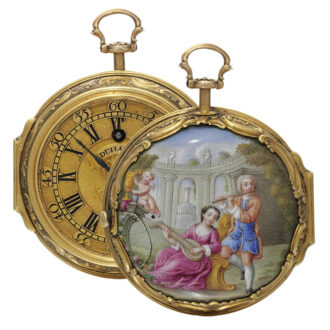
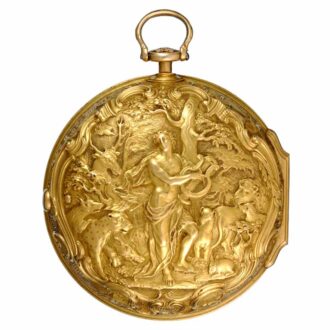
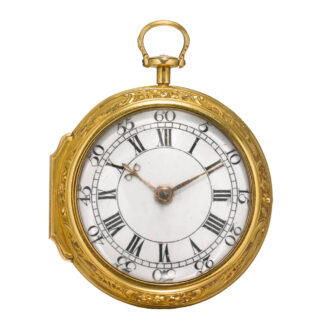
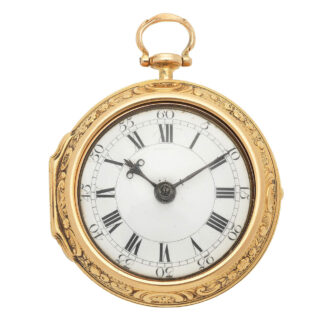
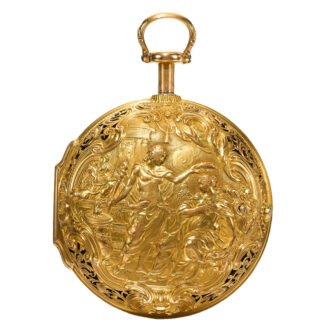
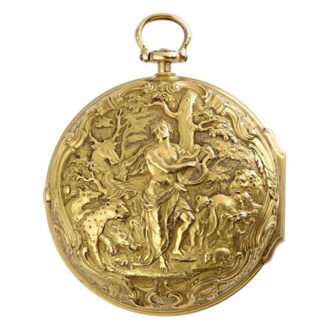
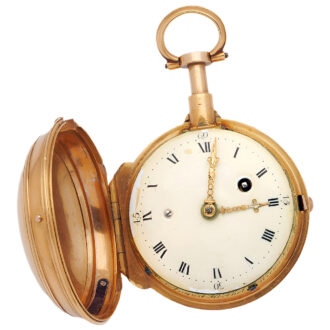
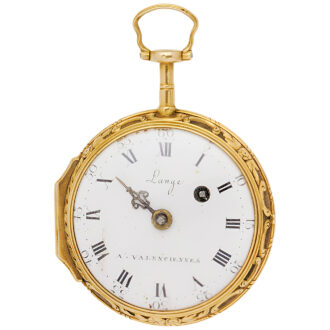
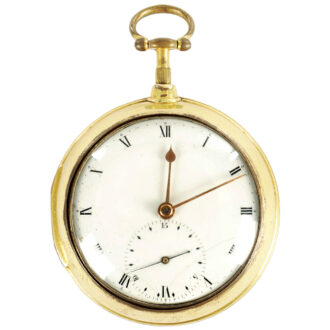
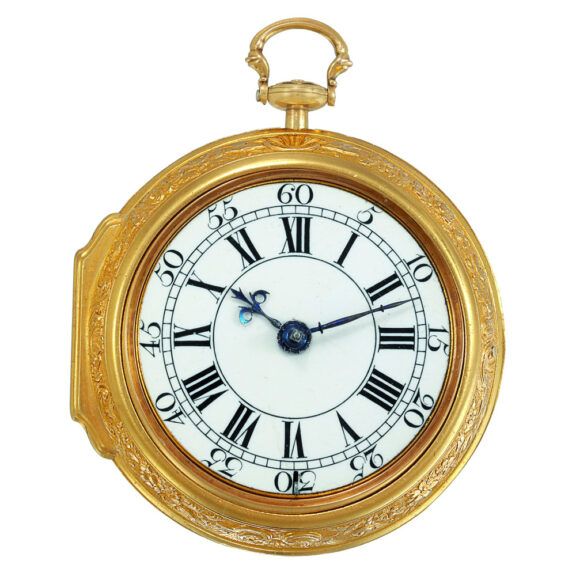
Very fine, exceptionally rare and historically important English 22 carat gold pair cased pocket watch with symmetric repoussé decoration by George Michael Moser, the earliest example of its type known to exist, London Hallmarked 1744-1745. Hinged gilt brass full plate movement with baluster pillars, fusee and chain, 12 toothed cylinder escapement, brass escape wheel, plain steel three armed balance, diamond endstone, single footed cock pierced engraved with foliate scrolls. White enamel dial with Roman chapters, an outer minute ring with Arabic five minutes and original blued steel beetle and poker hands. Outer case entirely with asymmetric rococo repoussé NSAS2ia cartouche depicting Venus Restraining Aeneas from Killing Helen, the frame with shell and scroll decoration separated by flowers at the N, E, S, W positions, the bezel matching the frame, the push with serpent surround, plain inner case, gilded dust cap. Movement and dust cap signed by Delander, an inner case with maker’s mark IW for John Ward, outer case with partially visible maker’s mark and G.(eorge) M.(ichael) Moser F.(ecit) in a cartouche.
–
Diameter: 49 mm
–
Signed: Delander London
–
NSAS: North-South Axis Symmetric according to the terminology used by art historians, this type of case design was considered to be the most difficult form of asymmetric symmetry to achieve and was divided into five different types. The case of this watch is a type 2ia, which means that the border comprises architectural motifs. This type of repoussé work was the favourite of Moser and was reserved for his best pieces due to its difficulty of execution. It is also a key factor in his being regarded as one of the greatest chasers of the 18th century due to the difficulty involved in laying out and executing what is, in essence, a mirror image border along the north-south axis. The use of this technique gave his central decoration, be it chased or enamelled, greater force and gave importance to the key figure in the decoration. This watch is one of only 20 pieces that exist today with this type of cartouche signed by Moser. It is also the earliest recorded example of a type ‘NSAS2ia’ cartouche by Moser and is often used as a comparison piece in literature to show the various attributes of Moser’s early work. The importance of the piece is further enhanced by the fact that it is the only recorded collaboration between Moser and Delander. The Delander who made this watch was likely Nathaniel Delander, the son of Daniel Delander, one of London’s best makers at the end of the 17th century, who was applying to be made Master of the Clockmakers’ Company. The watch is hallmarked for 1744-1745 would mean that the case was probably chased in early to late 1755, at which point symmetric cartouches were reserved for Moser’s best clients. This, combined with the fact that 60 percent of Moser’s production was reserved for four makers – Mudge, Graham, Webster and Ellicot, London’s top watchmakers of the day – suggests that this may well have been Delander’s Masterpiece for submission to the Clockmakers’ Company where he was made master at the end of the following year. An interesting side note is the choice of a serpent around the push-piece to open the case. Moser was, without doubt, warning the owner of the watch to open the watch with caution and to remain respectful of what the case contained.
Signed: Delander London
Share this page: