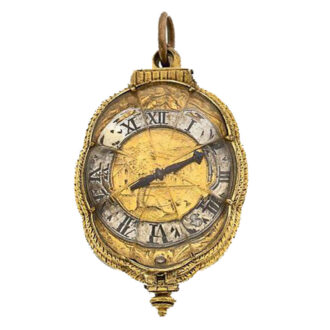
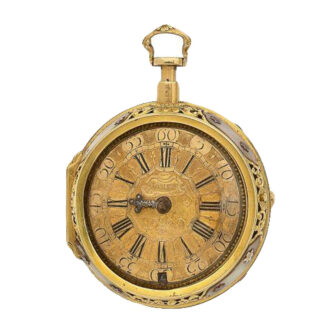
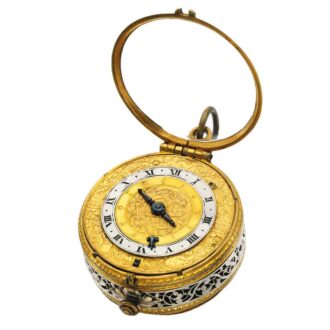
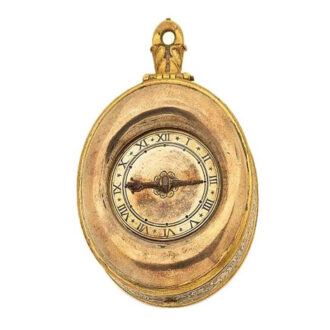
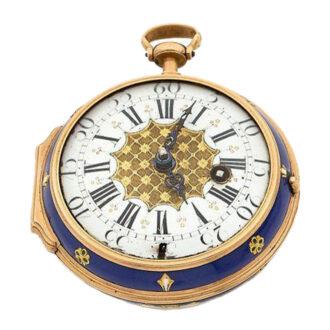
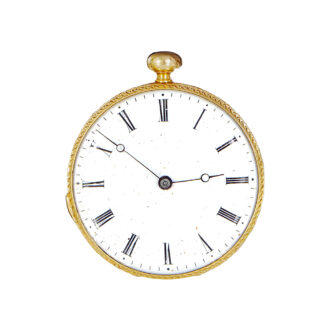
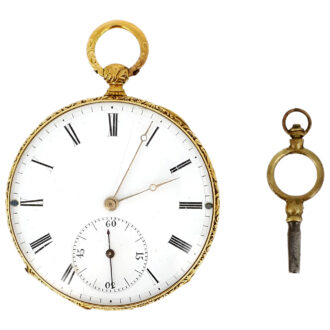
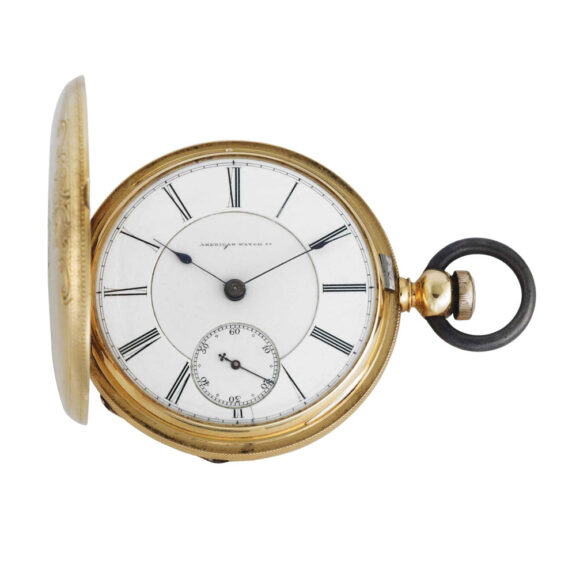
American 18 carat gold hunting cased lever watch Circa 1858
- Kenmerk
- CH0472
- Diameter
- 54 mm
- Estimate
- € 3.000 - 5.000
- Price sold
- € 2.050
Gold key wound lever watch by American Watch Co.
–
An American 18 carat gold hunting cased keywound lever pocket watch, circa 1858. Retailed by Appleton, Tracy & Co. Gilt finished 3/4 plate movement, some jewels carried in screwed gold chatons. Gold cuvette. White enamel dial with Roman numerals and subsidiary seconds. Engine turned case with open cartouche to the front lid, interior of back lid inscribed WARREN PACKARD, Nov. 20th, 1860. Case stamped ‘GW & Co.’, dial signed by watchmaker, movement signed by retailer.
–
Diameter: 54 mm
–
Signed: American Watch Co – Appleton Tracy & Co
–
Born on November 5th of 1863 in Warren, Ohio, James Ward Packard remains best known for the production of cars under his surname that were the finest luxury American vehicles of their day. His interest in mechanics though led not only to this and other creations but also to a deep and abiding love and appreciation of the finest of watchmaking efforts. To watch devotees Packard stands as an icon and Christie’s is honoured to present the following examples that helped to comprise a collection of legend.
–
Packard graduated in 1884 from Lehigh University with a degree in mechanical engineering. In this same year he went to work at Sawyer-Man shops and during this year filed his first patent for the Packard Electric Lamp. Over his lifetime he would receive at least 43 United States patents, 13 of which related to lamps. In 1890 upon returning to his hometown of Warren, James Ward Packard opened the Packard Electric Company with his brother William Doud Packard. The company and their productions were extremely successful allowing both for the opening of a second branch of the firm in Canada in 1894 and also the lighting of Warren, Ohio as the first city in the United States to operate incandescent bulb street lamps. Over time the company did change hands and eventually became incorporated into General Electric. The two brothers’ most famed collaboration would come with the founding of their automobile manufacturing company. In 1893, they formed Packard & Weiss under a partnership with George L. Weiss of the Winton Motor Carriage Company. The firm produced their first car, the ‘Ohio Model A’ in 1899 after Packard studied the motor plans of Daimler and Benz and the body-building methods of Levasseur in the aims to produce the top of the line automobile that he would become known for. By the following year the company was incorporated as Ohio Automobile Company which officially became the Packard Motor Car Company in 1902. The firm moved in 1903 to Detroit and at this time James Ward and William Doud focused on automotive electrical systems in production at their Packard Electrical Company. This division was purchased by General Motors in 1932 and was renamed Delphi Packard Electric Systems in 1995, later becoming wholly independent in 1999.
–
Up until World War II the Packard Motor Car Company remained renowned as one of the premier luxury car manufacturers in the world. During the war effort the Packard Company produced airplane engines under license from Rolls Royce. Unfortunately after the war Packard suffered, as did many other American car companies, as Ford and General Motors began a price war that ran many others out of business. The firm acquired the Studebaker Corporation in 1954 in an attempt to save the ailing company but the 3.5 million square foot Packard Plant was closed in 1956. The year 1958 saw the last automobile to be produced with a Packard nameplate.
–
James Ward Packard retired as Chairman of the company much earlier in 1915. He died on March 20th of 1928 after a three-year illness. His legacy includes not only his massive contributions to the field of engineering, lighting and automotives but also a substantial gift of $1.2 million to his alma mater of Lehigh University which in turn created the Packard Laboratory.
–
As relates to the field of horology, James Ward Packard stands as one of two American gentlemen, the other being Henry Graves, Jr., who supported, encouraged and demanded the production of the most exceptional and complicated of watches. Their ‘contest’ to acquire the most complicated of timepiece led to the great patronage of Patek Philippe and also Vacheron Constantin. Henry Graves, Jr. ultimately received the most complicated of watches of the day from Patek Philippe but Packard was provided by the company with 17 watches including ones each with ten and sixteen complications. Upon his death the majority of his watch collection was given to the Horological Institute of America which later became the AWCI (American Watchmakers-Clockmakers Institute).
–
This American Watch Company watch belonged to James Ward Packard’s father, Warren Packard.
Signed: American Watch Co – Appleton Tracy & Co
Share this page: