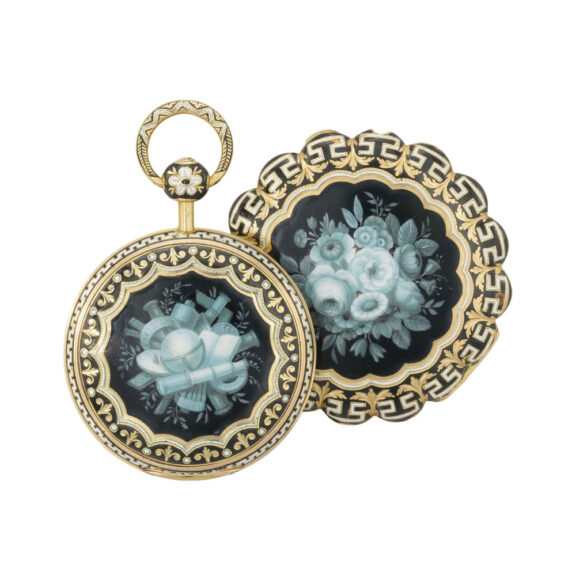
Swiss cabriolet watch made for the Turkish market Circa 1820
- Kenmerk
- CH0354
- Diameter
- 47 mm
- Estimate
- € 15.000 - 25.000
- Price sold
- € 20.000
Gold and enamel cylinder in pair cases
–
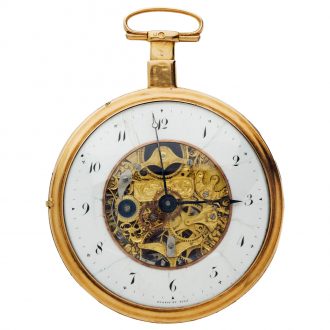
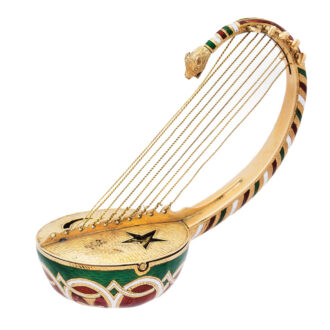
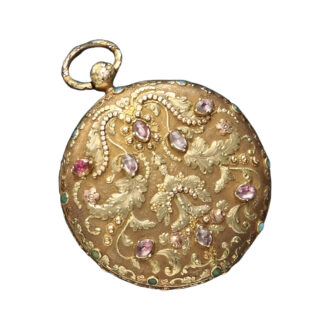
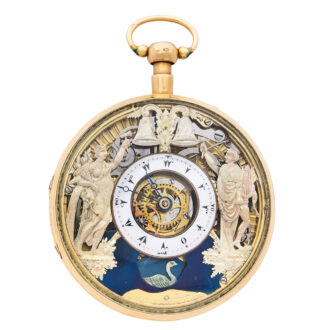
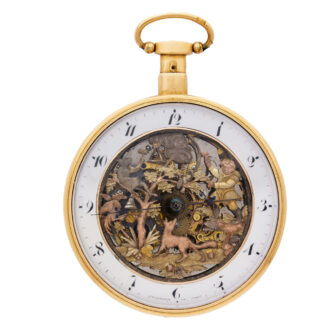
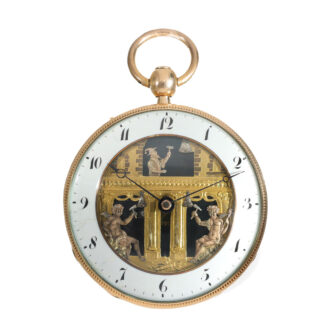
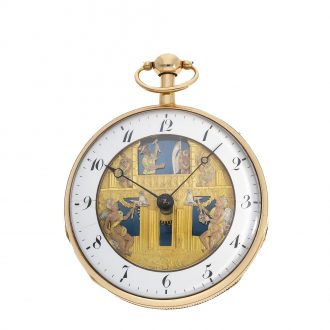
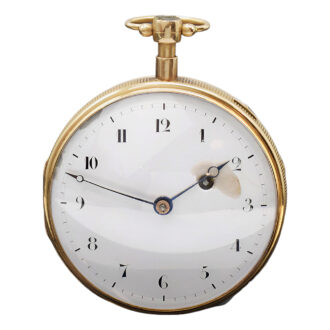
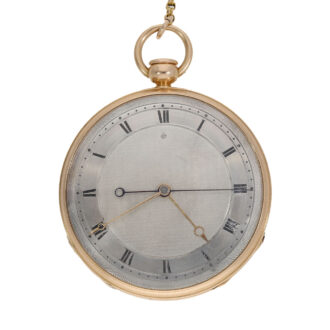
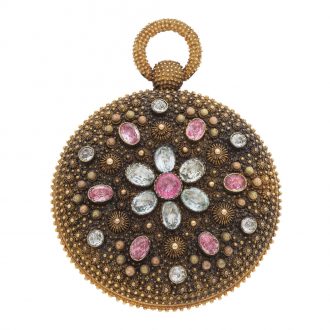
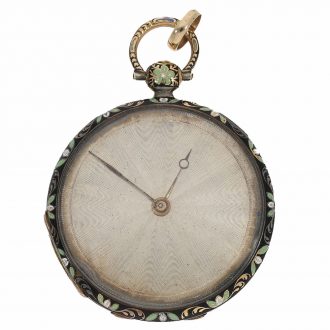
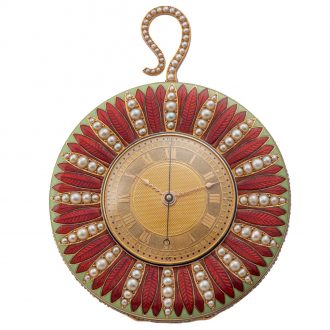
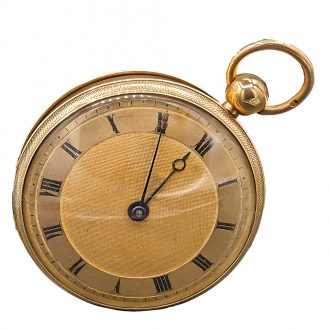
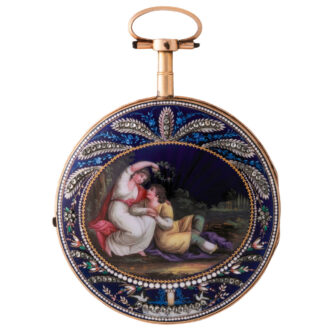
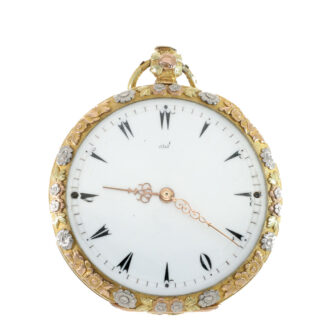
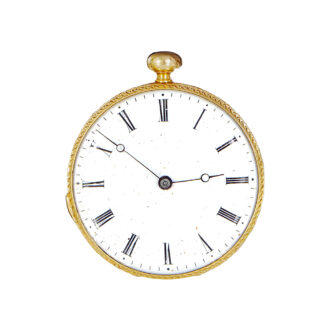
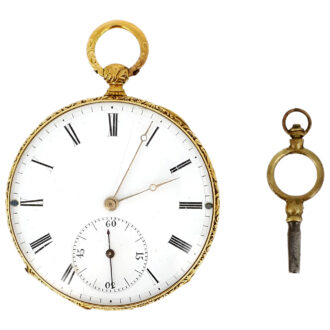
A very fine and rare Swiss 18 carat gold and enamel pair-cased cylinder cabriolet watch made for the Turkish market, circa 1820. Retailed by Le Roy, Constantinople. Possibly manufactured by Frères Melly, Genève. Gilt finished cylinder movement, plain three-armed brass balance. Black and white champlevé enamel scroll and foliage decorated cuvette. White enamel dial with Turkish numerals, gilt moon style hands, outer railway minute divisions. The inner case with a geometrical black and white champlevé enamel decorated bezel, rim and bow, floral decorated pendant, the reverse centred by a painted en grisaille enamel trophy of scientific instruments on black background, similarly decorated scalloped outer case, reverse centred by a painted en grisaille bouquet of flowers on black enamel background. Cases numbered and with case maker’s mark FM, dial signed with Le Roy’s Turkish signature.
–
Diameter: 47 mm
–
Signed: Le Roy
–
The first documented appearance of a watch in the Ottoman Empire dates back to 1531 when a Venetian purportedly reported that he had seen a gold ring with a watch bought by Sultan Süleyman I in Venice. This first manifestation of Ottoman interest in watches caused Western emissaries to present timepieces to the Sultans in order to obtain favours. Shortly after, local rulers and officials were equally bequeathed watches and clocks. The number of watches and clocks in the Empire further increased following an agreement made with Austria in 1547, stipulating the payment of a tribute comprising large sums of money, silver, ornaments and clocks to prevent Ottoman aggressions. Manufactured exclusively for the Ottomans, these watches and clocks progressively created a demand for timepieces in the region. Religion certainly played an important role as well. As Muslims, Ottomans were obliged to pray five times a day, and the determination of the prayer times was always a concern to religious leaders. As in medieval Europe where the first clocks are believed to have appeared in monasteries to help regulate the daily prayer services, the first clocks were used in the monasteries of the Mevlevi Dervishes in Istanbul.
–
During the 18th century, Swiss, French and English watchmakers started competing for the Ottoman market and opened branches in Constantinople. To match the local taste, timepieces were decorated with Islamic dials, enamel scenes depicting views of the Bosporus or religious motifs for example, and most importantly lavishly decorated cases. Such watches and clocks became a common feature in the palaces along the Bosporus. Correspondence between European watchmakers and trade included extensive lists of watches and clocks supplied to the Ottoman Empire. Certain Ottoman miniatures show ceremonies during which valuable gifts were given to the Sultan, such as watches and clocks. The nature of such gifts reflected the idealized values of the giver and the receiver, the value determined by status and prestige as well as political expediency and purpose. Symbols of luxury and richness, these sumptuous objects were highly embellished and studded with precious stones.
–
The renowned 20th century Turkish author Ahmet Hamdi Tanpynar writes in his novel The Time Regulation Institute: “The watch which is the most intimate friend of its owner, companion to the beat of his pulse at his wrist, a friend at his breast sharing all his joys and sorrows, heated by the warmth of his body and espoused by his organism, and the clock which stands on his table and experiences with him all the happenings of the time span which we call a day, both inevitably come to resemble their owner, and become accustomed to think and live like him.”
–
Examples of watches and clocks made for the Ottoman Empire are on permanent exhibition in Istanbul’s Topkapi Palace. The collection comprises over 300 timepieces dating from the 16th to early 20th century, many diplomatic gifts from Western countries, used in the palace harem and pavilions while the most valuable pieces were kept in the treasury.
–
Julien Le Roy is one of the clockmakers who contributed most to the progress and the reputation of French watch- and clockmaking. Born in Tours on August 6, 1686, and died in 1759 in Paris. He came to Paris in 1699. In 1713 he achieved his master’s degree and in the following years, he became a jury member of the Paris Guild of Watchmakers. Later, Le Roy became director of the Société des Arts de Genève and, in 1739, Court Watchmaker (French Horloger Ordinaire du Roi) under Louis XV, he had his private quarters in the Louvre. He improved almost all branches of clockmaking and many important inventions in the realm of time measurement are owed to him. In 1717, Julien Le Roy presented an equation clock to the Royal Academy of Sciences which showed the true time, the place of the sun and its decline. His most important discoveries concerned watch mechanisms. The adjustable ‘potence’ for the verge escape wheel considerably improved the escapement’s functioning and the steel end-piece (coqueret) which allowed oil to be retained in the balance pivots in order to diminish frictional force, was quickly adopted by other watchmakers. He was the inventor of dumb repeating watches too, in 1740, he created a new arrangement that allowed the area allotted to the repeating work to be enlarged. This invention, called ‘à bâte levée’, was also adopted by his fellow clockmakers. In 1755 he invented a small anchor escapement used as a regulator for the repeating train. He contributed to the Encyclopédie by writing several articles on clockmaking together with his son Jean-Baptiste, the Academician. Le Roy ran his workshop in the Rue de Harlay in Paris until his death. Examples of his timepieces can be found in various important museums around the world, such as the Louvre and the Victoria and Albert Museum.
–
A pair-cased cabriolet watch. The cases of this type of watch are made in such a way that the inner case can be turned into the outer case so that the watch can be used either as an open faced or as a hunting cased watch. The purpose of the reversible case is to protect the glass and the dial from impact when wearing the watch, for ladies tied to a chain around the neck, for men in the pocket, especially during intense or vigorous activities.
–
A grisaille (en grisaille), or grey painting, is a painting in which one does not apply natural colours but restricts oneself to depicting things in all possible shades of the same colour, usually grey or brown.
Signed: Le Roy
Share this page: