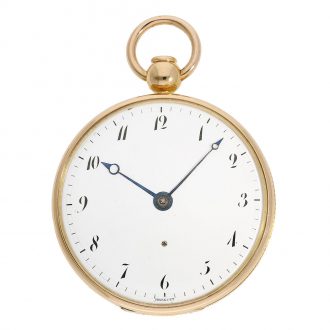
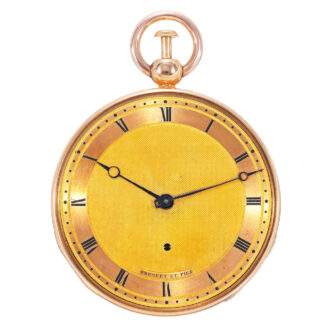
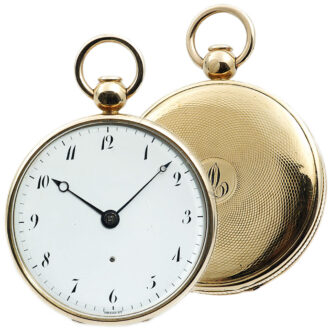
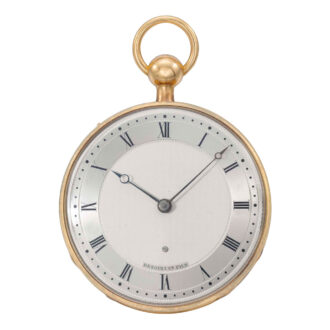
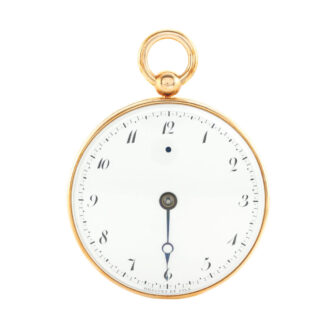
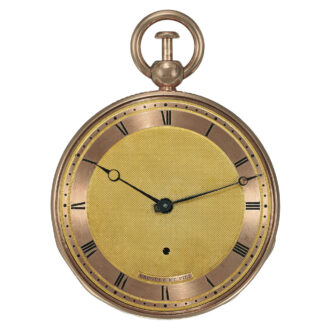
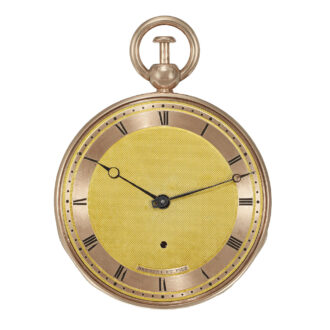
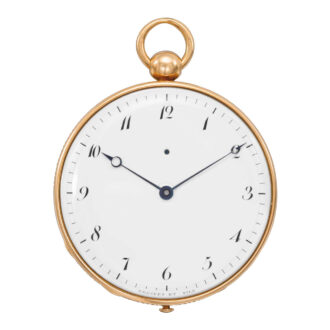
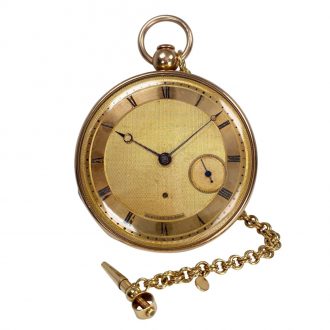
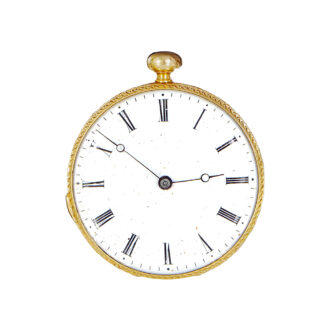
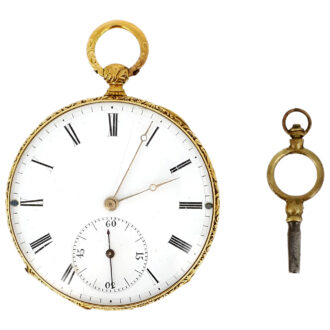
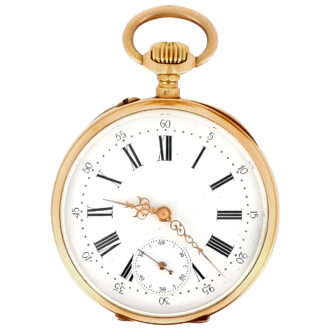
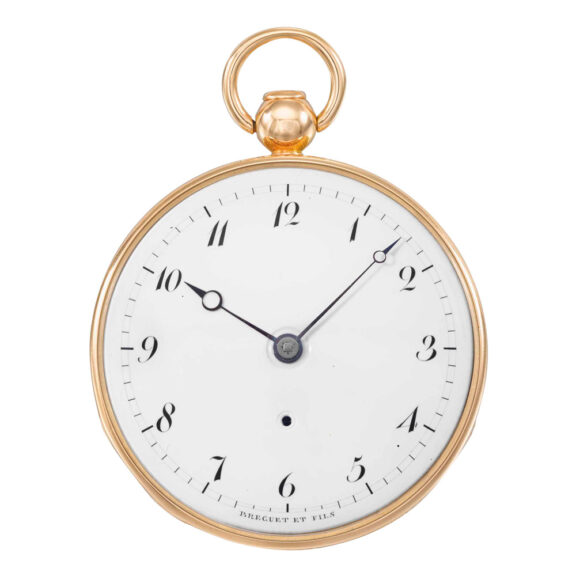
French gold à toc quarter repeating cylinder watch Circa 1807
- Kenmerk
- CH1723
- Diameter
- 53 mm
- Estimate
- € 17.500 - 35.000
- Price sold
- € 31.200
Gold open faced repeating key-wound pocket watch by Breguet
–
A fine French 18 carat gold open faced à toc quarter repeating keywound cylinder watch, circa 1807. Montre à répétition à quarts. Sold to Count Stanislas Potocki on 31 December 1807 for the sum of 1,320 Francs. Gilded ruby cylinder movement, plain three-armed brass balance, parachute suspension on the top pivot, blued steel flat balance spring with bimetallic compensation curb on the regulator, à toc quarter repeating on two hammers onto two blocks in the case. Gilt cuvette. White enamel dial with Breguet numerals, secret signature 2161 Breguet below 12 o’clock and blued steel Breguet hands. Case with ribbed band, quarter repeating pull-twist push-piece in the pendant. Case No. 1454 by Jean-Louis Joly, cuvette signed Breguet No. 2161, dial signed Breguet et Fils and with secret signature below 12.
–
Diameter: 52.5 mm
–
Signed: Breguet et Fils
–
A superb example of timepieces made by the workshops of Abraham-Louis Breguet (1747-1823) and his successors, widely acknowledged for having set the standard by which all fine watchmaking has been judged ever since. Abraham-Louis Breguet was born in Neuchâtel, Switzerland, but it was in Paris that he spent most of his productive life. No aspect of watchmaking escaped his study, and his inventions were as fundamental to horology as they were varied. His career started with a series of breakthroughs: the development of the successful self-winding perpétuelle watches, the introduction of the gongs for repeating watches and the first protection for balance pivots. Louis XVI and his Queen, Marie-Antoinette, were early enthusiasts of Breguet’s watchmaking. Each watch from his workshops demonstrated the latest horological improvements in an original movement, mostly fitted with lever or ruby cylinder escapements that he perfected. Breguet took refuge in Switzerland from the excesses of the French Revolution. He returned to Paris overflowing with the ideas that produced the Breguet balance spring, his first carriage clock (sold to Napoleon Bonaparte), the ‘sympathique’ clock and its dependent watch, the tact watch and finally the tourbillon, patented in 1801. Breguet became the indispensable watchmaker to the scientific, military, financial and diplomatic elites of the age. His timepieces ruled the courts of Europe. For his most celebrated clients, Breguet designed exceptional timepieces. For Caroline Murat, queen of Naples, conceived in 1810 the world’s very first wristwatch. Honours saluted his enormous contribution to horology. Appointed to the Board of Longitude and as chronometer maker to the navy, he entered the Academy of Sciences and received the Legion of Honour from the hands of Louis XVIII. When he died in 1823, all mourned the architect of the greatest revolution in the science and art of timekeeping.
–
Count Stanislas Kostka Potocki (1755 -1821). The Polish nobleman, politician, writer, collector and patron of the arts was one of the most emblematic figures of the Age of Enlightenment in his country. A member of an old noble Polish family and son of General Eustachy Potocki, Stanislas was educated at the Warsaw Collegium Nobilium before studying literature and the arts in Wilanow. On 2 June 1776, he married Princess Aleksandra Lubomirska, the daughter of Stanislas Lubomirski, a Grand Marshall of the Crown, also one of Breguet’s faithful clients. In 1792, he became a General of the Army, participating in the Russo-Polish war of 1792, for the defense of the constitution of 3 May 1791. Count Potocki furthermore held the knighthood of the White Eagle and the Saint Stanislas Merits and was Great Master of the Polish Freemasons. From 1792 to 1797, he lived abroad, having left his country after its first dismemberment. He was arrested in Carlsbad after the uprising of Kosciuszko, and then lived in captivity for eight months in Josephstadt. When the Great Duchy of Warsaw was created he became the Senator Palatine, Head of the Council of State and of the Council of Ministers. Napoleon made him Minister of Culture and Education, and he retained these posts even after the annexation of the Polish Kingdom by Russia in 1815. Potocki founded the University of Warsaw in 1816 and was elected President of the Senate in 1818, a post which he held until 1820. An art lover and avid collector, he devoted his fortune to promoting literature, sciences and arts, and built up a beautiful collection of paintings, Etruscan vases and engravings in his home, Wilanow Palace. In 1805, in a visionary move, Potocki opened his art collection and a portion of the castle to the public, thus making Wilanow one of Poland’s earliest museums. Count Stanislas Polocki died on 14 September 1821 and was buried at Wilanow.
Signed: Breguet et Fils
Share this page: