Rare German Mammoth bone verge pocket watch Circa 1900
- Kenmerk
- TA5431
- Diameter
- 55 mm
- Estimate
- € 7.500 - 15.000
- Price sold
- -
Mammoth bone verge hunter
–
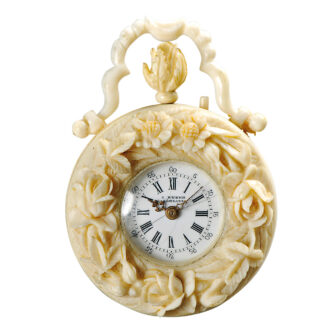
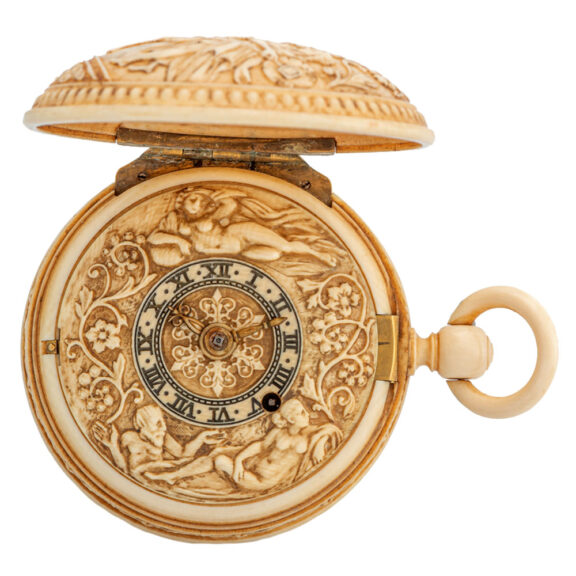
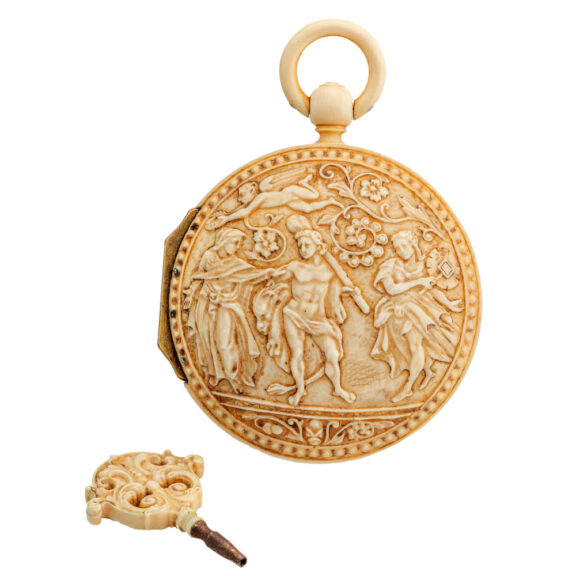
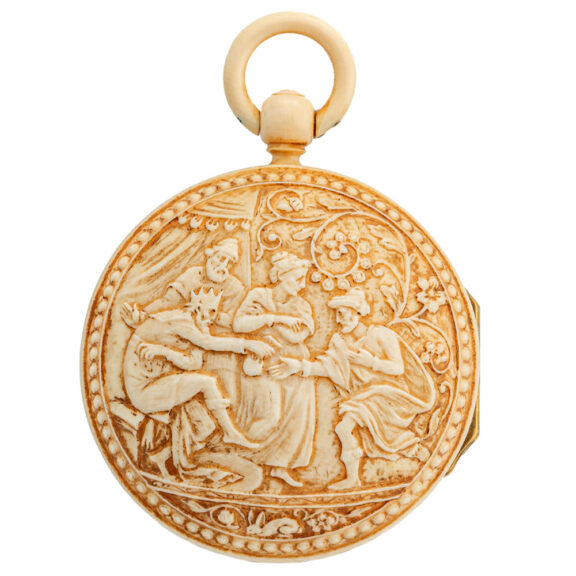
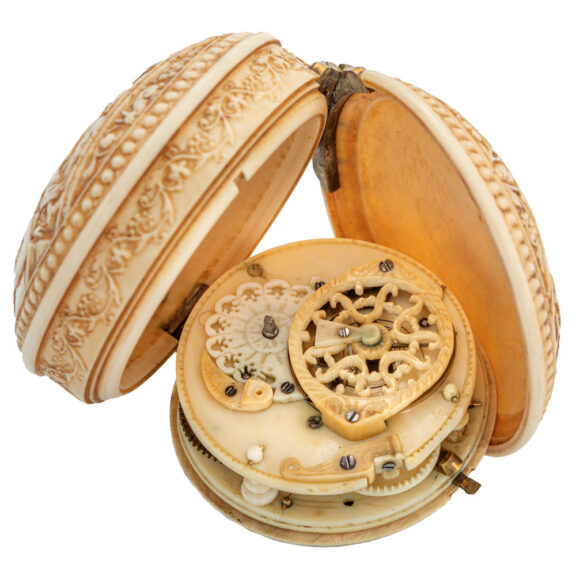
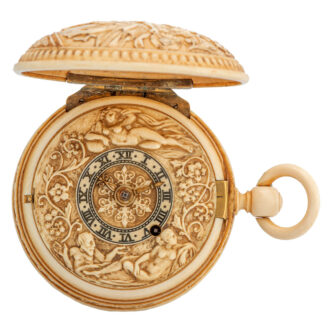
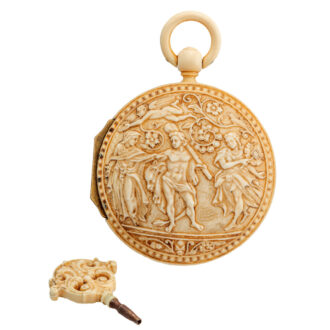
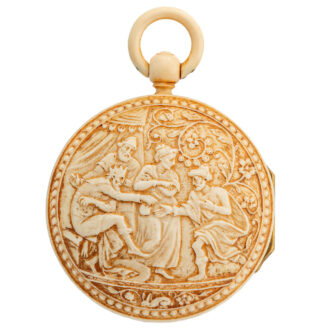
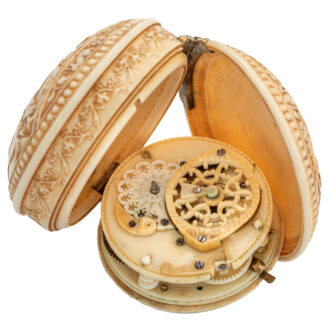
A very rare German Mammoth bone hunting cased keywinding pocket watch, circa 1900. The cover, the case back and the case band are entirely carved in high relief. On the cover, a scene showing Hercules wearing the skin of the Lion of Nemea and holding his olive wood club on his shoulder, standing probably between Omphale and a servant. On the case back, Judas Iscariot receives the price of betrayal, on the case band, a garland of foliage and flowers. A bone dial with radial Roman numerals, the outer part carved in high relief with a scene showing a satyr ogling a beautiful nymph lying naked and bone Poker & Beetle hands. A full plate movement, principally made of bone, baluster pillars, fusee and chain, verge escapement, monometallic balance with three arms and blued steel flat hairspring, pierced and engraved Louis XV continental cock, regulator disc.
–
Diameter 55 mm
–
Signed: No Name
–
Accompanied by the original winding and setting key (bone and iron).
–
At the turn of the 18th and 19th centuries, in Central Europe, a few watches were produced with movements made entirely of bone (with the exception of a few elements made of brass). Of this production, one watch is known bearing a signature, that of Joh. Zeidler in Kraslice (German: Graslitz), a town in the Sokolov district, in the Karlovy Vary region of the Czech Republic: The latter was certainly made as a gift for Empress Josephine, Napoleon’s wife, the cock being pierced and engraved with her coat-of-arms. The Zeidler watch has a cock with the arms of the Romanovs, the Russian imperial family. All three watches have very similar gold cases and suggest that they were produced in the same region.
–
The watch we are proposing today has a movement of the same kind, with a cock in a Louis XV spirit. On the other hand, the case of this one lets us glimpse a German realisation of the end of the 19th century in a revival spirit. In the second half of the 19th century, a few watches with movements also made entirely of bone were produced in Russia. They were the work of the Bronikoff (or Bronnikov workshop, which also produced numerous watches in boxwood (examples are now kept in various Russian museums and in the collections of the Patek Philippe Museum in Geneva and the Das Museum der Zeitschau Beyer in Zurich).
Share this page: