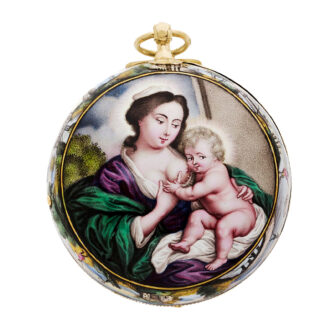
Important German gold and enamel verge pendant watch Circa 1670
- Kenmerk
- TA2779
- Diameter
- 34 mm
- Estimate
- € 35.000 - 60.000
- Price sold
- € 36.000
Gold single handed pendant watch
–
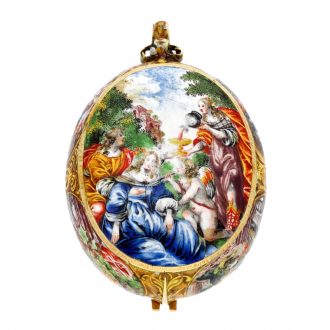
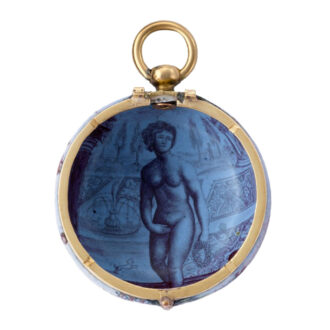
An extremely fine and important German 18 Carat gold and enamel pre-balance spring single-hand pendant watch, circa 1670. The enamel paintings were copied from engravings by Otto van Veen from Quinti Horatii Flacci Emblemata, third edition, 1612.
–
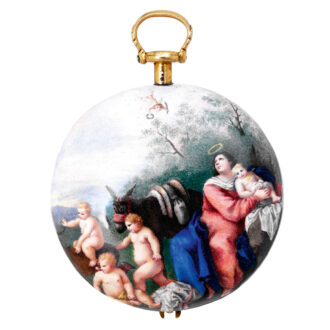
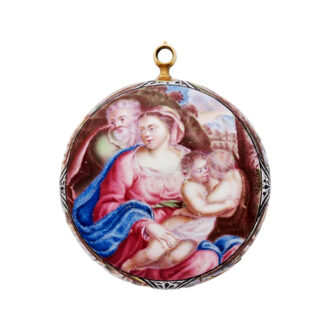
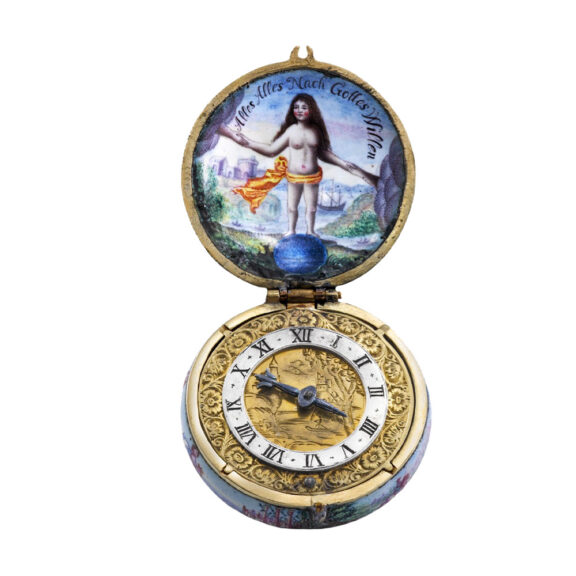
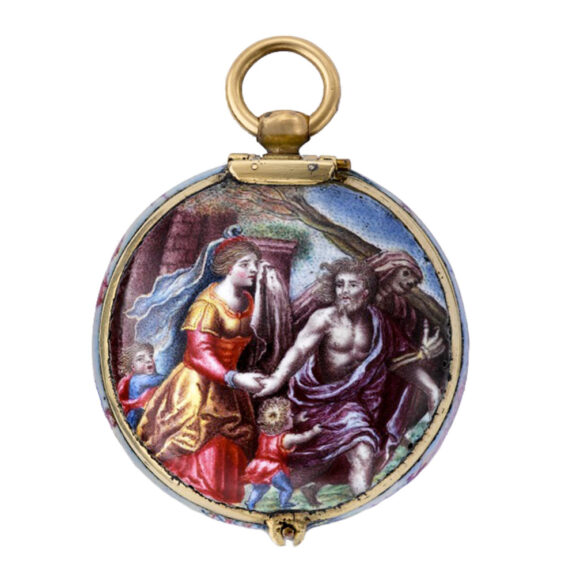
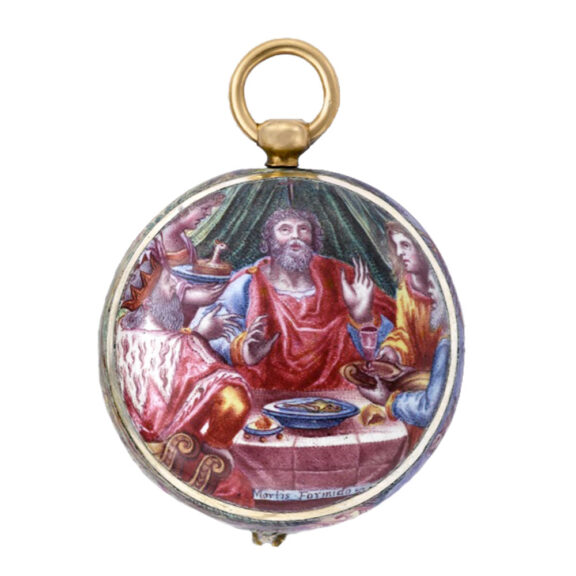
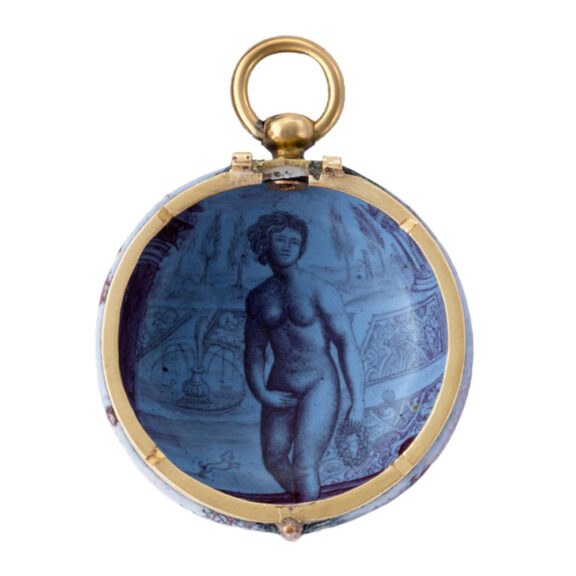
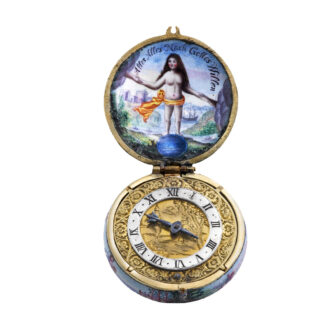
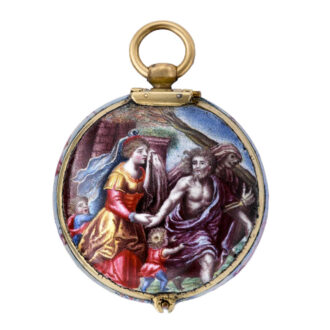
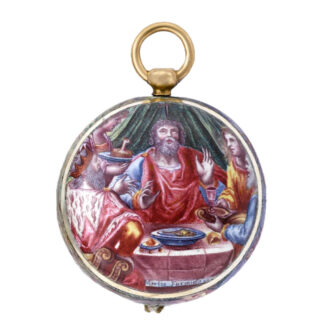
The front cover with a polychrome enamel scene depicting a man being led away from his family by Death, a banner below saying Morte Linqunda Omnia (through death you must leave everything), a painted bare breasted young woman standing on a globe on the interior representing consolation and admonition, her hands held by two hands issuing from the clouds, in the background a castle on the coast and the motto Alles Nach Gottes Willen (all by the will of God), the band decorated with maritime and hunting scenes, the back showing a scene of Damocles at the feast of Dionysios and a banner with Mortis Formido (fear of death), the interior with a very finely painted monochrome turquoise enamel portrait of the naked Venus in the mannerist style, a formal garden in the background.
–
Fire gilded dial, finely engraved border with flowers and foliage, the centre engraved with a castle in a river landscape, applied silver chapter ring with radial Roman hours, half hour divisions and a blued steel single tulip hand. Matte gilt full plate movement, fluted vase pillars, fusee with gut line, verge escapement, steel foliot balance without spring, pierced and engraved cock with small foot secured by a screw, worm and wheel setup with steel brackets and silver scale.
–
Diameter: 34 mm
–
Signed: No name
–
The dial is patinated.
–
The present watch is the earliest known example of a German watch with a painted enamel case. It is also a masterpiece of 17th century enamelling and is very likely to have been made in Augsburg, probably by one of the highly skilled French protestant enamelists who were persecuted in France under Louis XIV and emigrated to Switzerland, Germany, England and Holland during the last quarter of the 17th century. Those enamelists who emigrated to Germany set up workshops in the famous clock making centre of Augsburg and later in Berlin. The scenes of Damocles at the feast of Dionysios and Morte Linqunda Omnia are taken directly from engravings by Otto van Veen from Quinti Horatii Flacci Emblemata of 1612.
–
Otto van Veen (also Vaenius) was born in Leiden in 1556, he was trained as a painter. In 1572 he fled with his family to the southern Netherlands. He studied under Dominicus Lampsonius in Liege, after which he left for Italy for a period of five years. He returned to Liege before moving to Brussels and finally settling in Antwerp. He became the leading painter in Antwerp, and Rubens was one of his pupils. He produces books of engravings including Horatii Flacci Emblemata, Amorum Emblemata and Amoris Divini Emblemata. These engravings were used for copying by other artists, notably those engaged in copying in miniature for enamels. In 1612 he was appointed Master of the Archducal Mint. He returned to Brussels in 1615 where he died in 1629.
–
The Quintus Horatii Flacci Emblemata was printed in two separate editions in 1607, published by Jérôme Verdussen. The first contained Latin texts by classical authors, particularly Horace with allegorical engravings and the second edition contained Dutch and French quatrains alongside Latin, this collection of texts and engravings were recognizable as emblems. The third edition of 1612 had additional texts in Spanish and Italian.
–
Venus is the Roman goddess of love, originally the ancient Italian goddess of vegetation, and protector of gardens and vineyards. Later she was identified with the Greek Aphrodite. She was born from the foam of the sea. Venus was often depicted in Roman culture as a woman with a round object in her hand, for example, an apple or a mirror, but sometimes also with Cupid (the Roman god of love) or Victoria (the personified Roman goddess of victory) on her hand and also with a rudder or a dolphin. She was a favourite subject for many artists in antiquity too.
–
Damocles, literally ‘Fame of the Men’, was a courtier of Dionysius the Elder, tyrant of Syracuse, in ancient Greece.
–
Dionysius I or Dionysius the Elder, circa 432 until 367 BC, was a Greek tyrant of Syracuse in Sicily. He conquered several cities in Sicily and southern Italy and made Syracuse the most powerful of the Western Greek colonies. He was regarded by the ancients as an example of the worst kind of despot. Cruel, suspicious and vindictive.
Share this page: