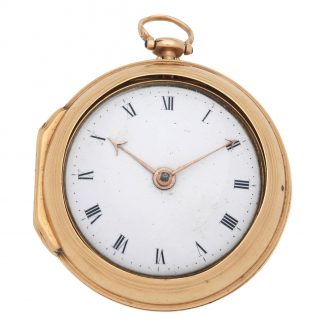
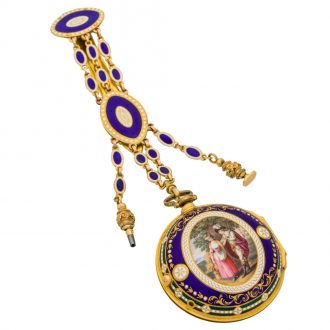
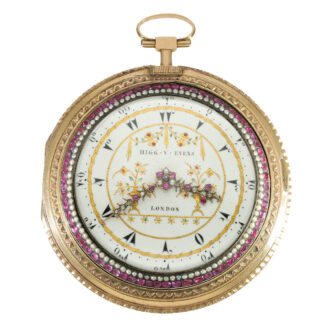
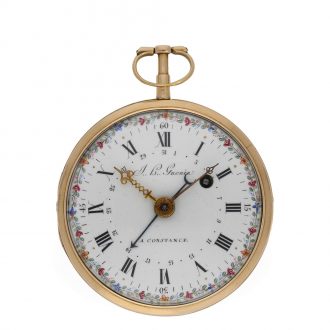
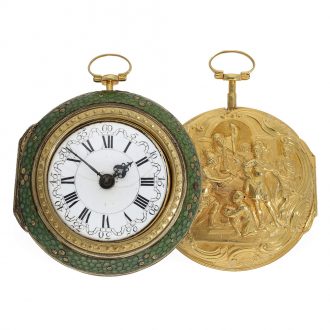
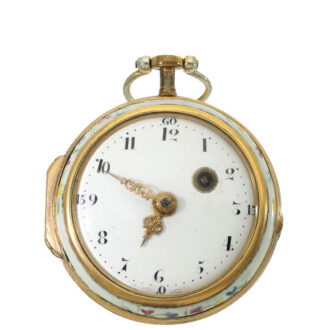
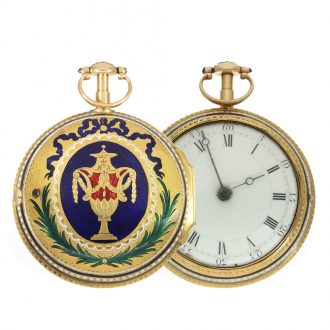
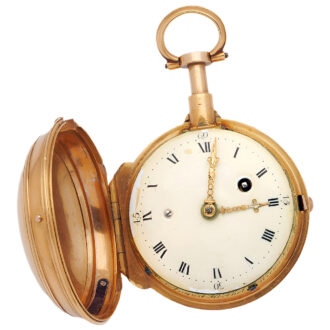
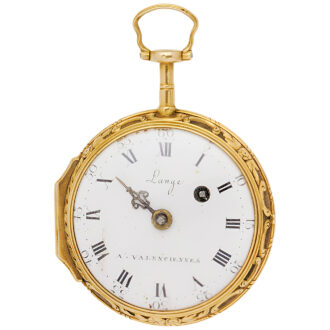
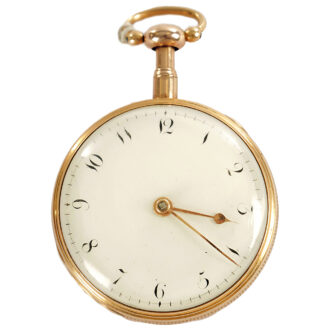
German/English gold and enamel verge watch Circa 1670/1780
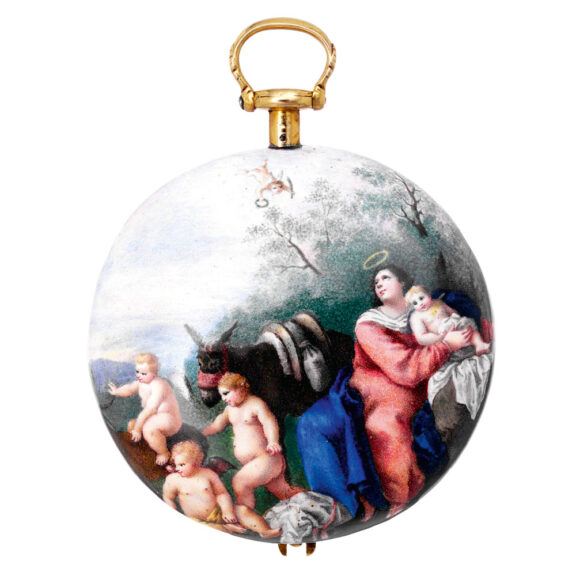
- Kenmerk
- BA1607
- Diameter
- 49 mm
- Estimate
- € 8.000 - 16.000
- Price sold
- € 7.900
Gold and enamel open faced pendant watch
–
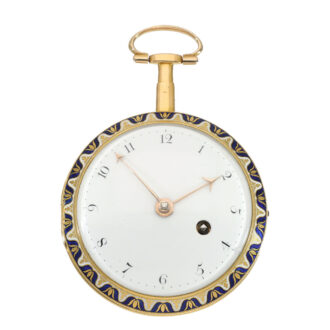
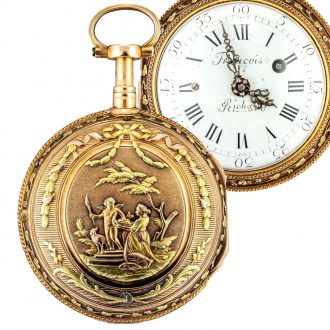
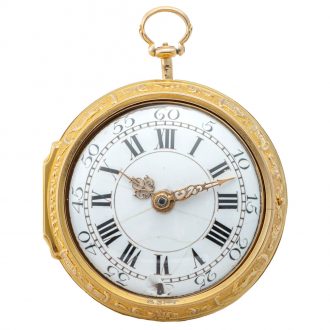
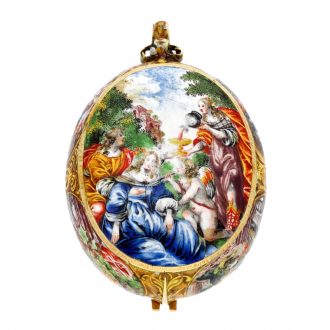
A very fine, important and unusual German/English 20 carat gold and enamel open faced key-wound verge pendant watch, circa 1670 and 1780. Frosted gilt full plate movement with cylindrical pillars by Isaac Phelippon, fusee and chain, verge escapement, plain steel balance with flat balance spring, single-footed cock. White enamel dial with painted Roman hours, outer minute track with five-minute Arabic numerals and a winding aperture at 4. Case possibly Augsburg, rounded edge, hinged gold bezel decorated with foliage, the case back with a finely painted enamel scene depicting the rest on the flight into Egypt with the Madonna and Child, a donkey, a goat and two angels, the inside painted with a rural landscape. Movement signed.
–
Diameter: 48.5 mm
–
Signed: Isaac Phelippon London
–
The case features an unusual technique of enamel painting reminiscent of the German school, especially that of Augsburg. The disposition of the enamel scene, without the ring dividing the back from the band, which was typically present during the second half of the 17th century, is also unusual. It was a common practice in the 18th century to replace the movement in a particularly expensive or beautiful watch case, to take advantage of technological advances in horology. Examples can be found in numerous museums and private collections.
–
Enamel is a form of glass. Its base is a colourless compound called flux, which is a combination of silica (obtained from fine white sand), lead, potassium or sodium salts, lime and borax. By varying the proportions of these components, different degrees of hardness and resistance to the environment can be achieved. The metals most suitable for enamelling are gold, copper, silver, and platinum. The colour effects are created by the addition of metal oxides, which give various hues. The enamelling of watch cases was usually practised on gold and copper. The few surviving watches from the 16th century and the vast majority of those from the 17th century are almost always made of high-carat gold.
Signed: Isaac Phelippon London
Share this page: