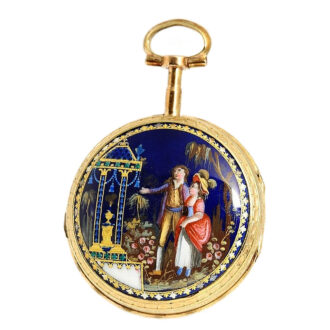
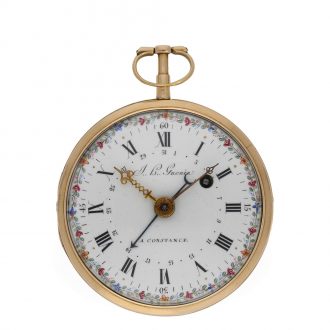
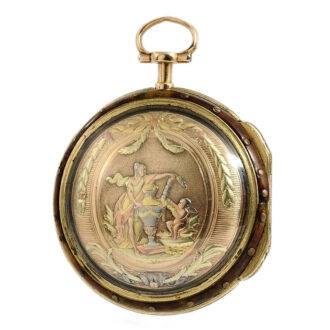
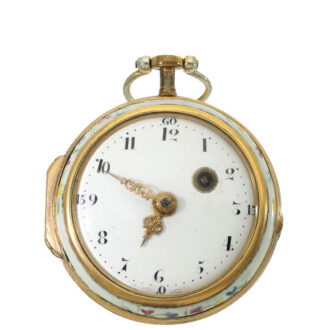
German 18 carat gold and lapis lazulli verge watch Circa 1780
- Kenmerk
- FF0039
- Diameter
- 44 mm
- Estimate
- € 7.000 - 14.000
- Price sold
- € 10.000
Gold and lapis lazulli watch by François Poncet
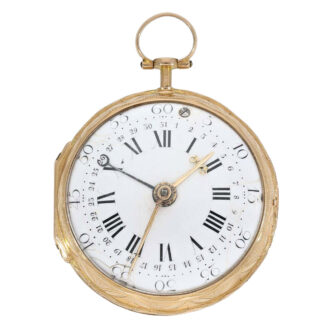
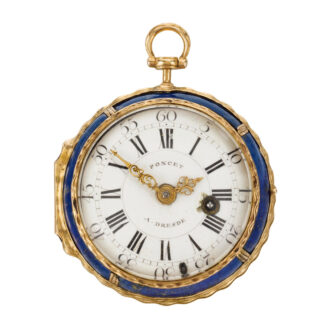
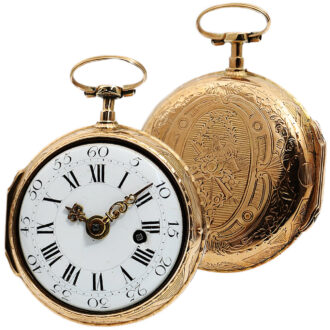
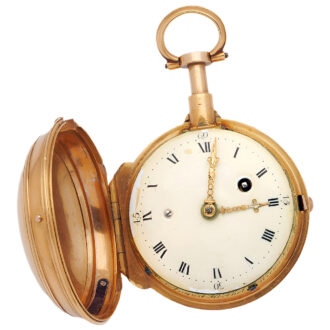
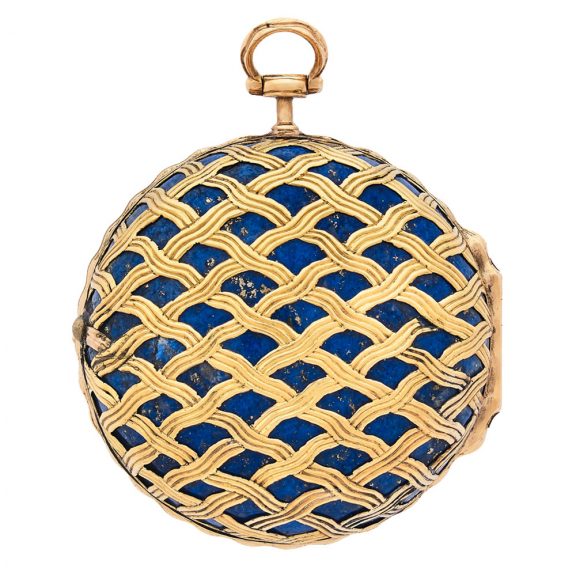
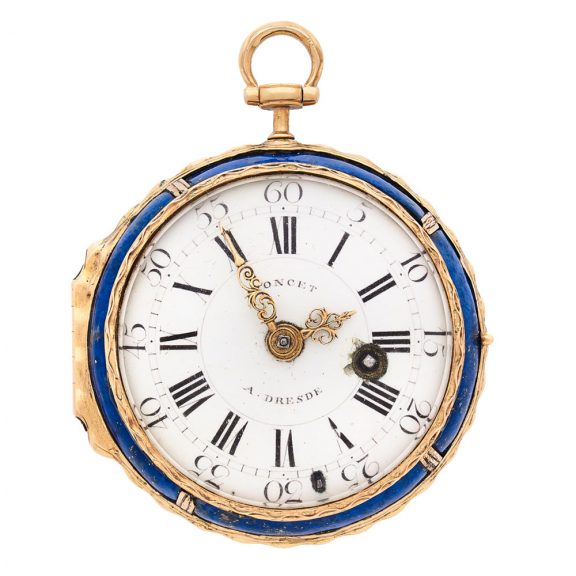
A German 18 carat gold and lapis lazuli pocket watch with goldsmith’s work in the style of Johann Christian Neuber at the court of Saxony, circa 1780. Full plate gilt movement with key winding, verge escapement, pierced and engraved balance cock, blued balance spring, fusee and chain, adjustment disc, stylized pillars between the two plates, signed Poncet à Dresden.
White enamel dial with Roman numerals for the hours and Arabic numerals for the five minutes, decorative gilt hands and railroad minute track, opening for the winding square, signed Poncet à Dresden.
Round case on hinge mounted in lapis lazuli with chased gold mounts with a wavy basket motif, the bezel set with lapis lazuli plates interspersed with gold motifs.
–
Diameter 44 mm
–
Weight. 69.5 gr.
–
Signed: Poncet, Dresde
–
Jean Francios Poncet, Harrow and later Dresden, born 1714-died 1804 Court Clockmaker to Princes of Saxony & Kings of Poland.
This very fine watch is one of the few known examples with a lapis lazuli case. In the second half of the 18th century, Dresden was famous for the production of incredibly fine precious objects that combined the art of the lapidary and the goldsmith.
Among the examples of precious objects at the Saxon court in Dresden is the work of a master goldsmith Johann Christian Neuber (1736-1808) who inspired a generation of master goldsmiths thereafter, which explains our lapis lazuli case.
Johann Christian Neuber (1736–1808)
Johann Christian Neuber (1736-1808) was a renowned German goldsmith and lapidary from Neuwernsdorf, Saxony, from 1775 he was appointed court jeweller to Frederick Augustus III of Saxony.
He is particularly known for his hard stone creations, including his famous “box-cabinets” or “Steinkabinett-Dosen,” which incorporate mosaics of local gemstones.
Works and innovations
Neuber is famous for his gold boxes decorated with mosaics of local gemstones, called “Steinkabinett-Dosen.”
These boxes were often accompanied by a booklet detailing each stone used, making the object a veritable portable mineralogical cabinet.
He also collaborated with the Meissen porcelain factory to create pieces combining porcelain and gemstones.
Neuber’s works in museum collections
Neuber’s works are held in prestigious museums, such as the Louvre in Paris and the Victoria and Albert Museum in London.
His work reflects the elegance and refinement of 18th-century Saxon goldsmithing, combining art, science, and craftsmanship.
Johann Christian Neuber remains an iconic figure in European goldsmithing, having brilliantly combined the beauty of local gemstones with exceptional artistic creations.
Jean François Poncet (c. 1720 – 1789)
Jean François Poncet (c. 1720-1789) was a renowned 18th-century Swiss clockmaker, known for his work in Saxony and Poland.
Biography and career
Born in Geneva, Poncet trained as a clockmaker in his hometown, which was renowned for its excellence in this field. In 1735, he moved to Warsaw, Poland, where he worked for the royal court.
In 1748, he moved to Dresden, Saxony, where he was appointed court clockmaker to King Augustus III of Poland, also Elector of Saxony.
He became inspector of the Grünes Gewölbe (Green Vaults), the treasury of the Saxon court.
Contributions to watchmaking
Innovations: Poncet is known for his high-precision watches and ornate clocks, often decorated with precious stones and enamels.
Style: His creations reflect the Rococo style, with particular attention to detail and aesthetics.
Poncet’s watches in museum collections
Jean François Poncet’s watches are held in prestigious museums, such as the Musée des Arts Décoratifs in Paris and the Victoria and Albert Museum in London.
His work influenced European watchmaking, notably through the introduction of innovative techniques and refined designs.
Jean François Poncet remains an emblematic figure of 18th-century watchmaking, having successfully combined technical precision and elegant aesthetics in his creations, such as this example with this extremely rare lapis lazuli case.
Signed: Poncet A Dresde
Share this page: