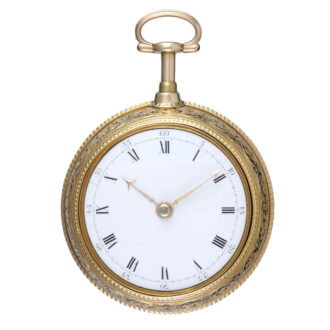
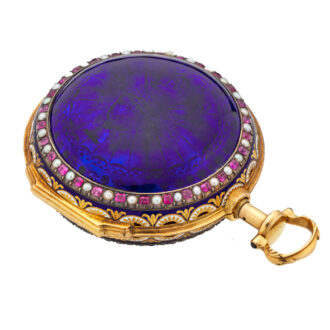
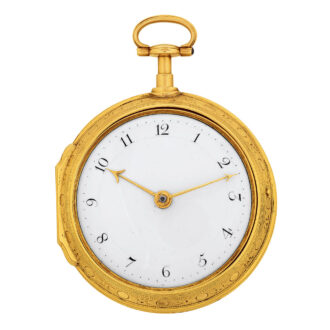
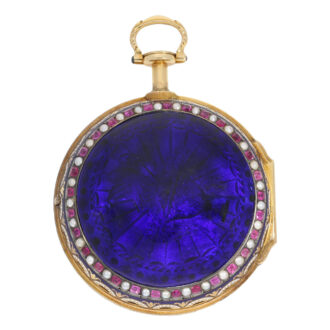
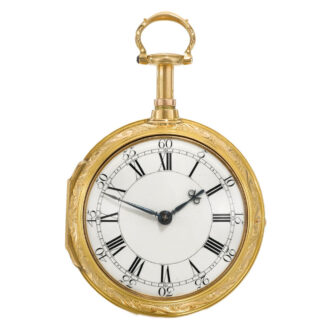
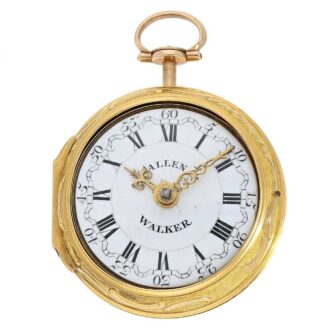
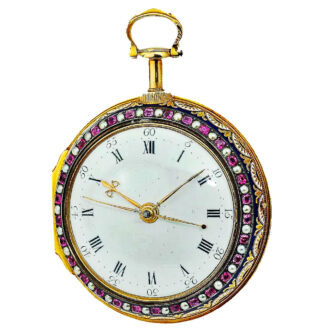
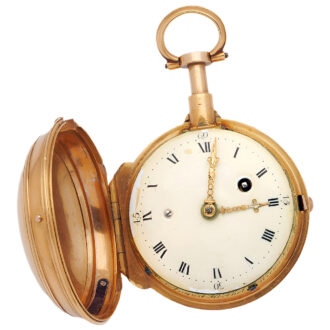
English watch with two opposing balance springs Circa 1788
- Kenmerk
- SA0143
- Diameter
- 55 mm
- Estimate
- € 25.000 - 50.000
- Price sold
- -
An unusual gold watch with two opposing balance springs
–
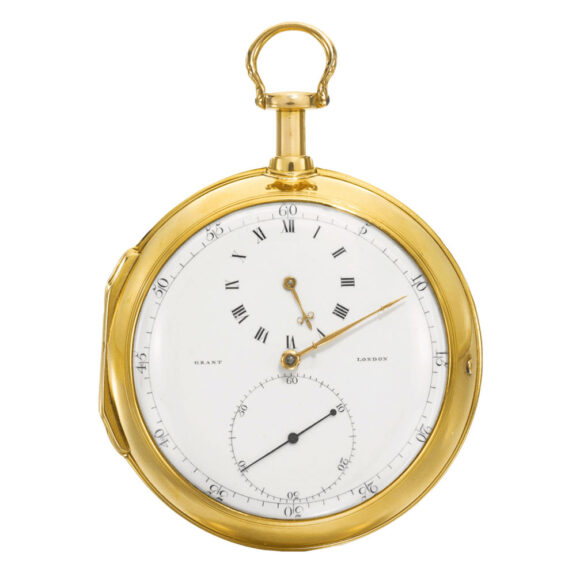
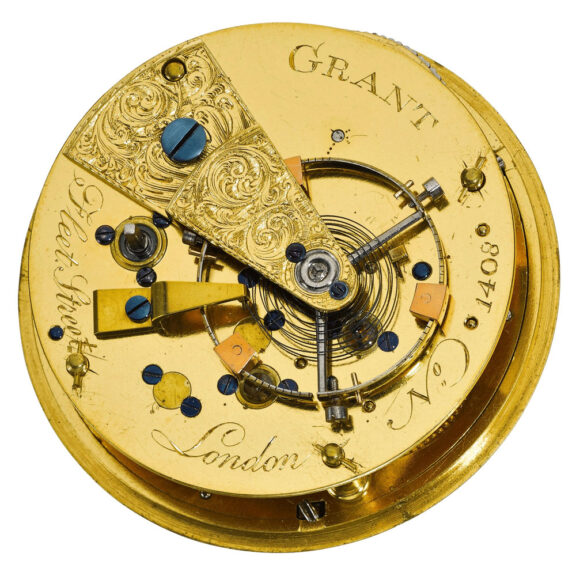
An English important and unusual gold open-faced consular cased watch with two opposing balance springs and early use of the lever escapement, circa 1788, gilded full plate movement, fine lever escapement with jewelled pallets, fork with jewelled horns acting on separate rollers, ratchet tooth escape wheel, jewelled up to and including the fusee, decoratively engraved balance cock, diamond endstone, three armed bimetallic compensation balance with interior adjustable gold weights, two opposing blued steel spiral balance springs, fusee with Harrison’s maintaining power, turned pillars, movement signed Grant, Fleet Street, London.
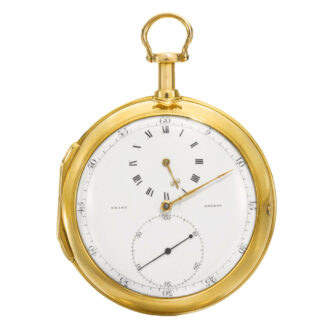
White enamel regulator type dial, subsidiary hour dial with Roman numerals, outer Arabic minute ring, subsidiary seconds, gold beetle and poker hands, dial signed Grant, London
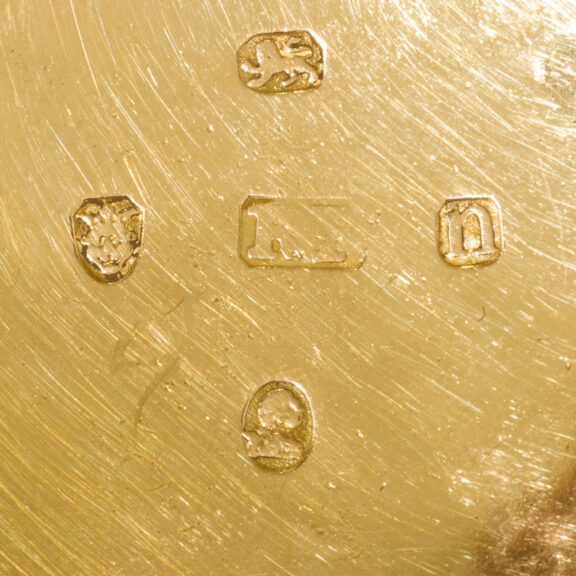
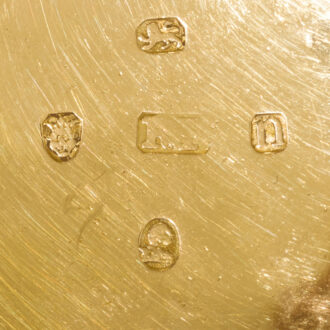
Heavy plain polished case with case maker’s mark RP for Richard Palmer
–
Diameter: 55 mm
–
Signed: Grant Fleet Street London
–
John Grant was apprenticed to his uncle, the eminent watchmaker Alexander Cumming, and became a Freeman of the Clockmakers’ Company in 1781. In 1810, Grant became Junior Warden and died in office. Grant remains best known for his experimentation with the lever escapement. A number of English makers, including Grant, worked on the improvement of the lever movement after its invention by Thomas Mudge. He was succeeded by his son, also called John, who was Master of the Clockmakers’ Company five times between 1838 and 1867. John Grant is famous for his experimentation with the lever escapement. Today, only eight watches by Grant are known to survive with early lever escapements and, of these, the present watch is the earliest and most important. The watch has an impeccable provenance, its first owner being Dr John Ridout (who qualified in 1779) worked at Blackfriars and died in Sherborne in 1823. The extremely fine movement is one of the first to bejewelled up to and including the fusee, and the movement’s fork and roller action is similar to Mudge’s in the “Queen’s Watch”. There is some conjecture as to why Grant counter-sprung this watch (with one spiral spring above the balance and the other beneath) rather than using a helical spring as Emery and others were doing. It has been suggested that Grant used this method in order to keep his watches slim but it may simply be due to the difficulty of achieving the best configuration for the helical spring.
Signed: Grant Fleet Street London
Share this page: