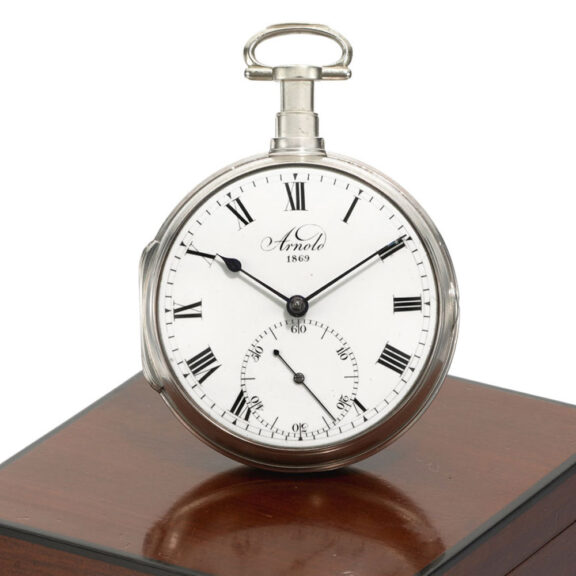
English fine and large silver pocket chronometer Circa 1802
- Kenmerk
- SA0449
- Diameter
- 61 mm
- Estimate
- € 6.000 - 12.000
- Price sold
- -
Fine and large silver consular cased pocket chronometer
–
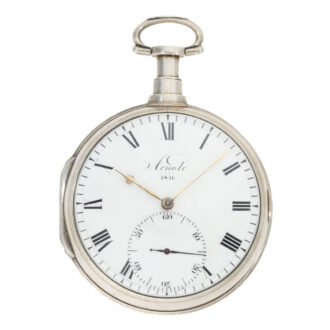
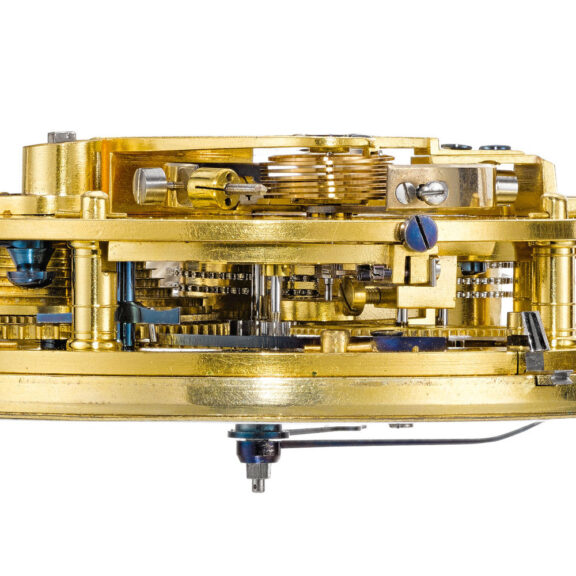
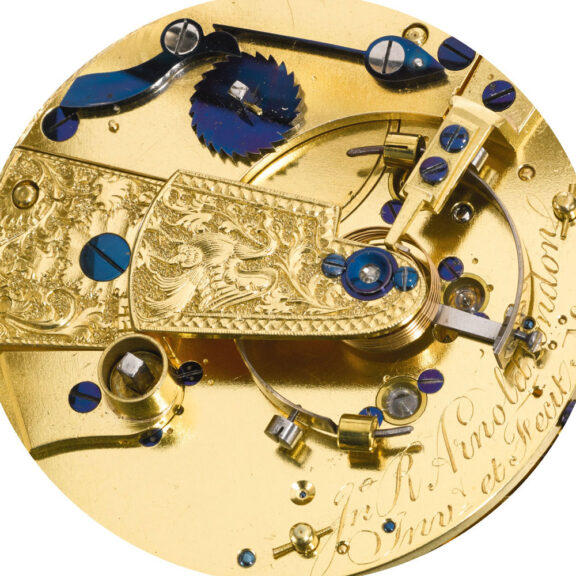
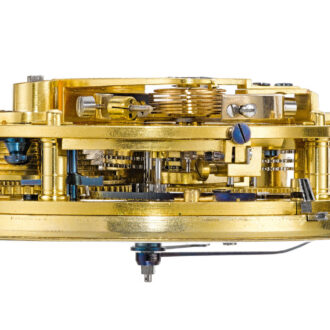
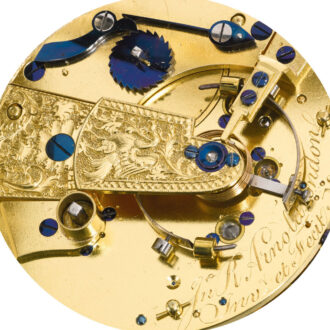
An English fine and large silver consular cased pocket chronometer, circa 1802. Gilded full plate movement, Earnshaw-type spring detent escapement, balance cock decoratively engraved with a griffin and foliate scrolls, ‘Z’ balance, gold helical spring, diamond endstone, signed Jn. R. Arnold, London, Invt. et Fecit.
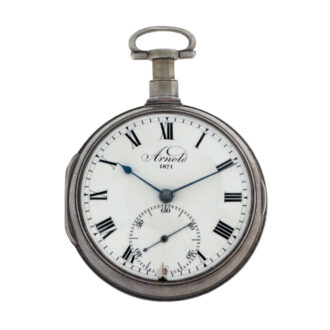
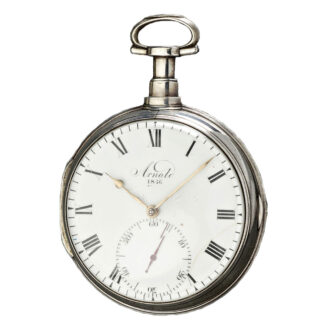
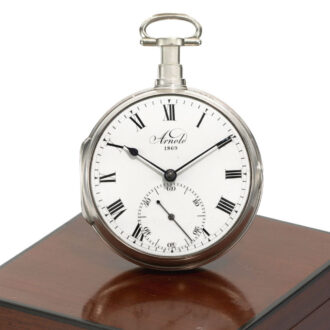
White enamel dial, Roman numerals, outer minute ring, large subsidiary seconds, blued steel hands, signed and numbered Arnold.
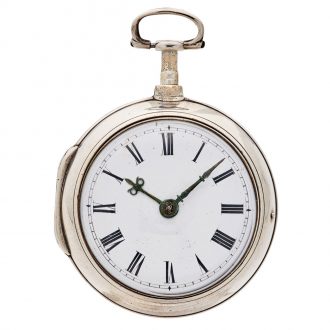
Plain silver consular case, the back opening to reveal fixed cover with winding aperture, inner and outer backs both with maker’s mark ‘TH’ in rectangular cameo for Thomas Hardy.
Later deck box three-tier mahogany box with key.
–
Diameter: 61 mm
–
Signed: Jn. R. Arnold, London, Invt. et Fecit
–
In his book John Arnold and Son, Vaudrey Mercer lists the present chronometer and notes the fact that this watch has an Earnshaw escapement is “certainly a surprise since at this time Earnshaw was demanding a reward for his escapement”. Nevertheless, it would have been prudent for John-Roger to use Earnshaw’s version from time to time, if only to reaffirm his claim that the basic concept was his father’s invention.
Cecil Clutton included this watch in his book “Collector’s Collection” where he notes that he gave the chronometer to George Daniels who “took it to task after which it ran for 2 1/2 weeks +2 and -2 seconds a day.” Clutton also notes that, in his opinion, this chronometer is “of the highest quality, fully equal of anything executed in the life-time of John.” This watch is one of three or four watches recorded where Arnold has fitted an Earnshaw type of spring detent escapement to one of his movements. It is otherwise typical, with a ‘Z’ balance, gold helical spring, standard signature, and a griffin displayed on the cock. The four-arm escape wheel follows Earnshaw’s early tooth profile but made in the Arnold manner where much more of the wheel has been cut away for lightness. The detent is typically Arnold (only the reverse of normal) and has a side-fitting jewel. The detent mounting is similar to Earnshaw’s, consisting of a brass arm and block for depth adjustment, but half of the block pivots on a rivet, with two pairs of opposing screws for the left/right adjustment.
Signed: Jn. R. Arnold, London, Invt. et Fecit
Share this page: