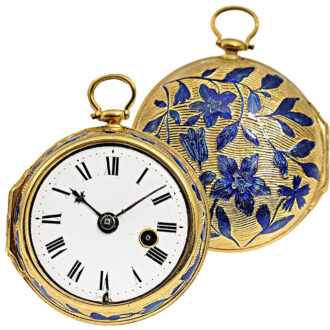
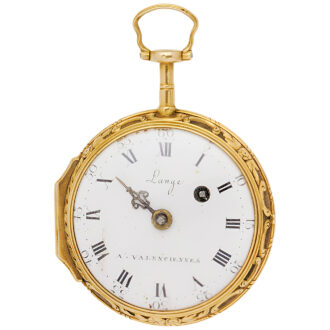
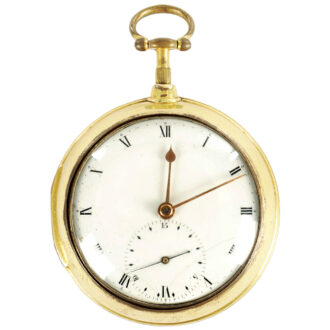
English fine and rare verge watch with repousse Circa 1737
- Kenmerk
- SA0330
- Diameter
- 50 mm
- Estimate
- € 7.500 - 15.000
- Price sold
- € 15.250
Fine and rare pair cased verge watch with repousse scene
–
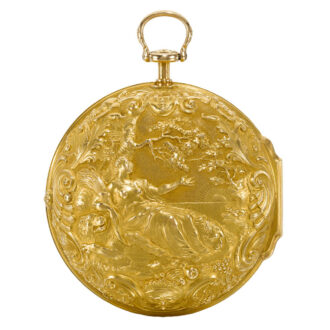
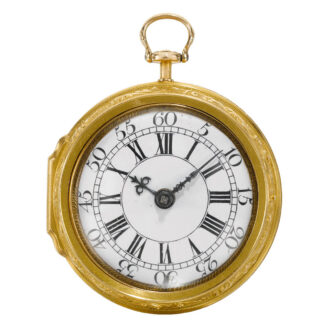
An English fine and rare pair cased verge watch with repousse scene attributed to Fourestier, circa 1737, gilded full plate movement, decoratively pierced and engraved masked balance cock, plain flat three arm balance, fusee and chain, square baluster pillars, movement signed D. Hubert, London.
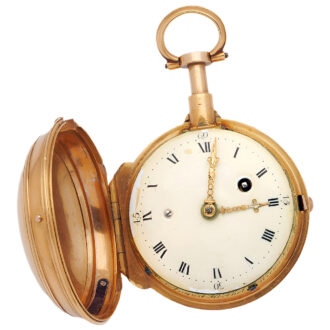
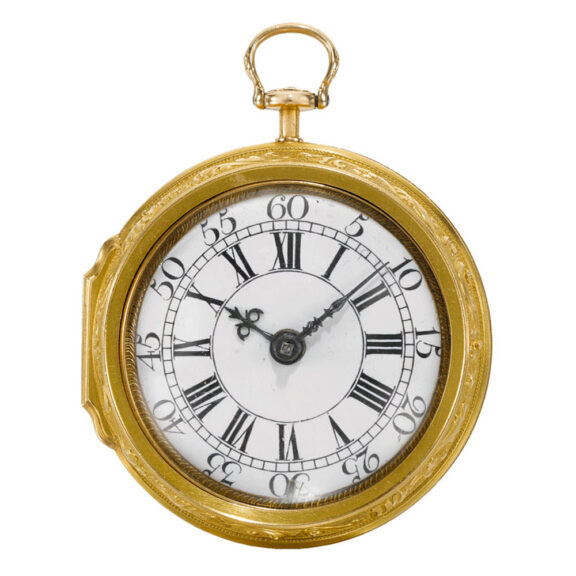
White enamel dial, Roman numerals, outer Arabic minute ring, blued steel beetle and poker hands.
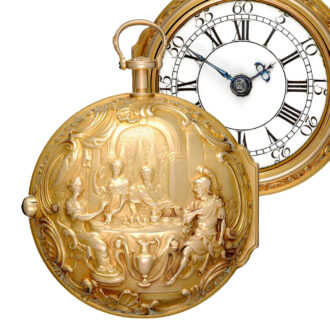
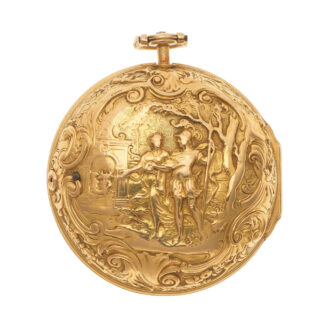
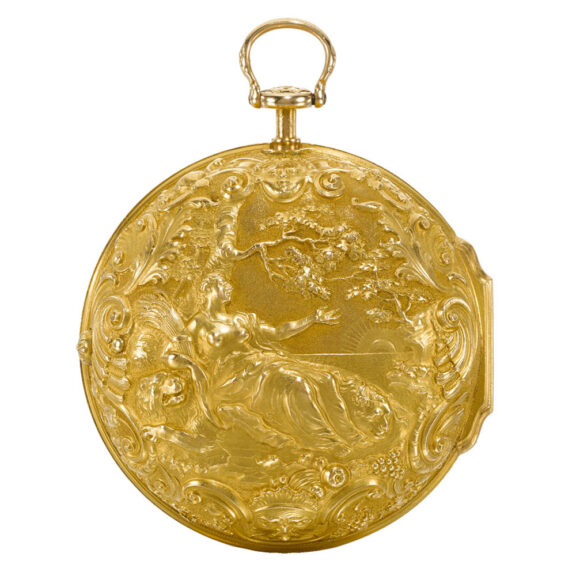
Plain gold inner case, winding aperture to rear, with maker’s mark AR or AP conjoined incuse possibly for Adam Roumieu junior, outer case with repoussé scene depicting Cybele, the Earth goddess, flanked by lions, begging for the Sun’s return within a symmetrical cartouche of shell, scroll work and foliage against a stippled ground and masked at the north and south, signed FFF possibly for François Fourestier Fecit, bezel similarly decorated.
–
Diameter: 50 mm
–
Signed: D. Hubert London
–
David Hubert was an eminent Hugenot watchmaker who was made Free of the Clockmakers’ Company in 1714, and subsequently became Master in 1743. Examples of his watches have at various times been in prominent watch collections; including the Ilbert, Dennison and Buckley collections, and a repeating watch movement by Hubert can be found in the collection of the Worshipful Company of Clockmakers in London.
The repoussé scene to the outer case is of exceptional quality and there is a wonderful clarity to the decorative scheme. In his book, The Art of the Gold Chaser, Richard Edgcumbe discusses the present watch and notes that François Fourestier, to whom the repoussé scene is attributed, was, like David Hubert, a Hugenot. Edgcumbe also points out that the superb masks which are chased and embossed to the north and south of the scene “look back” to the work of the painter and engraver Jean Berain (1638-1711). It is interesting to note that, until 1738-1740, cartouches were generally symmetrical whilst soon thereafter a degree of asymmetry is generally present. On the present watch, the elaborate scroll work east and west are the same, however, the scrolls north and south are not. The white enamel dial is of especially fine quality and the extra turning to the blued steel minute hand was fashionable at this date.
Signed: D. Hubert London
Share this page: