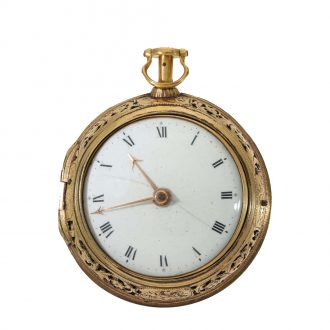
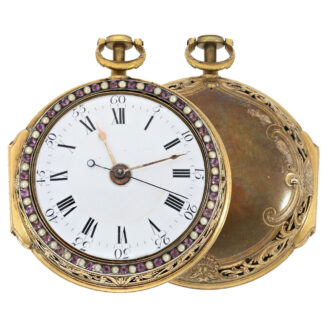
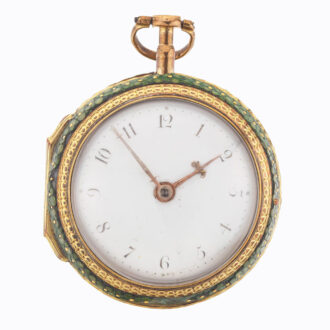
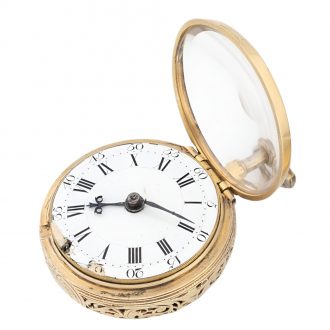
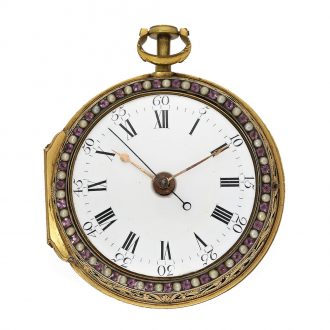
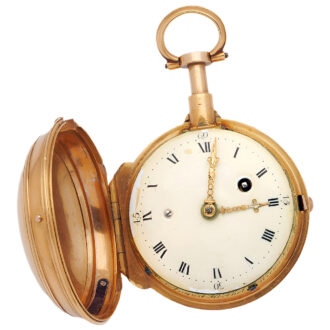
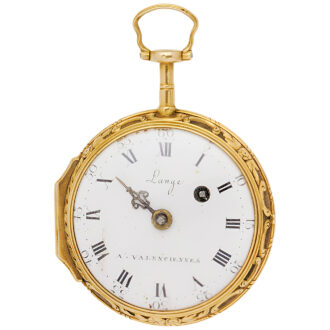
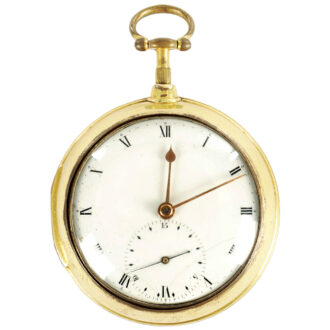
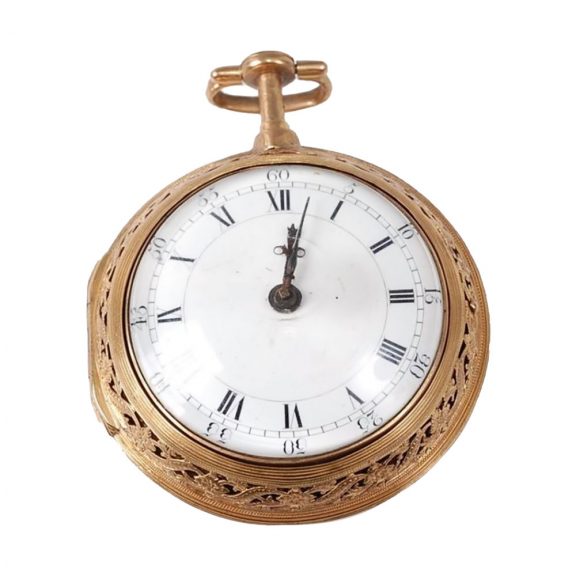
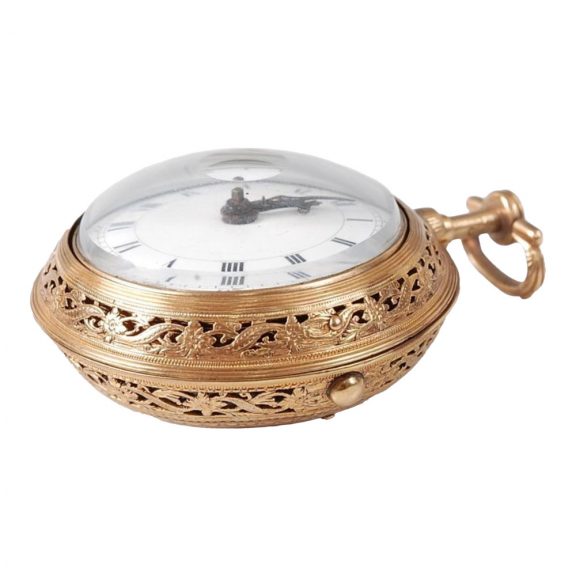
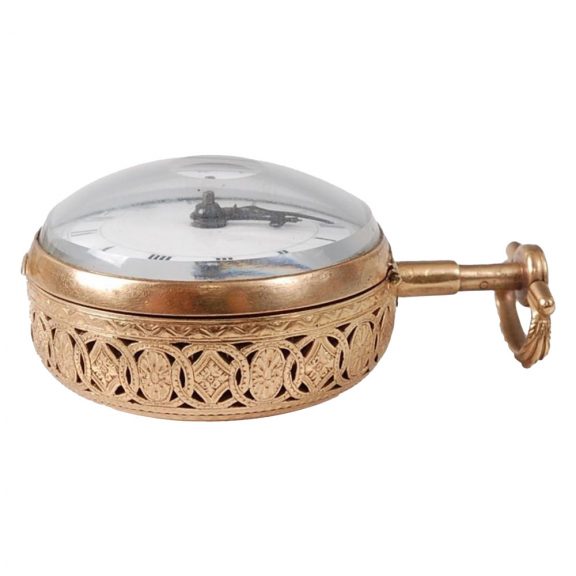
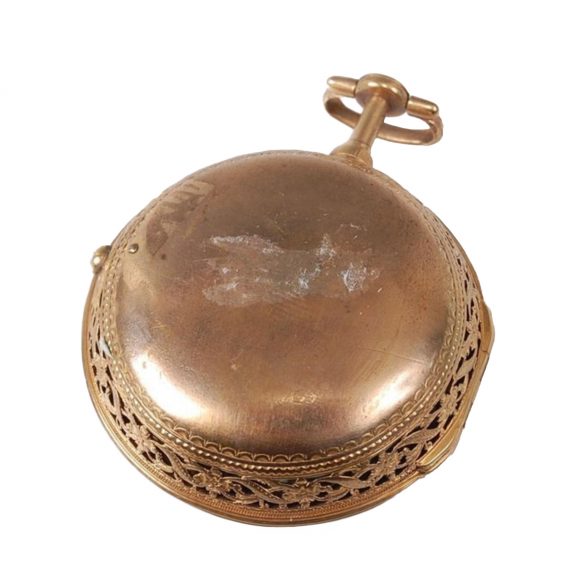
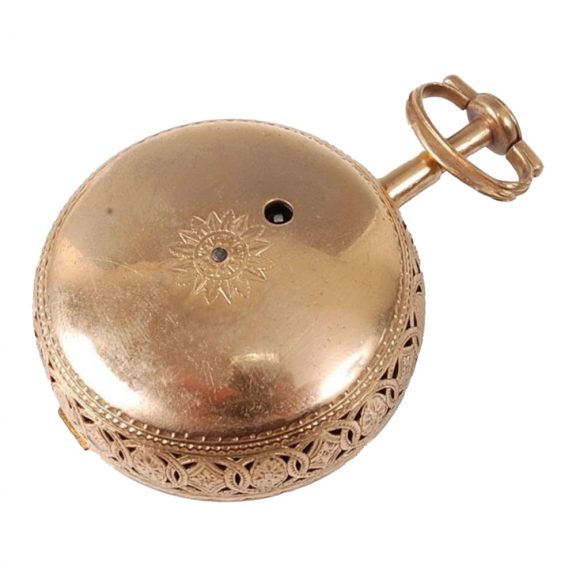
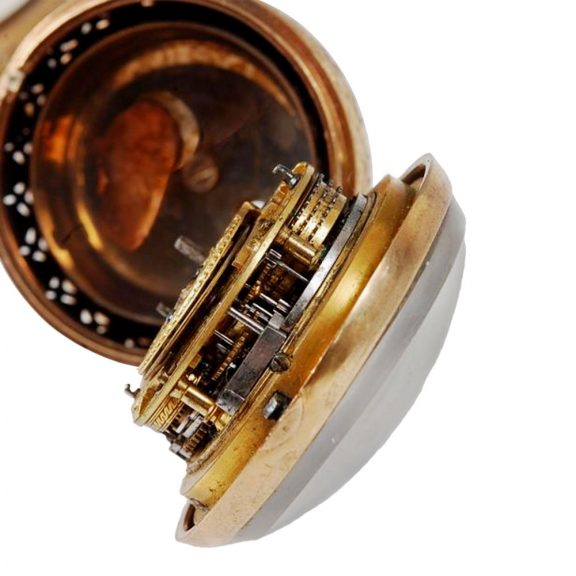
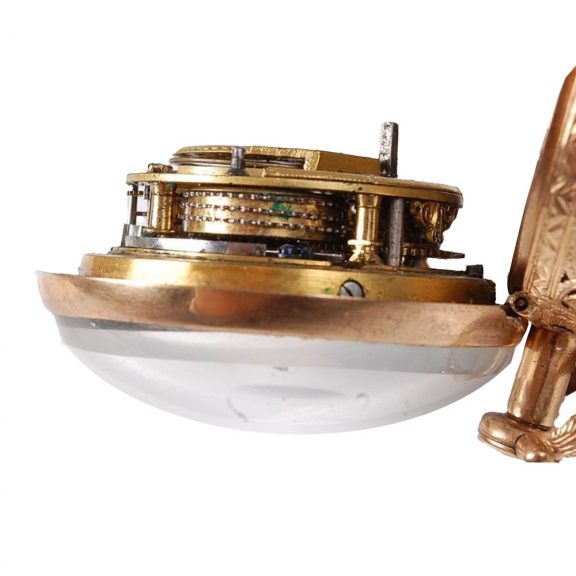
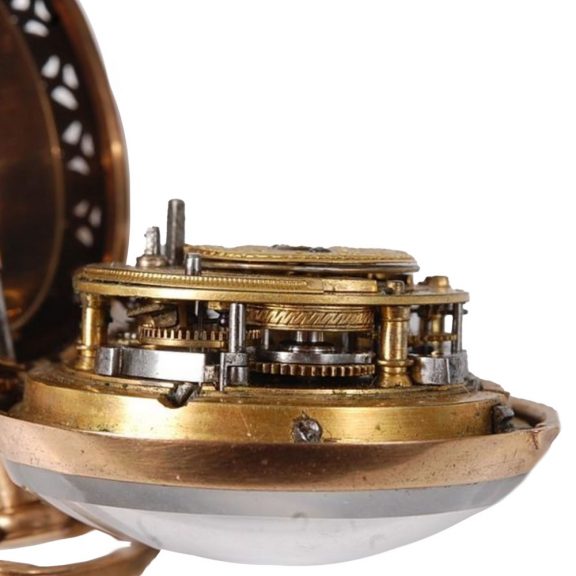
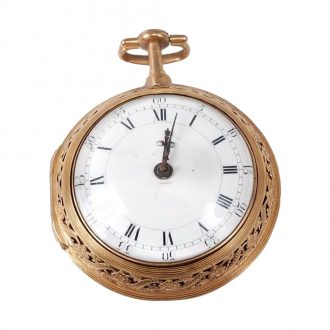
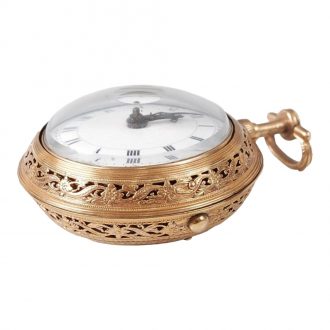
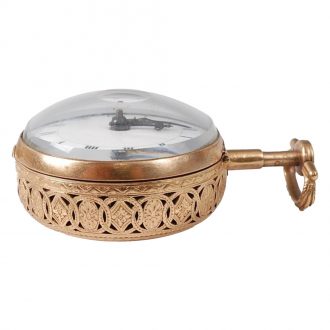
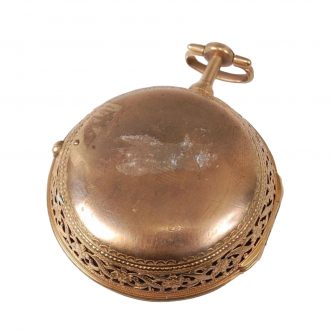
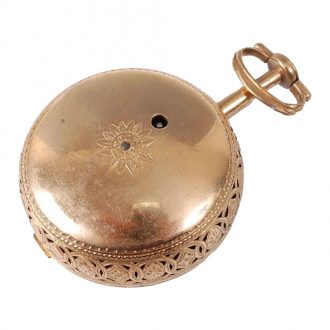
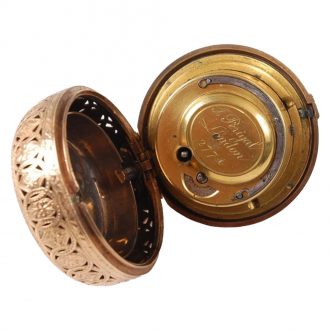
English gilt metal pair cased repeating clock watch Circa 1775
- Kenmerk
- AL2494
- Diameter
- 55 mm
- Estimate
- € 2.250 - 4.500
- Price sold
- € 1.550
Gilt verge repeating pocket watch by John Perigal
–
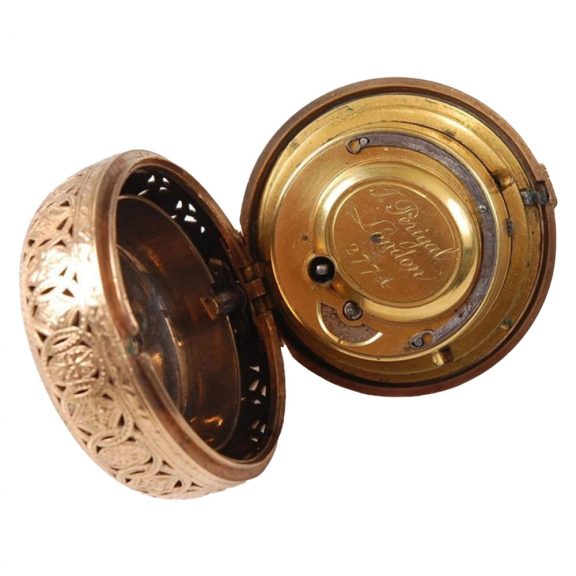
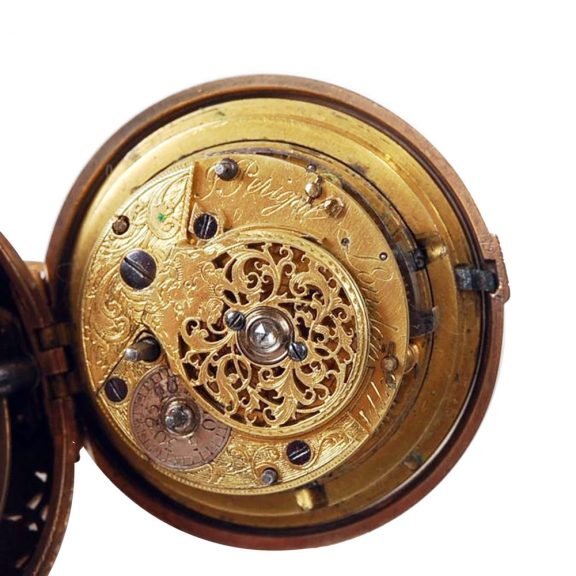
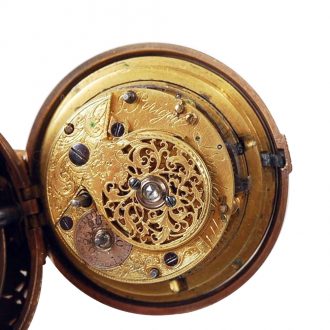
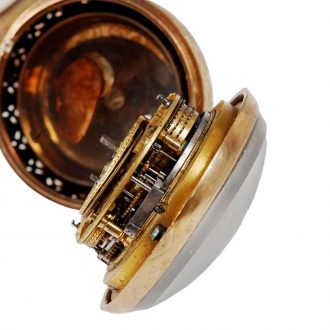
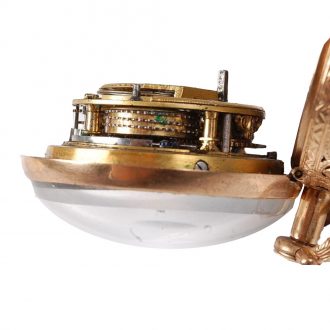
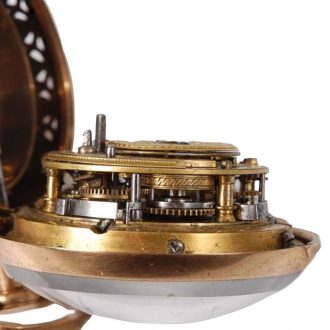
An English George III gilt metal pair cased quarter repeating pocket watch with pierced outer case, circa 1775. This watch has a chaindriven verge fusee movement on turned pillars, with a rosecut diamond end stone, pierced balance cock, push button, and quarter repeat, signed and numbered on the backplate J Perigal London. The unsigned convex white enamel dial features Roman radial hours, outer railway minute divisions, Arabic five minute divisions, and Poker & Beetle hands. It has a gilt metal pierced and engraved inner and outer case, and a signed and numbered dust cover.
–
Diameter: 55 mm
–
Signed: John Perigal, London
–
Perigal, John, English goldsmith, jeweller, and watchmaker
John Perigal was born in 1741 in London, the son of Gideon Perigal (1698-1774) and Catherine Wilder. His brother was watchmaker Francis Perigal, “Watchmaker to the King.” His father, Gideon, was a brother of watchmaker Francis Perigal (1701-1767), Royal Exchange, Threadneedle Street, London.
–
From 1755, he lived in St Giles in The Fields, and in 1790, he married Jane Grellier (1757-1804) in St James Westminster, London. This marriage produced eight children. Elias Charles Perigal (1784-?) became a goldsmith. His daughter Elizabeth Perigal (1782-1812) married the artist Benjamin Duterrau (1768-1851), a son of the clockmaker Benjamin Duterrau, in 1811. John Perigal was a member of The Society for the Encouragement of the Arts for several years.
–
John established a business as a goldsmith, jeweller, and watchmaker at 12 Coventry Street, Haymarket, London. He founded the firm of Perigal & Masquerier with goldsmith Lewis Masquerier. Lewis was presumably family, as John’s mother in law was Margaret Masquerier (1735-1805). However, the firm went bankrupt in 1777 and was finally dissolved in 1783. Later, Renock Browne became a business partner; the partnership was dissolved in 1799.
–
John Perigal died in 1820, aged 79, in Hammersmith and Fulham, London, and was buried on 3 June.
Signed: John Perigal, London
Share this page: