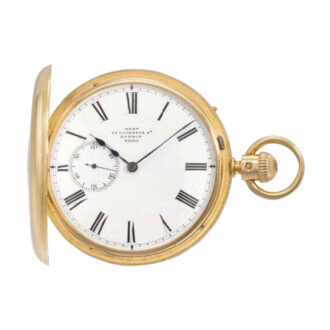
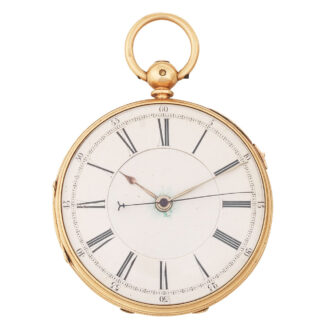
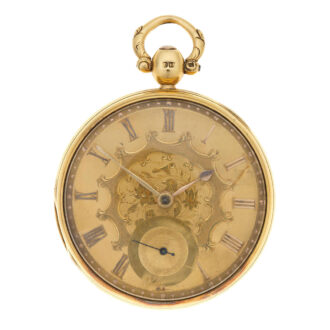
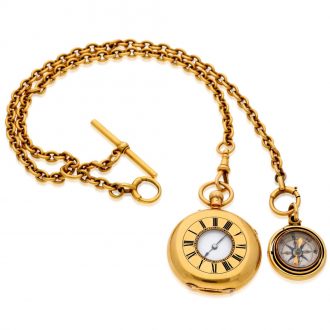
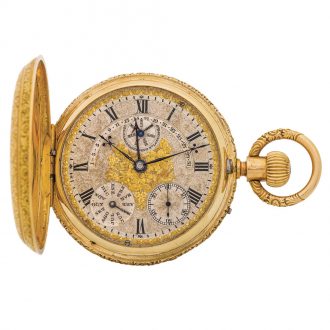
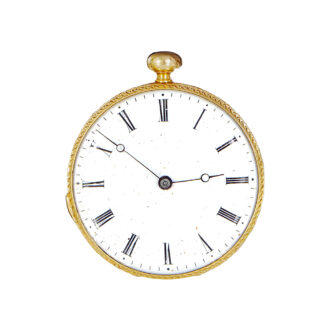
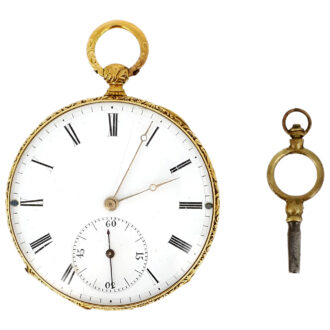
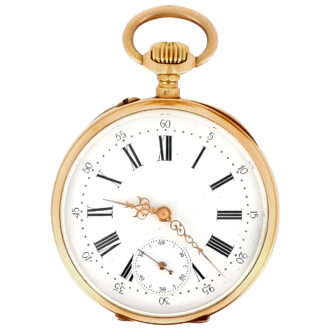
English gold lever made for the South American market Circa 1867
- Kenmerk
- TA4226
- Diameter
- 51 mm
- Estimate
- € 8.000 - 15.000
- Price sold
- € 9.650
Gold watch with retrograde triple date calendar
–
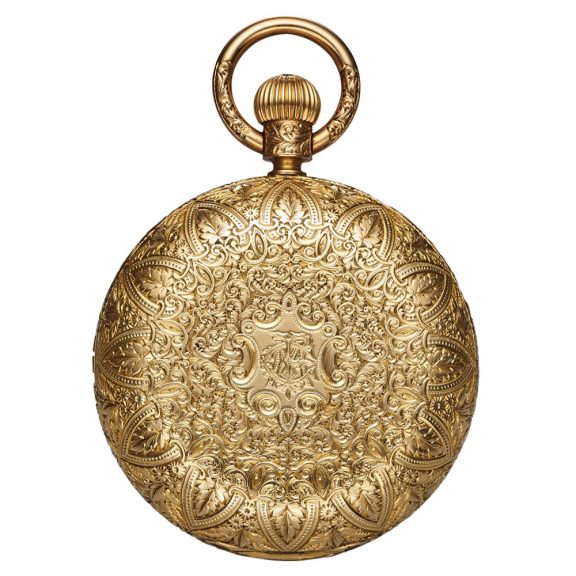
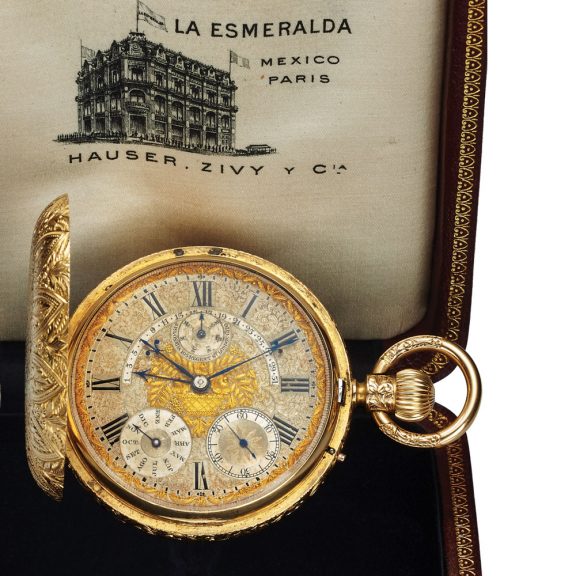
An extremely rare English, 18 carat yellow gold pocket watch made for the South American market, circa 1867. A keyless hunting cased watch with a retrograde triple date calendar. The case with London hallmarks for 1867-68. Retailed by Hauser Zivy & Cie., Mexico-Paris, La Esmeralda. The case is made by by Alfred Stram (AS), with covers, band and bezels entirely chased and engraved with floral and foliate decoration, front with engraved monogram. Hinged gold cuvette engraved: Manuel Fidel Castillo.
–
Silver dial with applied gold decoration, radial Roman numerals, outer minute track and outermost applied gold leaf and flower pattern. The centre with applied a gold flower basket, subsidiary dials for constant seconds, day and month indication, a scale for the retrograde date at 12 and blued steel fleur-de-lis hands. Gilt brass movement, 15 jewels, ¾ plate, lateral lever escapement, cut bimetallic compensation balance, blued steel Breguet balance spring, index regulator. Dial and movement signed, numbered in the case.
–
Diameter: 51 mm
–
Thickness: 15 mm
–
Signed: Losada London
–
Accompanied by a fitted box
–
José Rodríguez Losada was born in Iruela, in the province of Leon, on May 8, 1797. During his childhood, he spent some time at a court in Madrid. Losada, a liberal ex-army man, eventually left Spain for political reasons and settled in England, where he set up shop near Euston Road in London. He manufactured a variety of chronometers and watches of the highest quality, which he sold both in the country and shipped to Spain and South America. In 1835 he opened a beautiful showroom at 105 Regent Street. Losada never lost touch with his native Spain, and after 1864, winning an award, he supplied 36 chronometers to the Spanish government through the Royal Observatory in Cadiz.
–
He is also known for the clock tower he donated to the city of Madrid in 1866, which can be seen in the Puerta del Sol. The Horological Journal reported in 1878 that these were extremely beautiful clocks and all kinds of complicated clocks and repeaters, as well as perpetual calendars and chronographs, some exceptionally good chronometers, fine clocks, astronomical clocks, and coach clocks. He signed his watches with JR Losada, and he also wrote poems, some of which he dedicated to his friend Joseph Zorrilla. José Rodríguez Losada died in London on March 6, 1870, but his shop remained on Regent Street until about 1890.
Signed: Losada London
Share this page: