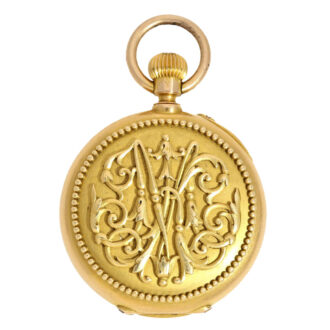
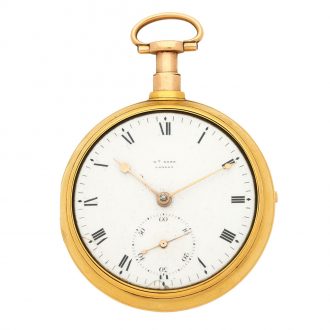
English gold pocket chronometer by Earnshaw Circa 1801
- Kenmerk
- SA0447
- Diameter
- 59 mm
- Estimate
- € 15.000 - 30.000
- Price sold
- € 30.500
Exceptionally fine gold pair cased pocket chronometer
–
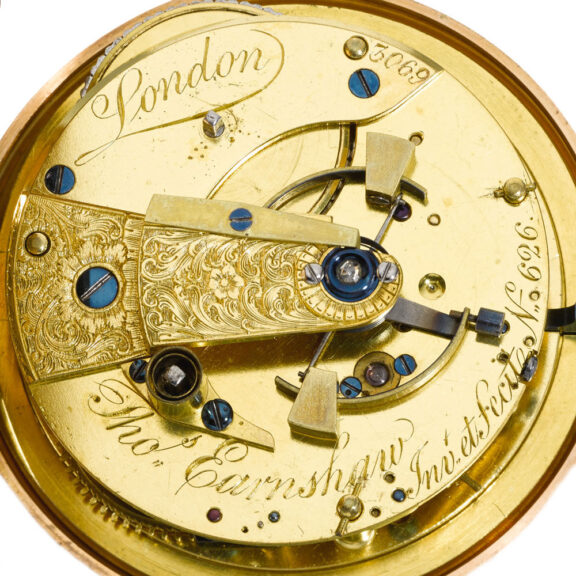
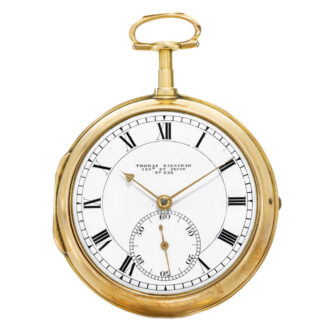
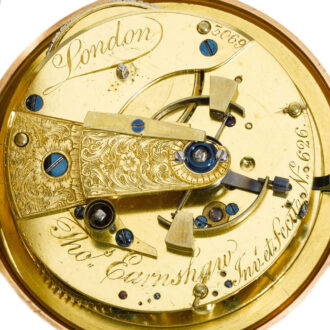
An exceptionally English fine gold pair cased pocket chronometer, circa 1801, gilded full plate movement, spring detent escapement, decoratively engraved balance cock, two-arm bimetallic balance with wedge-shaped weights, limiting bars and timing screws, blued steel helical spring, diamond endstone, cylindrical pillars, fusee and chain, signed Thos. Earnshaw Invt. et Fecit, London.
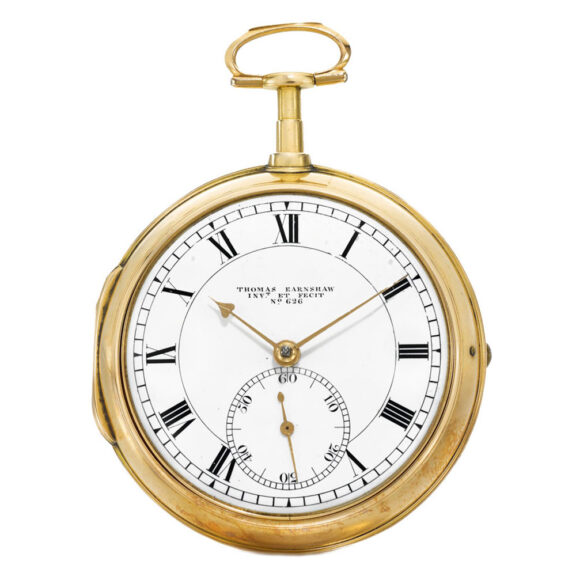
White enamel dial, Roman numerals, outer minute ring, subsidiary seconds, gold hands, signed Thomas Earnshaw, Invt et Fecit.
Plain gold inner and outer cases, long pendant and D-shaped bow, both cases with maker’s mark TC with axe above incuse for Thomas Carpenter.
–
Diameter: 59 mm
–
Signed: Thos. Earnshaw Invt. et Fecit London
–
An extremely handsome pocket chronometer, this is a classic Earnshaw that illustrates the excellent quality and finish the maker lavished on his finest watches. The movement of the present watch, no. 626/3069, with the exception of its finish, is to the same specification as Earnshaw no. 487/2828. Both 487/2828 and this watch have the same dial and hands and the cases are by the same makers, the difference being that 487/2828 is screwed into the inner case, whereas the movement of the present lot is hinged to the inner and thus can be ‘swung’ out.
Thomas Earnshaw 1749-1829 was an English watchmaker who following John Arnold’s earlier work, further simplified the process of marine chronometer production, making them available to the general public. He is also known for his improvements to the transit clock at the Royal Greenwich Observatory in London and his invention of a chronometer escapement and a form of bimetallic compensation balance.
In 1780, he devised a modification to the detached chronometer escapement, the detent being mounted on a spring instead of on pivots. This spring detent escapement was patented by Thomas Wright (for whom he worked) in 1783. Whilst initially the design was crude and unsuccessful, with modifications it later became the standard form in marine chronometers, following the invention of the detent escapement by Pierre Le Roy in 1748. John Arnold also invented a similar escapement in 1782.
In 1805, Earnshaw and Arnold were granted awards by the Board of Longitude for their improvements to chronometers; Earnshaw received £2500 and John Arnold’s son John Roger Arnold received £1672. The bimetallic compensation balance and the spring detent escapement in the forms designed by Earnshaw have been used essentially universally in marine chronometers since then, and for this reason, Earnshaw is generally regarded as one of the pioneers of chronometer development.
From around the mid-1790s, Earnshaw fitted his chronometers with plain steel balances, spiral springs and ‘sugar tongs’ bimetallic compensation (although he also continued to use the combination of compensation balance and helical spring). The arms of the ‘sugar tongs’ embrace the outer coil of the spring, altering their shape and length, the curved ends moving closer together or further apart with changes in temperature, thus compensating for the effect caused by these changes on the balance and spring. The timekeeping may not have been so constant, but the balance was lighter and the pivots therefore less susceptible to damage. This set-up would also have made the watch easier to regulate as compared to chronometer balances with timing screws. Shortly before 1800, Earnshaw ceased gilding the plates and blueing the steel parts of many, although not all, of his movements.
Signed: Thos. Earnshaw Invt. et Fecit London
Share this page: