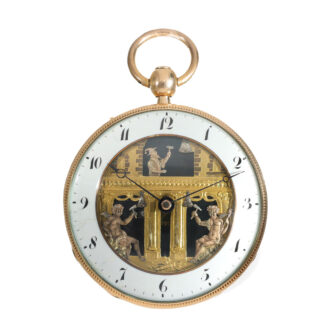
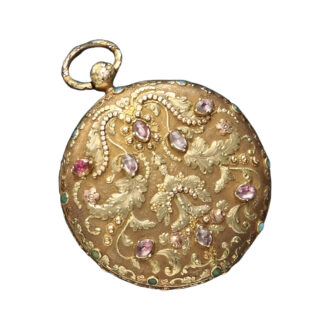
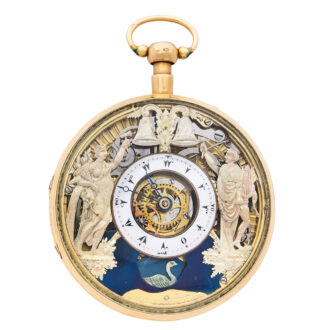
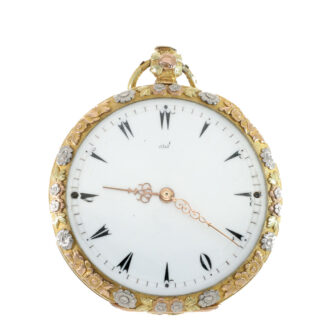
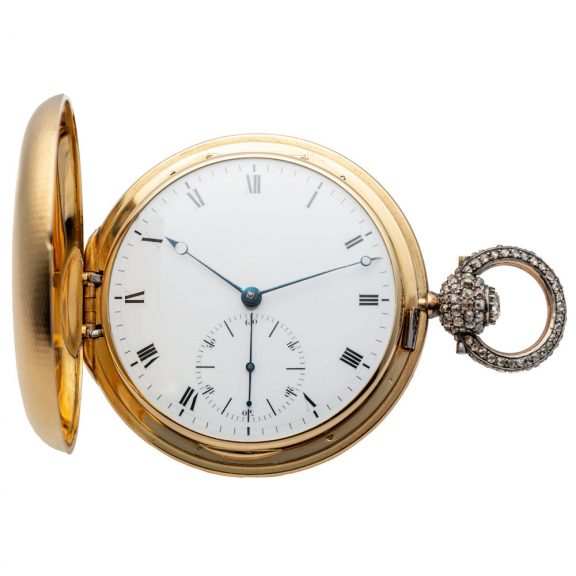
Swiss gold and diamond set pocket chronometer Circa 1820
- Kenmerk
- TA5037
- Diameter
- 66 mm
- Estimate
- € 10.000 - 20.000
- Price sold
- € 14.850
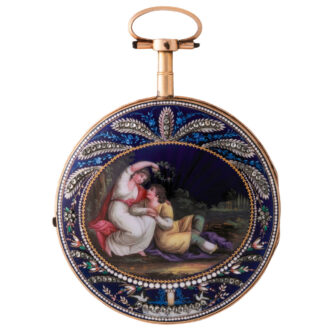
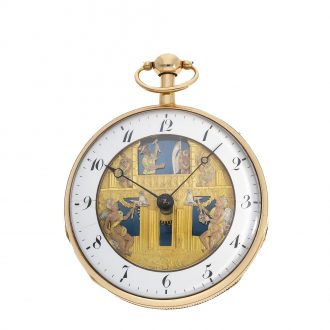
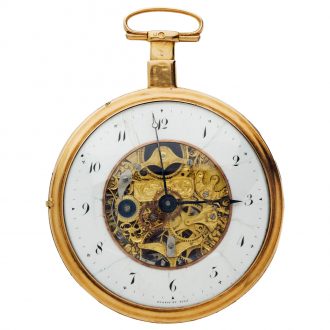
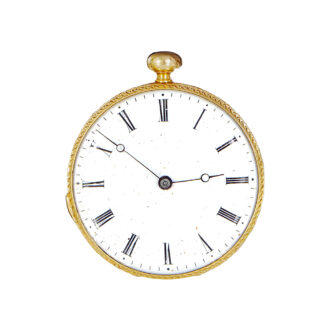
Gold watch with diamond bow
–
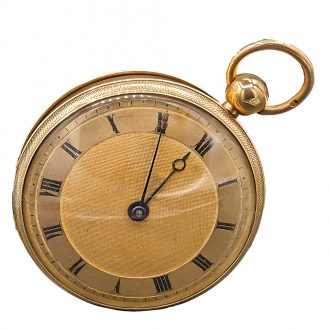
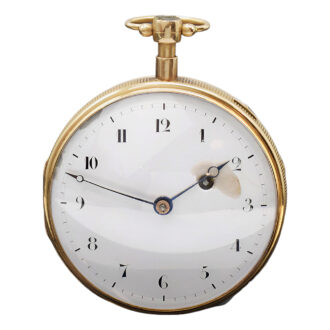
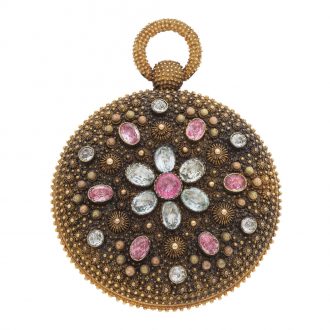
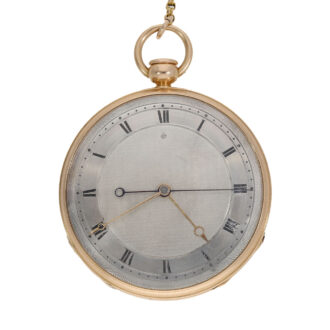
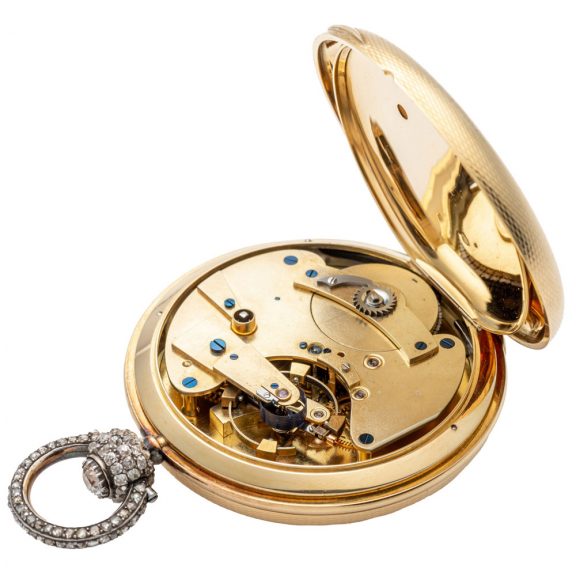
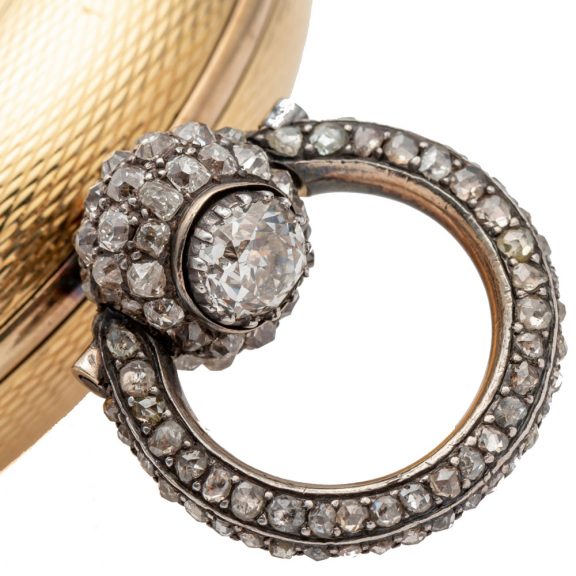
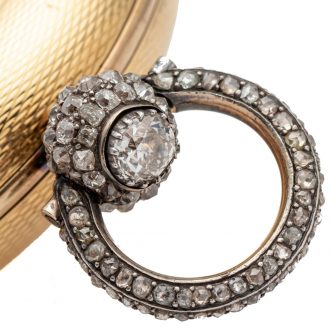
A large and elegant Swiss, 18 carat gold hunting cased diamond set pocket chronometre, circa 1820. Custom made case by Jules Perot (Master mark). A massive case with engine turned cover and back, old cut diamond set pendant and rose cut diamond set bow, cuvette engraved with technical details. White enamel dial, Roman numerals, outer minute track, subsidiary dial and blued steel hands. A frosted and gilt movement, three quarter plate with cylindrical pillars secured by screws, the back plate indented for the barrel secured by a bridge, the fusee with chain maintaining power, 13 jewels, spring detent escapement, two arm compensation balance with two trapezoidal weights and timing screws, free sprung blued steel helical balance spring.
–
Diameter: 66 mm
–
Signed: No Name
–
The movement of this watch is typical of the work of Frédéric Houriet. The calibre is similar to that used both by Houriet and Urban Jürgensen for the tourbillon made for Breguet. It was certainly at the request of an important personality that the highly impressive hunting case of this chronometer was made in France by Jules Perot, whose Master mark was registered on August 18, 1843. The cuvette is engraved with technical details, attesting that the movement was originally fitted with a spherical balance spring, like all other chronometers produced by Frédéric Houriet. Jacques-Frédéric Houriet (1743-1830) was born at La Chaux d’Abel.
–
He was an apprentice to his uncle, Daniel Gagnebin, at Renan and later to Abraham-Louis Perrelet. In Paris, he worked for Pierre LeRoy, Jean Romilly and Ferdinand Berthoud. Breguet was an apprentice at Versailles, but legend has it that they were friends. Houriet remained in Paris for nine years and returned to Le Locle. With his brother-in-law, David Courvoisier, Houriet established a selling house which he directed for forty yearsShortly after his return, Jürgen Jürgensen worked for him and became his agent for Scandinavia; Urban, his son, fell in love with Houriet’s lovely daughter Sophie-Henriette and married her. Houriet set up the first meridian telescope for exact time observations known to Le Locle.
–
For many years, probably from the time of his association with LeRoy and Breguet, he had given thought to the subject of isochronism and had experimented with a variety of forms of the balance spring. He devised many delicate pieces of apparatus to make tests on the various prototypes, and also invented the spherical form of spring, which he found to be perfect. At the National Exhibition held in Geneva in 1828, Houriet presented two chronometers of novel and exquisite workmanship. One of them, inspired by Commodore Perry’s difficulties on his famous expedition -because of magnetism- was made without steel save for arbours and a spring; the other was constructed with a tourbillon escapement. Both were wonderful products.
Share this page: