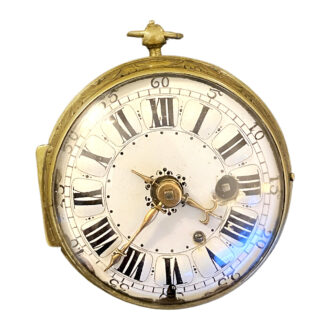
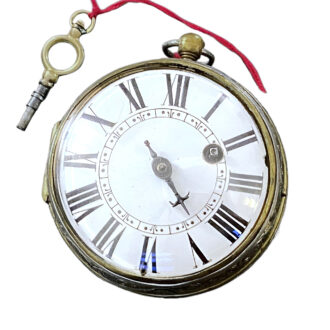
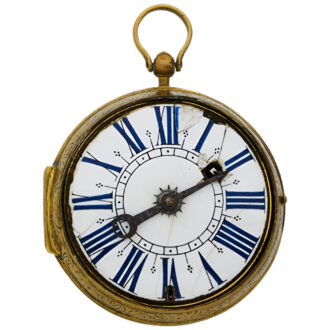
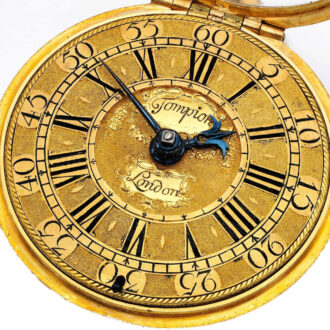
English gold verge by Thomas Tompion Circa 1697-1713
- Kenmerk
- SA0027
- Diameter
- 52 mm
- Estimate
- € 45.000 - 70.000
- Price sold
- € 58.000
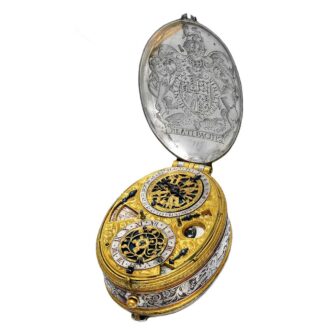
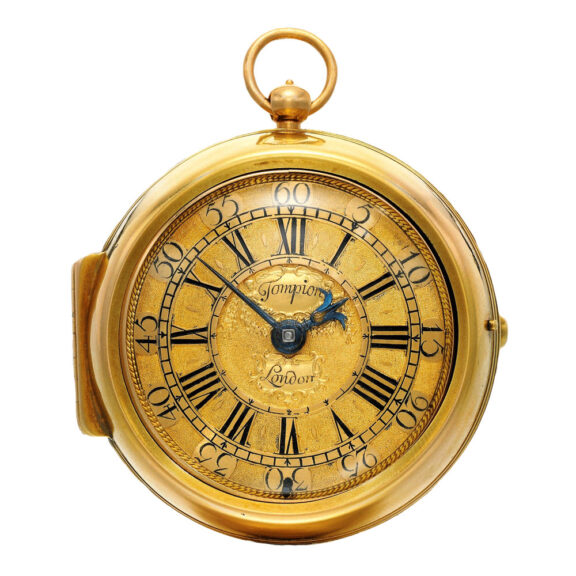
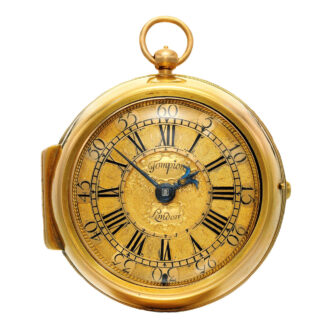
Superb gold pair cased verge watch
–
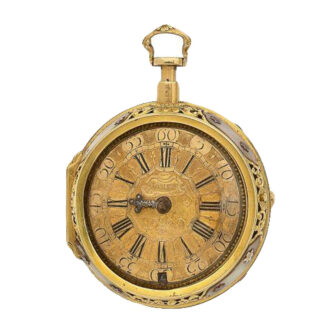
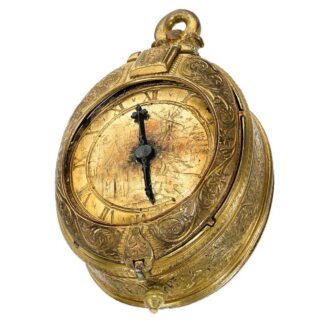
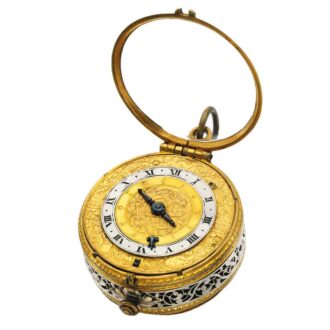
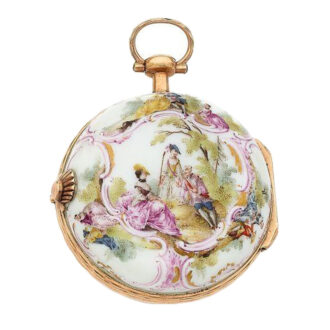
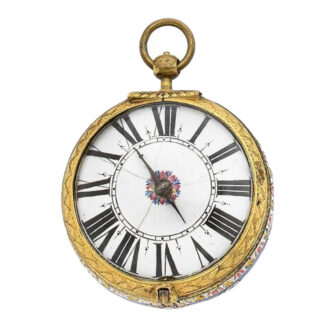
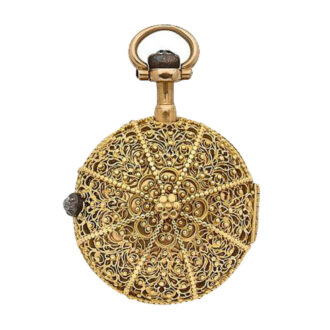
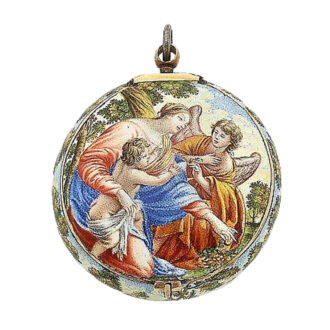
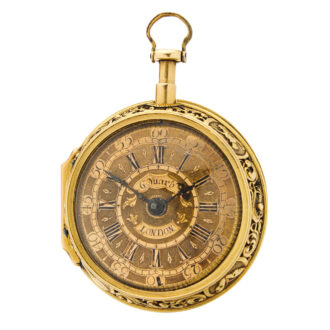
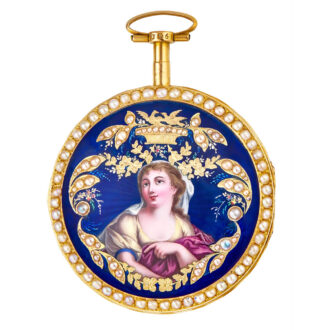
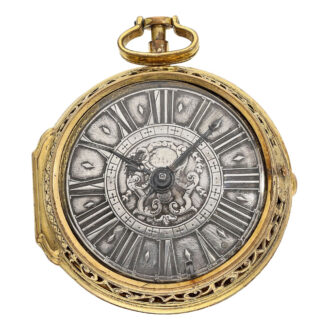
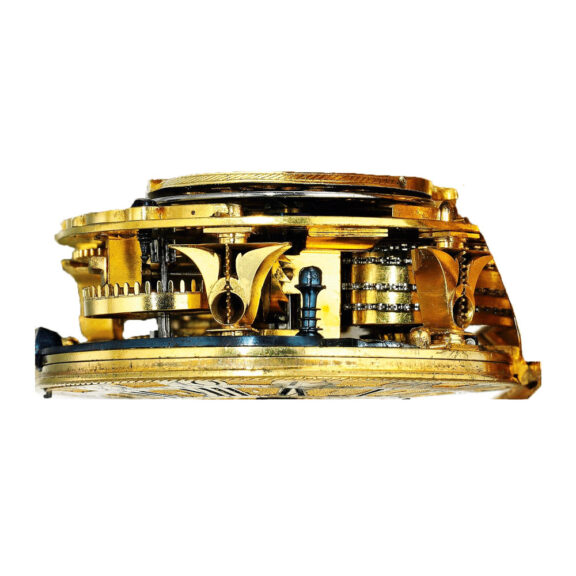
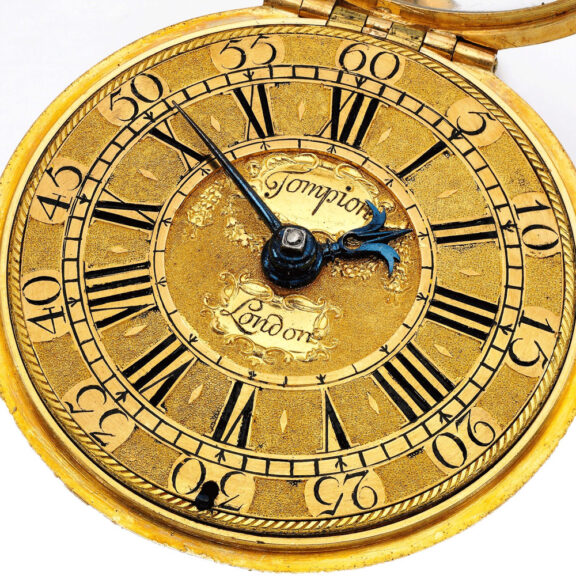
An English gold verge watch by Thomas Tompion with fire gilt full plate movement, pierced and engraved balance cock with pierced foot, flat steel three arm balance, fusee and chain, tulip pillars, gold champlevé dial, Roman numerals, outer Arabic minute track, the signed cartouche surrounded by two putti holding a garland of flowers, tulip hour and poker minute hands, plain gold cases, the outer case with a square hinge and rounded thumb piece, the inner case with shuttered winding aperture, case maker’s mark WS for William Sherwood, with London hallmarks for 1697, outer case hallmarked 1713 also with maker’s mark WS for William Sherwood.
–
Diameter 52 mm
–
Signed: T Tompion London
–
The central cartouche with two putti holding a garland of flowers was a typical design element that Tompion began using in the 1690s. The movement, with its tulip pillars and foliate engraved cock, without mask, also exemplifies Tompion’s style. Interestingly the inner case of this watch is hallmarked 1697, whilst the outer case is hallmarked 1713. Both cases are stamped with the maker’s mark WS for William Sherwood and both maker’s marks appear to be from the same punch, as matching natural ‘faults’ within the punch mark can be seen to both cases – however, it is curious that the cases should have been hallmarked some fifteen years apart. Stylistically the outer case could date from either 1697 or 1713.
Thomas Tompion (1639-1713), the greatest of English clockmakers was born the son of a blacksmith at Ickfield Green, a hamlet in the parish of Northill, Bedfordshire. It seems that he was trained, with his younger brother James, in the art of blacksmithing.
Very little is known of Tompion’s early life, but he was likely involved at some point in the repair of the local church clock as this was usually blacksmith’s work. Perhaps he developed his passion for horology from this. There is no record of Thomas Tompion serving as an apprentice in a clockmaker’s workshop but on September 4th, 1671, he was admitted to the Clockmakers’ Company and became Master in 1704.
In 1674 Tompion was introduced to Robert Hooke, the most important English experimental physicist of the 17th century. The following year, 1675, Hooke employed Tompion to make a watch with a special double spring on the balance. On 7th April, Hooke, accompanied by Tompion and Sir Jonas Moore, went to Whitehall Palace and showed the watch to King Charles II. The King was so impressed that he ordered a watch from Tompion for his own use.
Tompion employed several apprentices, most notably, Edward Banger who married Tompion’s niece in 1694 and became free of the Clockmakers’ Company in 1695. He formed a partnership with Tompion in 1701 but some years later a serious quarrel appears to have taken place and, after about 1708, they ceased to collaborate. The cause of the quarrel is not known but could possibly have been the result of rivalry between Banger and George Graham. The latter had worked as a journeyman in Tompion’s workshop since 1696 and had married another of his nieces. He was taken into partnership by Tompion in 1710 and succeeded the business on Tompion’s death in November 1713. Tompion was buried in Westminster Abbey, indicating the high esteem in which he was held, during his lifetime.
Signed: T Tompion London
Share this page: