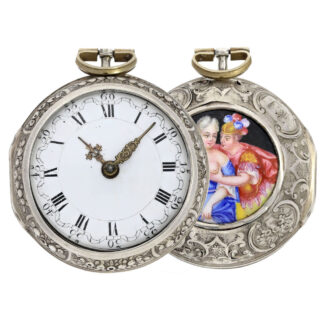
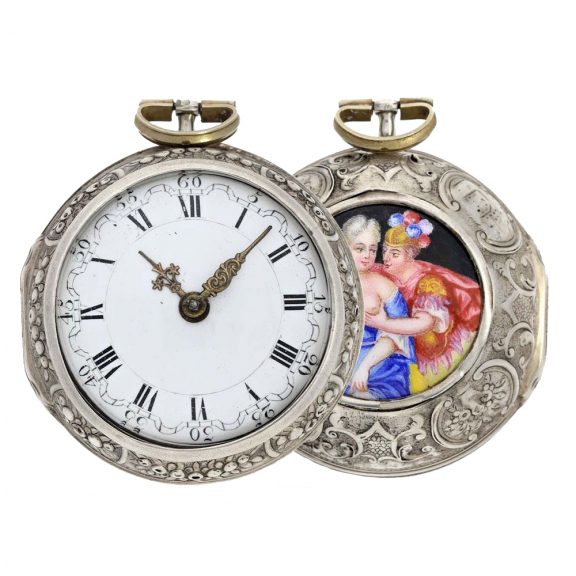
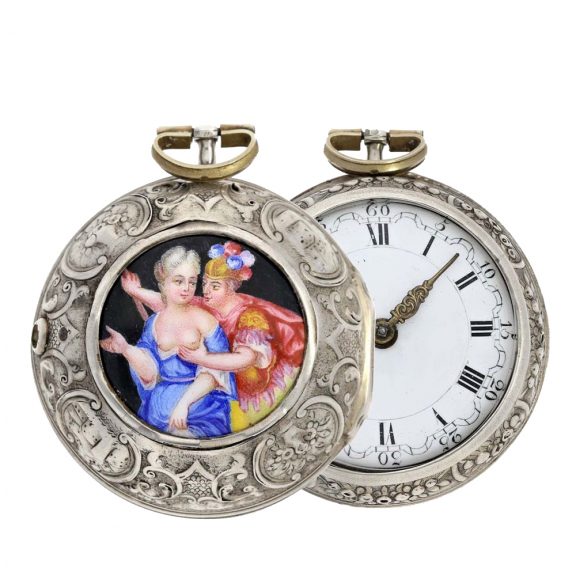
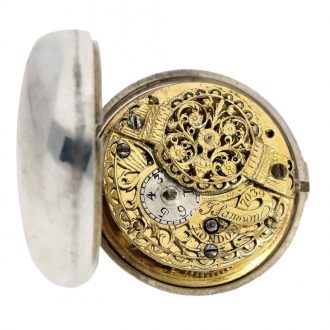
English pair case verge watch with rare enamel cartouche Circa 1752
- Kenmerk
- HC0684
- Diameter
- 50 mm
- Estimate
- € 2.000 - 4.000
- Price sold
- € 2.350
Pocket watch with erotic painting
–
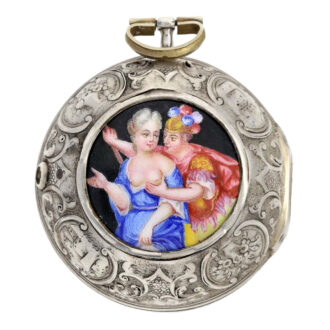
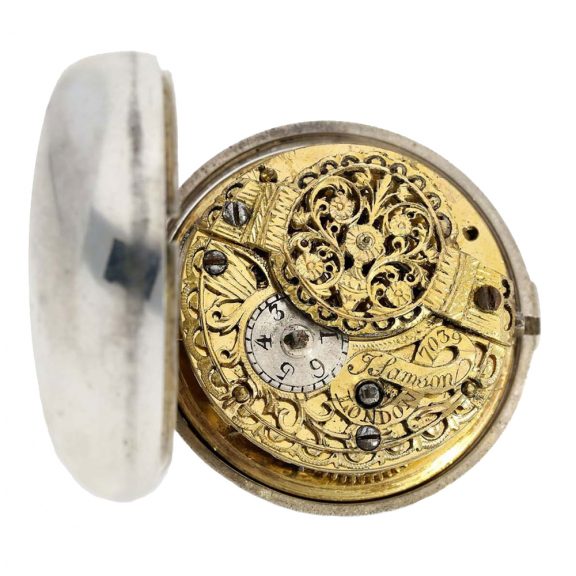
A pair case verge watch with rare enamel cartouche and erotic painting, probably Mussard school, made by J. Samson in London, England, circa 1752. The open faced pair case is crafted from silver, the first case has an extravagant relief decoration, peripheral floral paintings and two castles and a very fine central enamel painting, the quality and erotic scene of which indicate Mussard’s workshop, the second case is plain and has London hallmarks.
The white enamel dial has an outer ring with black Arabic hour numerals (outside), black Roman hour numerals (inside) and gilt hands. The movement has a verge escapement.
Matching numbers on case and movement and movement signed.
–
Diameter: 50 mm
–
Weight: 100 g
–
Signed: J. Samson, London
–
The speciality of the watch is the enamel cartouche. Even back then, the artistic quality of these works was so highly regarded that these cartouches were used over a period of almost 100 years as decorative elements for movements and cases. Works from Mussard’s Workshop and Huaud were especially appreciated. Jean V Mussard (1681-1754) was one of the best enamel painters of the early 18th century. He was the son of Jean IV. He began his career as a goldsmith and became Master on 7 December 1699. Later he became one of the most famous enamel painters, influenced by the style of Frères Huaud.
–
J. Samson
J. Samson was a pocket watchmaker in London, where he was active from 1760 – 1796. The Metropolitan Museum of Art in New York has a collection of pocket watches made by J. Samson, dating back to the 18th century.
–
Jean Mussard V
Jean Mussard V was born and died in Geneva in 1681-1754. He was one of the best enamel painters of the early 18th century, the son of Jean IV and a cousin of the Huauds. He began his career as a goldsmith and became a Master on December 7th, 1699. He later became a painter of enamel, in which discipline the style of Les Frères Huaud influenced him. Although their work inspired him, his paintings were more according to the taste of the time; they showed religious designs and purely secular ones. He partnered with his son Jean-Antoine and trained several pupils, including Gabriel Fontaine, André Oettner, and in 1712, Germain Colladon. The scene ‘The Death of Cleopatra’ can be found on several of his enamel watches, but two of his best known subjects are ‘Roman Charity’ and ‘Religious Scene’. His signature appears as ‘Mussard’, ‘Jean Mussard pinx’ and ‘Mussard pinx’.
Signed: J. Samson, London
Share this page: