Exceptional English quarter repeater cylinder watch Circa 1719
- Kenmerk
- AM0139
- Diameter
- 56 mm
- Estimate
- € 12.000 - 24.000
- Price sold
- -
Gold watch with champlevé dial by George Graham
–
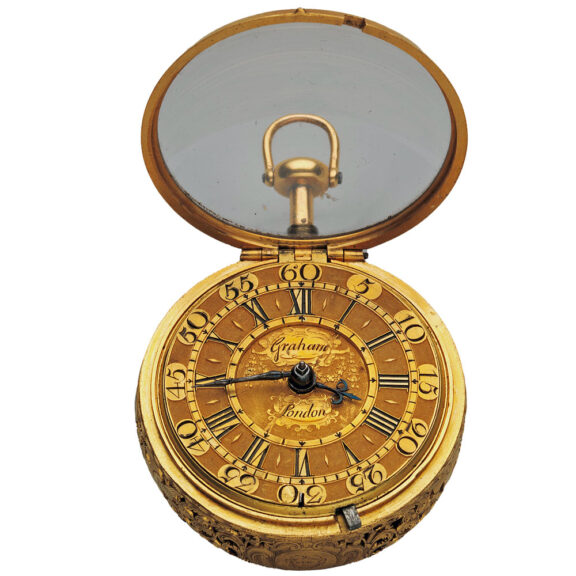
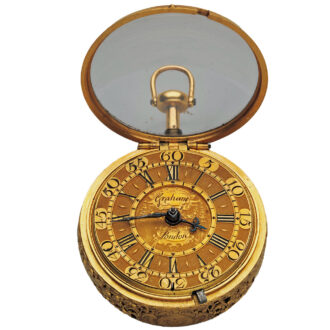
An early and exceptional English gold pocket watch with gold champlevé dial, circa 1719.
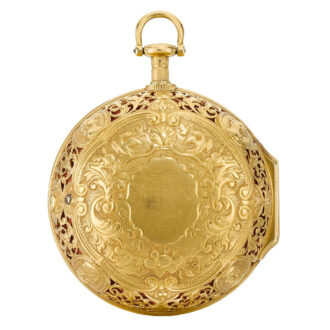
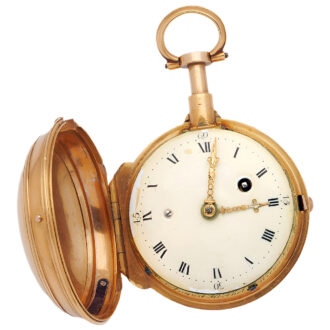
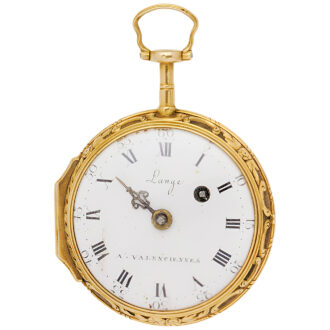
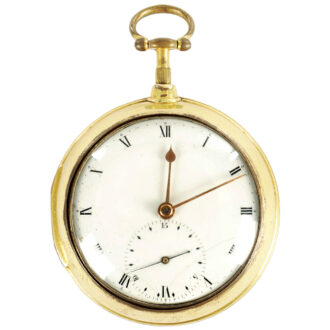
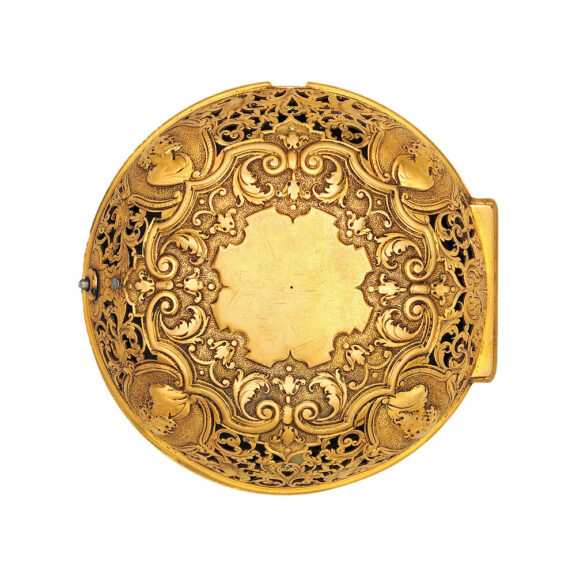
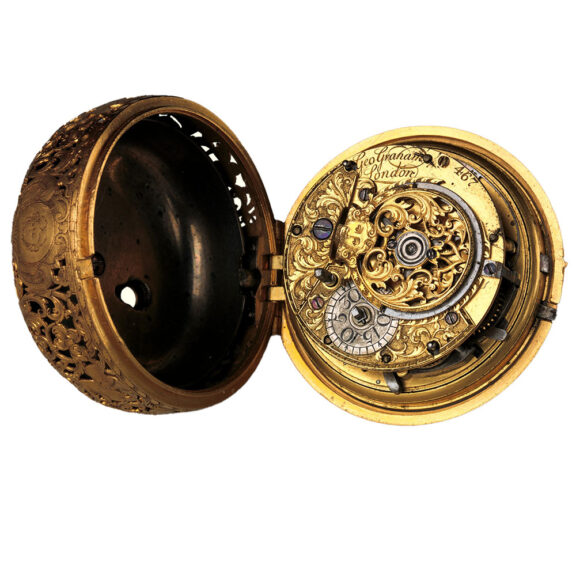
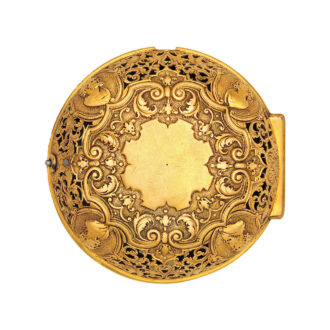
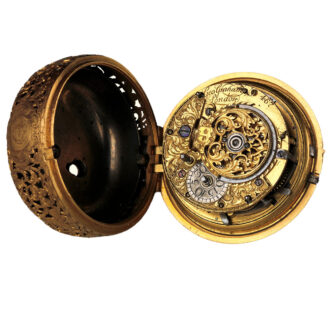
The watch features a full plate gilded brass and partly blued steel movement with applied pierced and florally engraved ornaments, chain/fusee, Egyptian movement pillars, three-arm steel balance, and a very finely engraved pierced balance cock with a cherub face. The cylinder escapement and silver regulator disc add to the watch’s precision. The gold champlevé dial displays Roman radial hours, an outer minutes track with Arabic five minutes numerals, and blue steel beetle and poker hands. The watch has two cases; a gold pierced and engraved outer case with a blanc cartouche and large lateral hinge; and a gold polished inner case. Graham of London signs the watch on the dial and back plate of the movement. The inscription 467 is engraved inside the back of the outer case. In conclusion, this early English gold pocket watch from 1719 is a remarkable piece of horological history and in excellent condition.
–
Diameter: 56 mm
–
Signed: Graham, London
–
This watch has intricate markings on the inside back of the outer case and inner case. The casemaker’s mark for William Sherwood Sr. is present on both cases, denoted by the initials “W S”. The London date letter for 1720 is also visible on the outer case, while the inner case features the letter “D” for the year 1719. English quality marks for sterling are present on both cases, indicated by the Lion passant symbol. Additionally, the London assay office mark, represented by the Leopard’s head, can be seen on both cases. The repeating watch was made by renowned watchmaker George Graham, as evidenced by the serial number “467” present on both cases.
–
George Graham was born on July 7th, 1673, maybe 1675, in Kirkliston, Cumberland, and died on November 16th, 1751. He was one of England’s most renowned clock and watchmakers, an inventor and geophysicist, and a Fellow of the Royal Society. Further, a Quaker like his mentor Thomas Tompion, Graham left Cumberland in 1688 for London to work with Tompion. He later married Tompion’s niece, Elizabeth Tompion. Graham is credited with inventing several design improvements to the pendulum clock, inventing the mercury pendulum and the orrery. This mechanical Solar system model illustrates or predicts the planets’ and moons’ relative positions and motions. He was made Master of the Worshipful Company of Clockmakers in 1722. Between 1730 and 1738, Graham had as an apprentice Thomas Mudge who became an eminent watchmaker in his own right and invented the lever escapement, an important development for pocket watches. On the latter’s arrival in London, Graham was introduced to John Harisson and became a long-time advisor and supporter of Harrison’s work on a marine chronometer. He was also widely acquainted with practical astronomy, invented many valuable astronomical instruments and improved others. On his death, as a sign of the great respect in which Graham was held, Tompion’s grave in Westminster Abbey was opened to receive the body of his former partner.
Signed: Graham, London
Share this page: