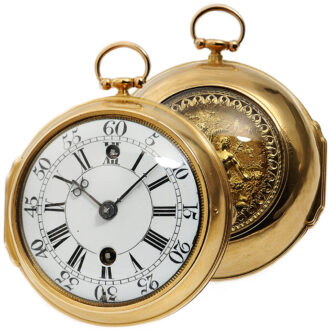
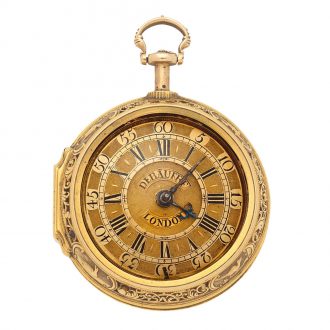
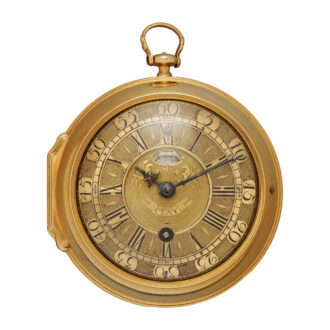
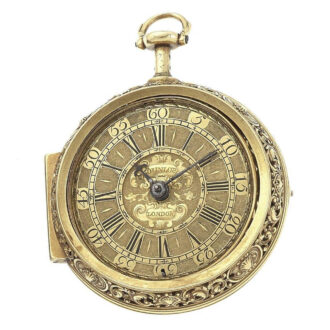
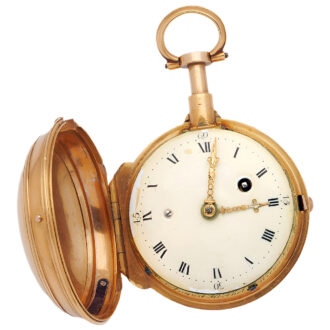
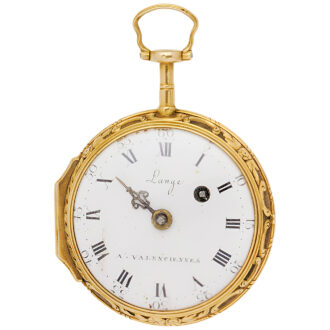
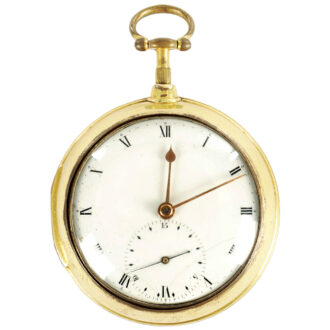
English repeating Repoussé verge pocket watch Circa 1720
- Kenmerk
- AD4323
- Diameter
- 45 mm
- Estimate
- € 4.500 - 8.000
- Price sold
- € 4.650
Gold open faced pair-cased watch by Peter Debaufre
–
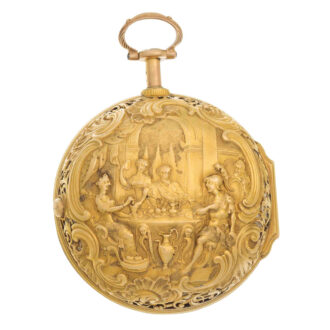
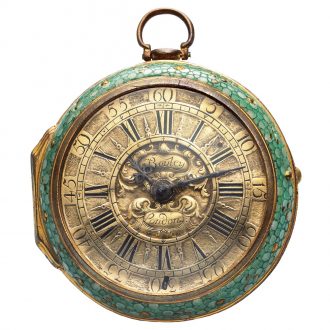
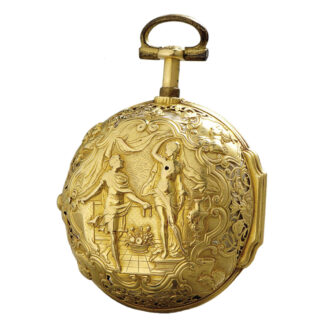
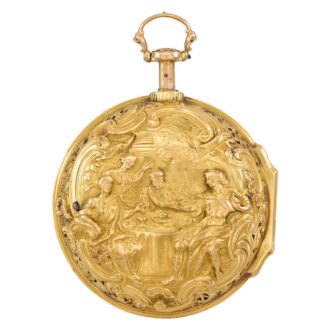
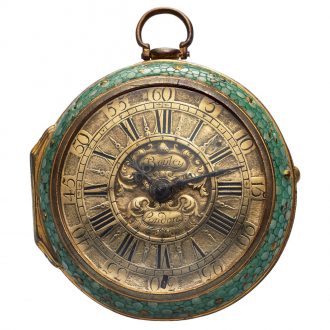
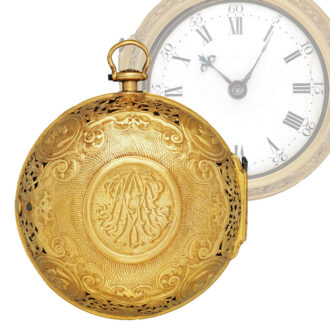
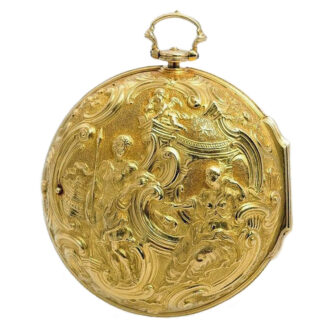
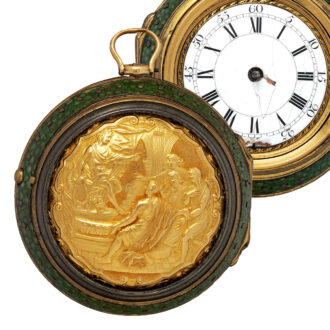
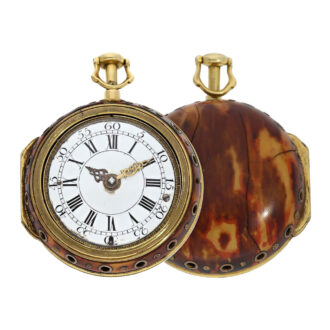
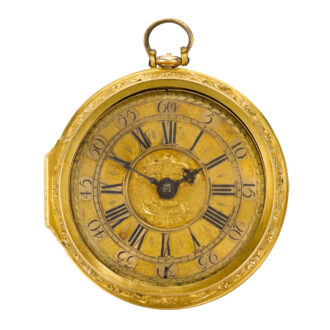
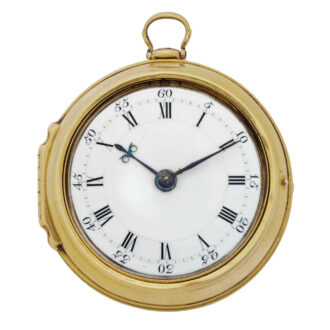
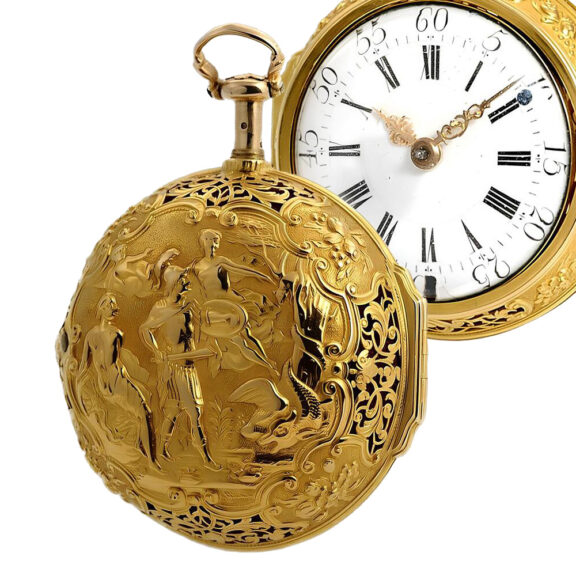
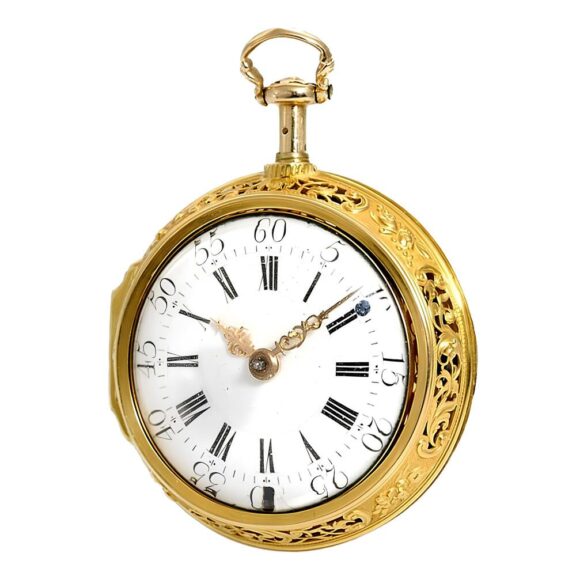
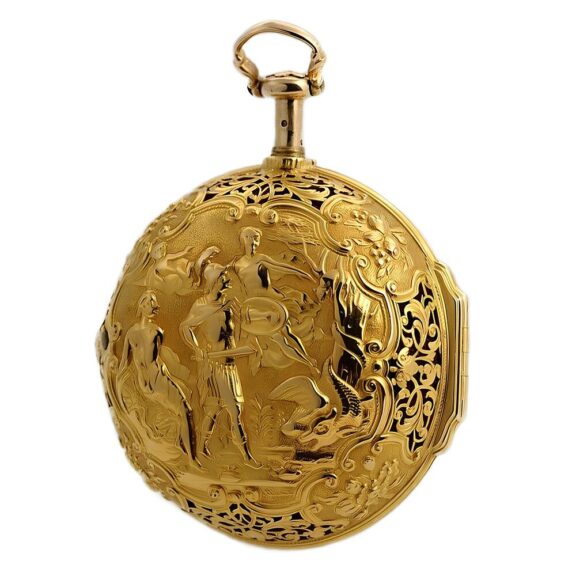
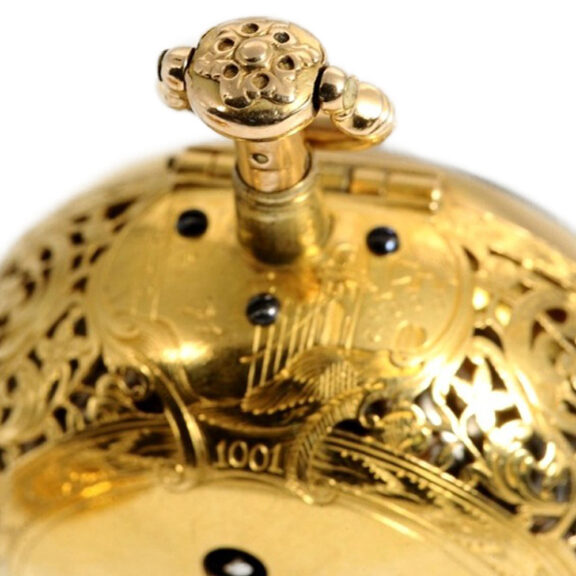
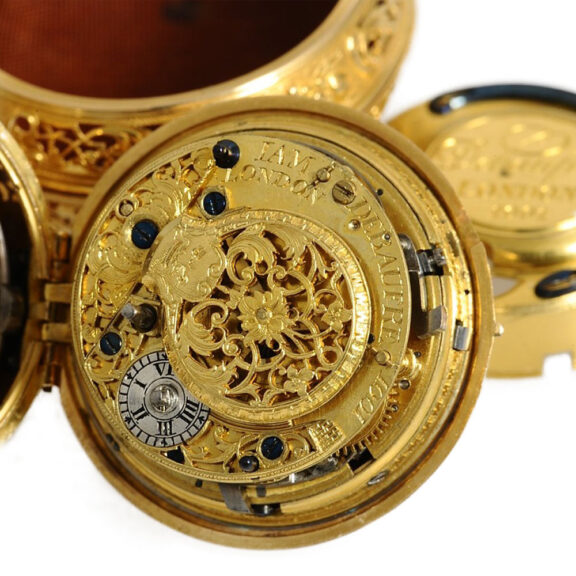
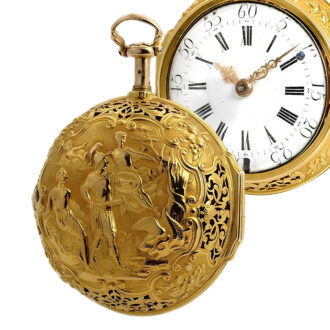
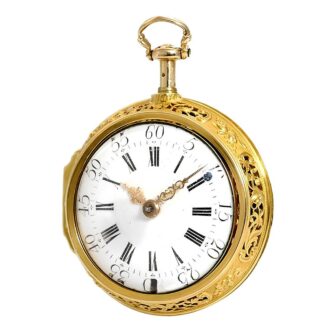
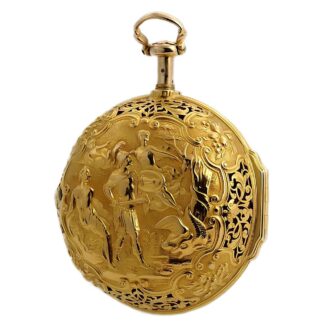
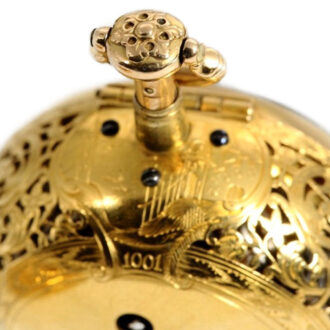
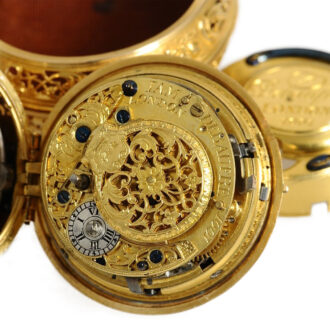
A decorative English double-cased quarter repeating Repoussé verge pocket watch, Perseus saves Andromeda, circa 1720. The watch consists of two cases: an outer case that is gold and features a repoussé scene of Perseus saves Andromeda, a pierced edge and a large lateral hinge, and an inner case that is also gold and has pierced edges decorated with engraved flowers, birds, a mask, and a view of a town. The watch includes a signed and numbered gilt dust cover, pusher for repetition via pendant and rear bell. The enamel dial displays radial Roman hours, radial Arabic minutes, and Louis XVI hands. The full plate movement is keywind with fire gilt and signed, with applied florally engraved decorations, chain/fusee, baluster-shaped movement pillars, two hammers, and a three-arm brass balance. The balance cock is very finely florally engraved and pierced.
–
Diameter: 45 mm
–
Weight: 106 g
–
Signed: Peter Debaufre, London
–
Peter Debaufre was a renowned craftsman born in Paris in 1675 and later moved to London in 1689. He is credited with developing the exceptional quality of the double-wheel dead-beat verge escapement. His watches were so esteemed that Isaac Newton was known to carry one. In 1704, Debaufre, in collaboration with his brothers Jacob and Nicholas Fatio, attempted to obtain a patent for jewel bearings in watches. However, their efforts were strongly opposed and ultimately fought off by the Clockmakers Company.
–
The story of Perseus and Andromeda is a famous tale in which Perseus encounters Andromeda tied to a trunk, ready to be sacrificed to a sea monster on his way back home. Perseus falls in love with Andromeda and kills the beast to free her. Subsequently, he takes Andromeda as his wife. This story has been depicted in various paintings, one of which is by Piero di Cosimo and is called “Perseus saves Andromeda,” which is exhibited at the Uffizi Gallery in Florence.
Signed: Peter Debaufre, London
Share this page: