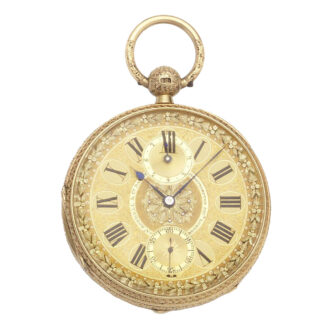
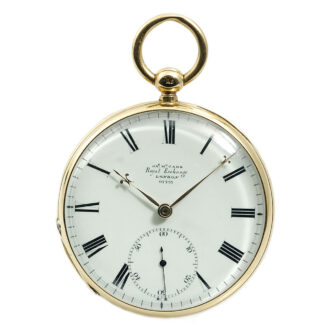
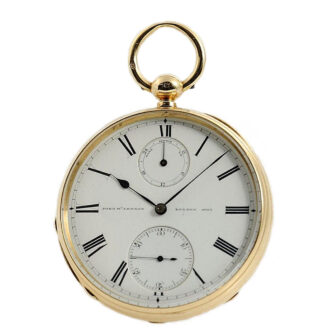
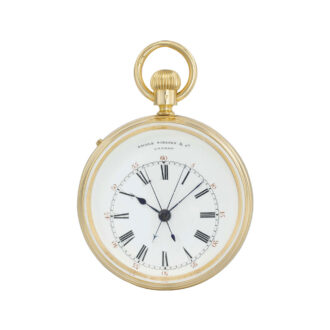
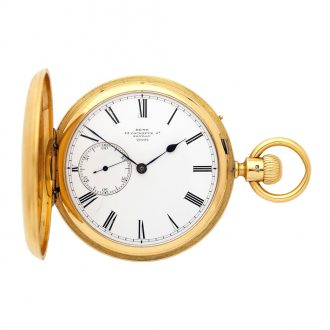
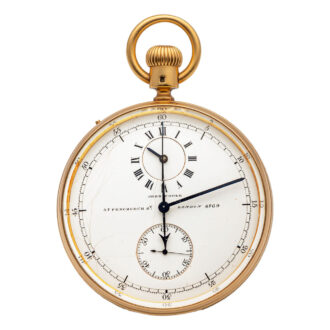
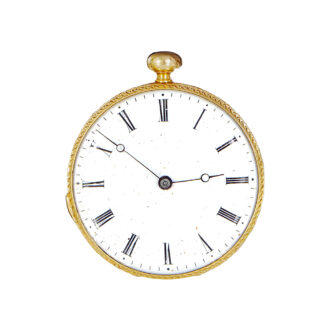
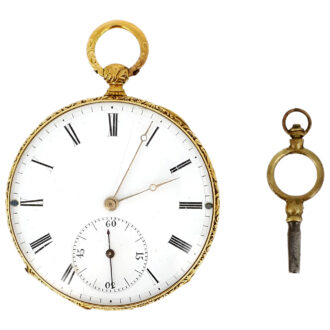
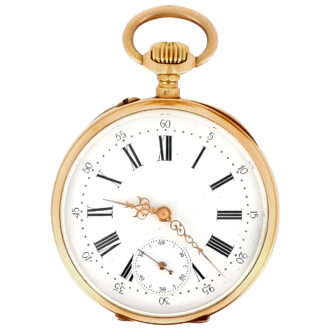
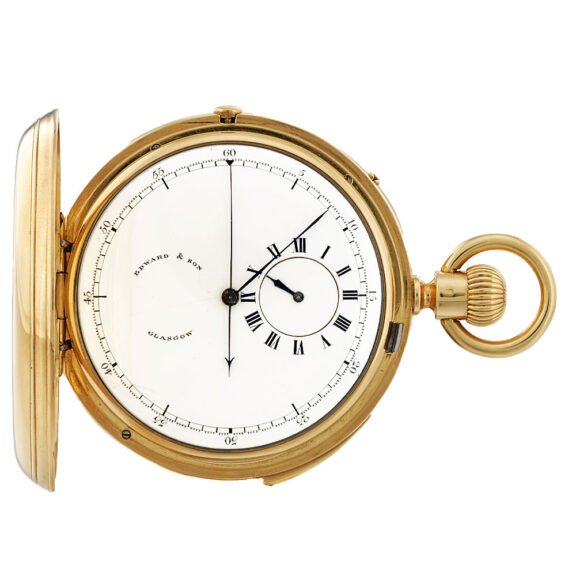
English repeating chronograph with regulator dial Circa 1874
- Kenmerk
- AA0447
- Diameter
- 54 mm
- Estimate
- € 7.500 - 14.000
- Price sold
- € 6.100
Rare gold full hunter chronograph by George Edward & Sons
–
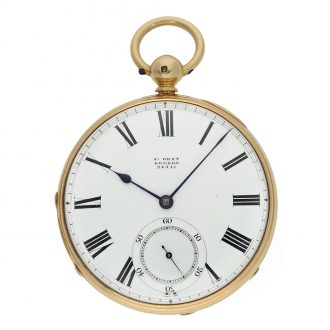
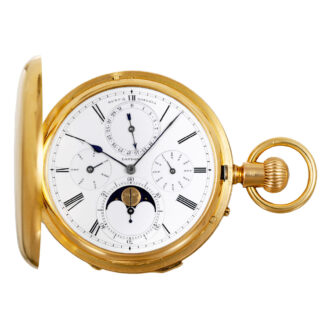
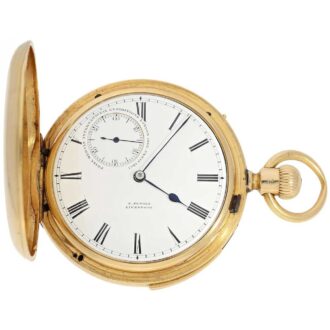
A fine and rare, English 18K yellow gold hunting cased keyless-winding pocket watch with two horological complications, circa 1874-1875.
Gilded brass ¾ plate movement, going barrel, English lateral lever escapement, cut bimetallic compensated balance with gold and platinum poising screws and blued steel hairspring with a terminal curve, index regulator; no motion train, the hours are independent of the minutes, hours driven directly from the barrel arbour, minutes from the centre wheel; Nicole Nielsen winding/setting system adopted to set the unusual independent hands, Nicole Nielsen’s chronograph work mounted under the dial.
–
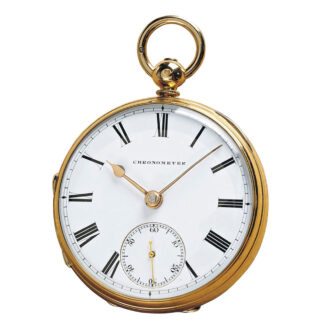
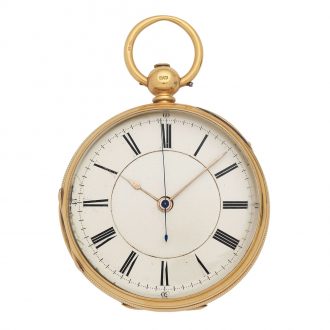
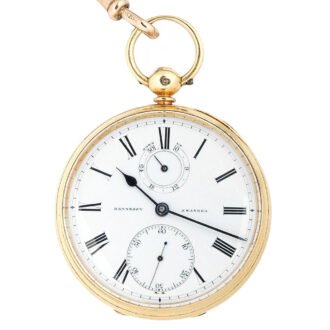
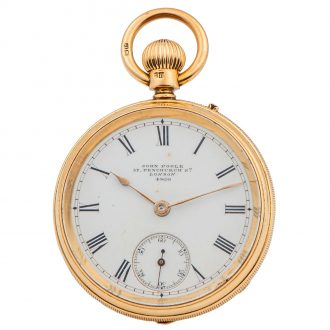
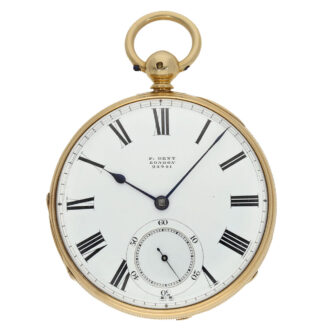
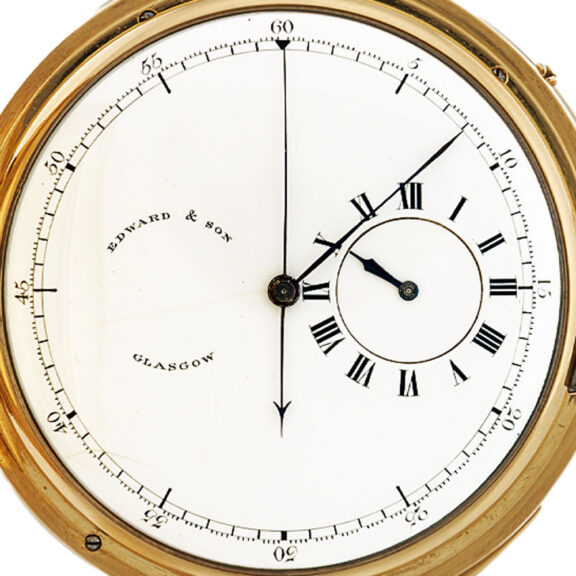
White enamel Regulator-type dial with an eccentric chapter at 3 o’clock with radial Roman numerals, central minutes with five-minute Arabic numerals, outermost chronograph scale, original blued steel hands, and two horological complications: – Minute-repeater on two steel gongs (activated by the slide at 5 o’clock): – Chronograph (activated by the single round push-piece located on the case band at 12 o’clock).
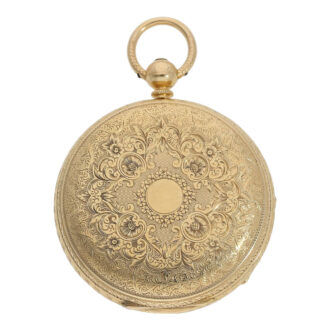
Round-shaped 18K yellow gold case, cover and case back polished. Case numbered: 7719 (by B B inside an oval inside the cover, and, A N inside an oval inside the case back and cuvette), with London letter date for 1874-1875). Dial, case and movement signed.
–
Diameter: 53 mm
–
Signed: George Edward & Son Glasgow
–
Repair required and hairlines on enamel and various types of decoration.
–
The watch has several unusual features, one of which was protected, as stated on the movement, by British Patent No. 7 719. The independent regulator dial can be found only in English watches and rather rarely. The early ones were set independently, the hour hand was set first and then the minute. In this case, Nicole Nielsen devised a system that can do it through the crown, it involves creating motion work, like train set on top of their standard system. Due to this, the barrel must be designed differently and moved at least in one direction during the setting. A split arbour was designed.
–
George Edward & Sons was founded in 1837 by George Edward in Glasgow. In 1863 the company was located at 92 Buchanan Street (Royal Bank Buildings); later, the business was expanded to 96. In 1874 a shop was opened in London at Mansion House Buildings, on 19 Cheapside Poultry. The company represented in Scotland the Pulsynetic Electric impulses clocking Ghent and Co. The company was also a supplier of chronometers for the Admiralty (Chronometer Makers to the Admiralty). The company was continued as Edward & Sons by George Edward Jr., David Herbert Edward, and Arthur Edward. In 1925the company became an Ltd (limited liability company). Telephone: 7683 City (2 lines). Telegrams and Cables: Edward, Glasgow. Bankers: British Linen Co. Bank. In 1963 the company in Glasgow relocated to 46 St. Vincent Street and was later taken over by the Mappin & Webb group.
–
Signed: George Edward & Son Glasgow
Share this page: