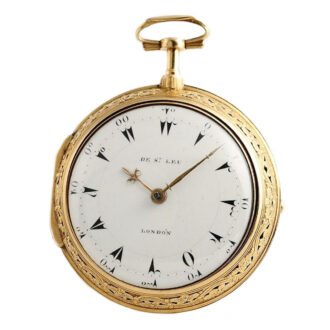
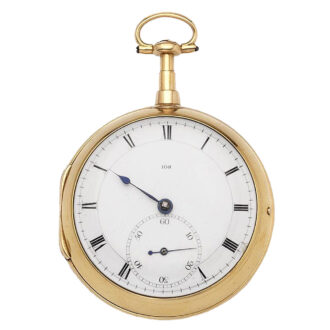
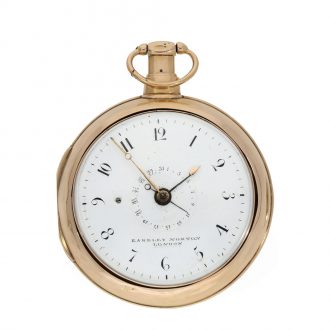
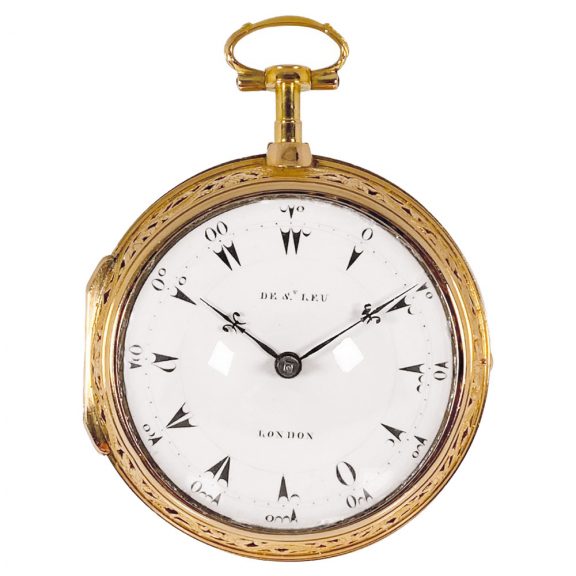
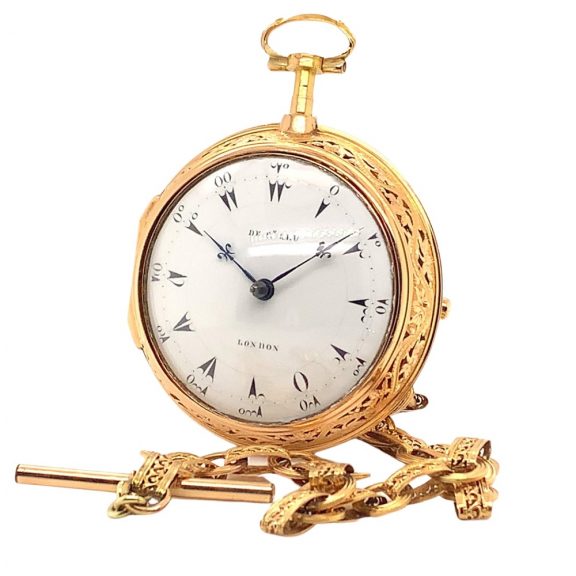
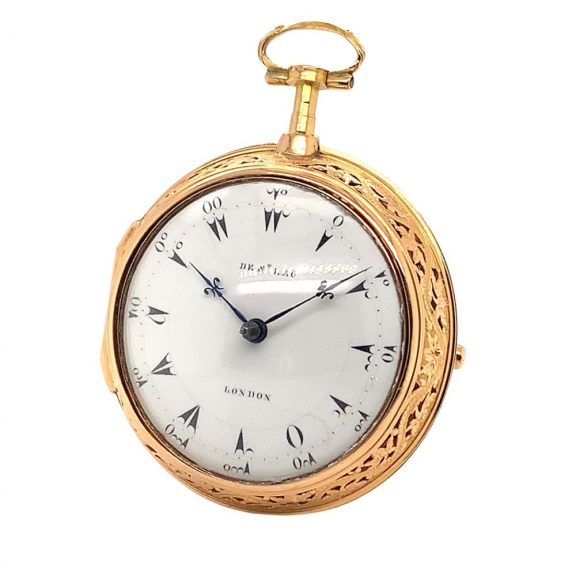
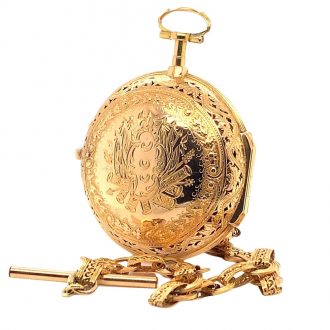
English self strike verge watch for the Ottoman market Circa 1794
- Kenmerk
- AD1586
- Diameter
- 60 mm
- Estimate
- € 5.500 - 11.000
- Price sold
- € 6.000
Gold pair cased pocket watch by Daniel De Saint Leu
–
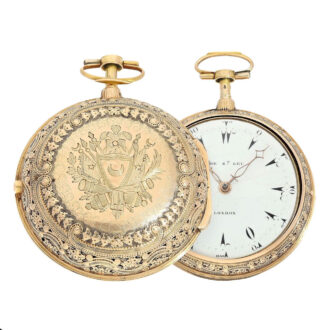
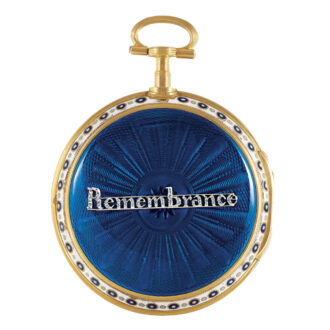
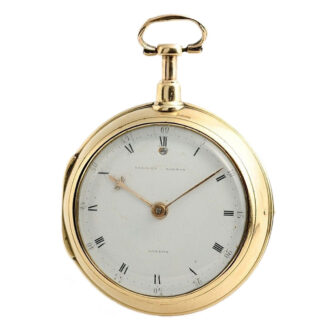
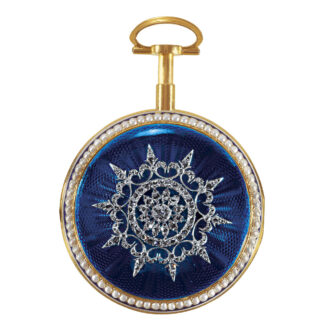
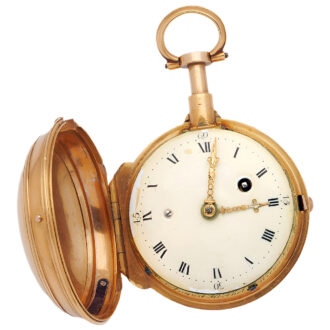
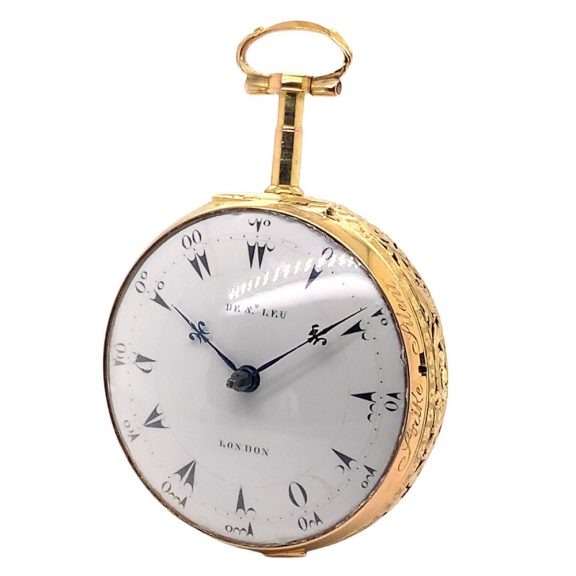
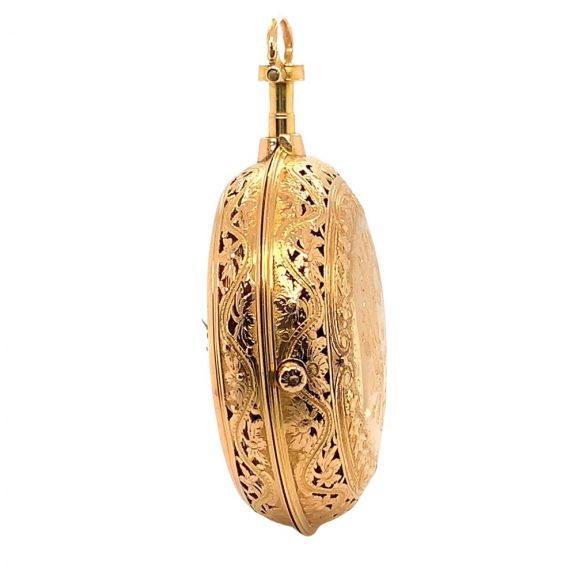
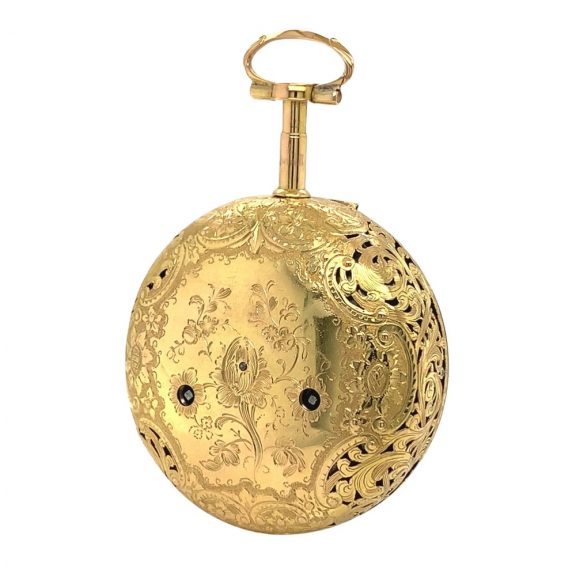
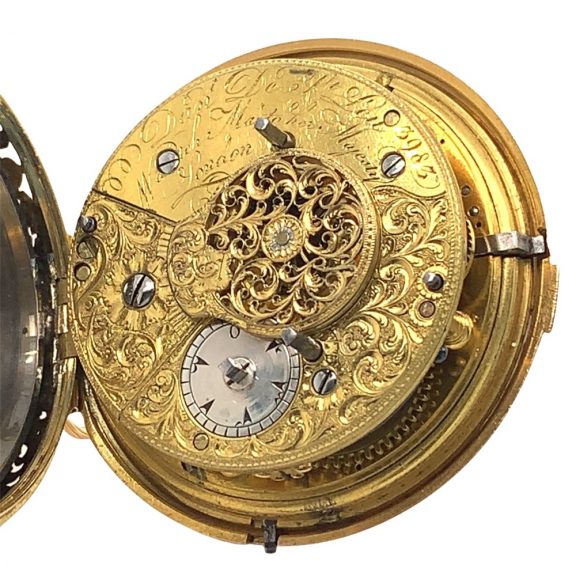
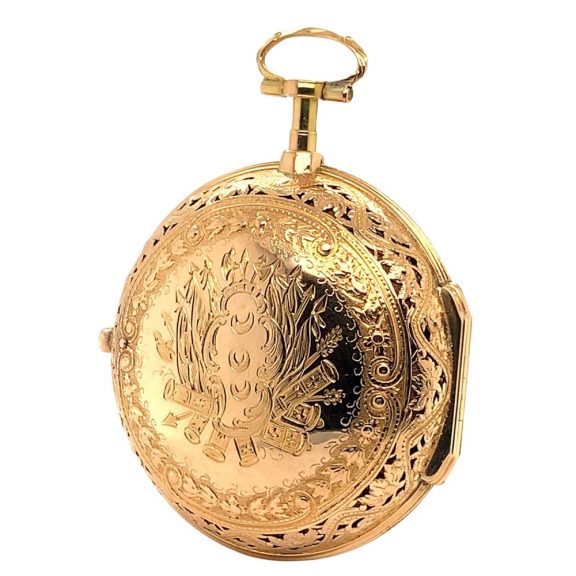
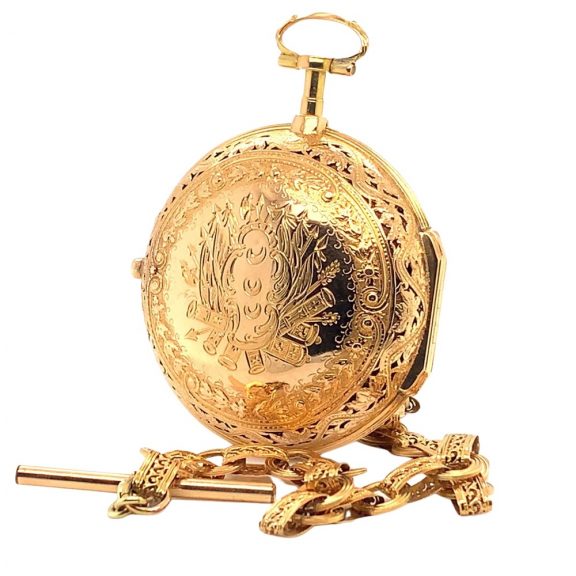
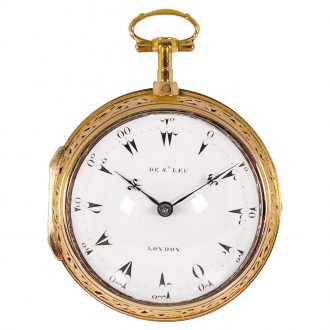
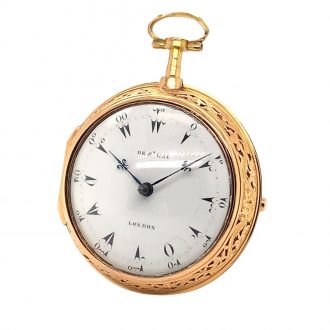
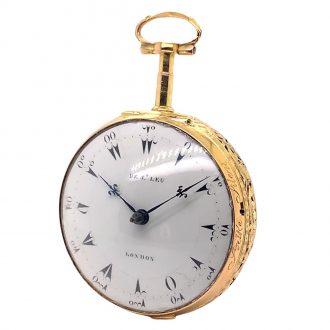
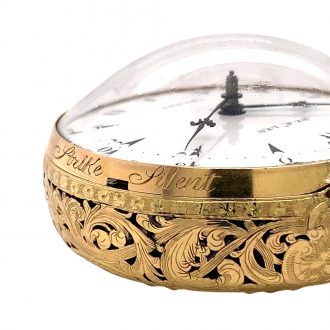
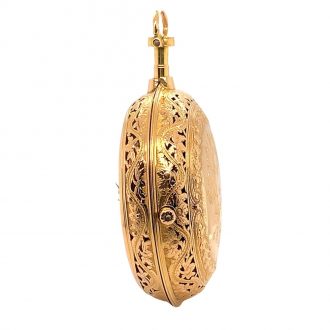
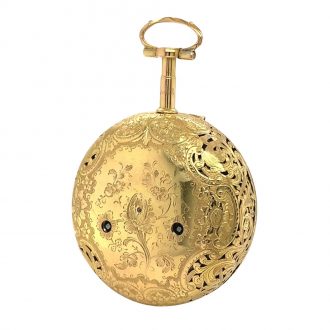
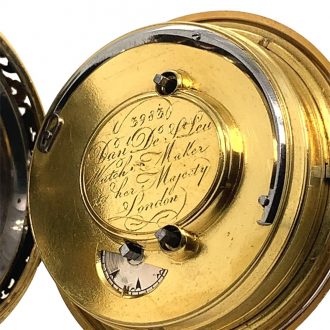
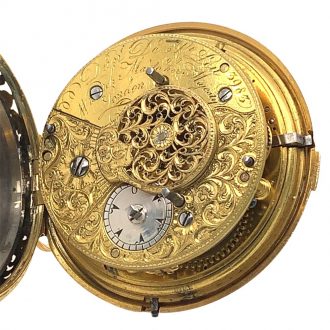
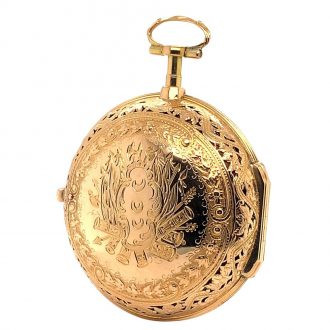
An important English pair cased pocket watch with self strike made for the Ottoman market, along with a matching 14 carat gold watch chain, circa 1794. The watch has a signed, fire gilt, florally engraved, key wound full plate movement with a verge escapement, chain and fusee, two hammers, solid movement pillars, a three arm brass balance, and a pierced balance cock lavishly hand engraved with entwined leaves. It also features a signed white enamel dial with radial Ottoman numerals and Fleur-de-Lys hands. The engraved outer case with maker’s punch mark IP is made of 18 carat gold, while the engraved inner case is made of 14 carat gold and has a rear bell.
–
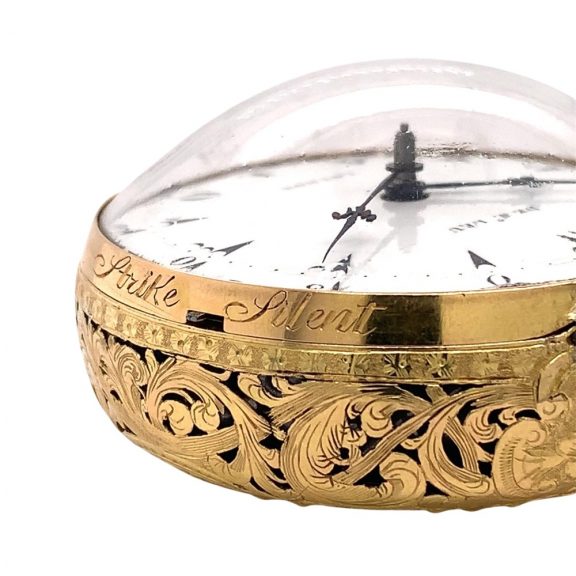
The beautifully preserved outer case is richly decorated with artfully crafted sound openings and adorned with flower garlands. In the center is a coat of arms with crescent moons surrounded by war trophies and bordered by a garland of leaves and flowers. The golden inner case is equally ornate with pierced rims and lavish engraved floral decorations. A slider on the edge enables you to deactivate the quarter hour strike.
–
Diameter: 60 mm
–
Weight: 180 g
–
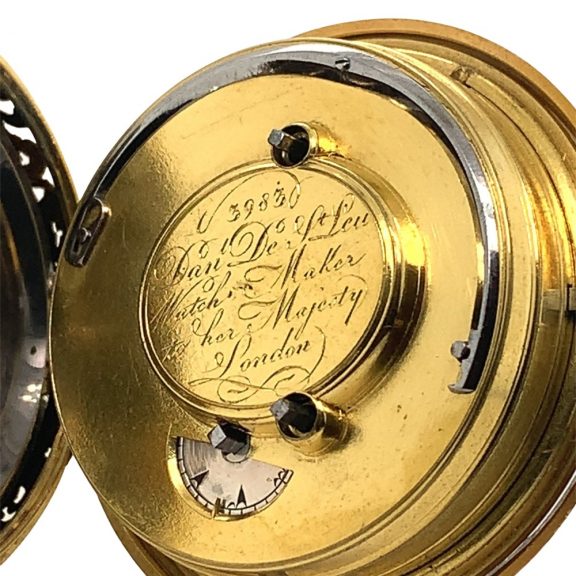
Signed: Daniel De Saint Leu Watch Maker to Her Majesty London
–
Daniel de St. Leu
Daniel De St. Leu was a Genevan of origin. As a watchmaker, he worked in Geneva and London. De St. Leu was listed in London from 1753 until 1797.
–
He manufactured some of the most exquisite and elaborate watches of the 18th century. Gaining royal favour, he was appointed watchmaker to Queen Charlotte, wife of King George III, in 1765, a title he held for the rest of his life, since all his watches after this date are either signed ‘Sevt. to her Majesty’ or ‘Watch Maker to her Majesty’.
–
He crafted movements of superior quality and specialized in making watches for affluent Ottoman clients, who requested their watches to be as pieces of jewellery, preferably in lavish decorated gold cases and set with precious stones. In the 18th century, the export of English watches to the Ottoman Empire was conducted on a large scale.
–
In his book ‘A New Dictionary of Trade and Commerce’ from 1756, Richard Rolt states that “Great quantities of watches are exported to Asia, particularly to Turkey, where they serve more for ornaments like pictures in rooms, than for use in pockets.”
Signed: Daniel De Saint Leu Watch Maker to Her Majesty London
Share this page: