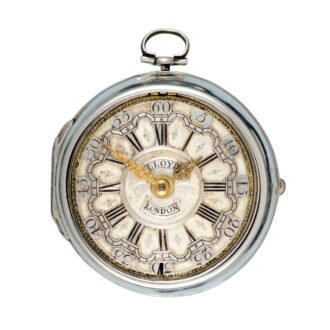
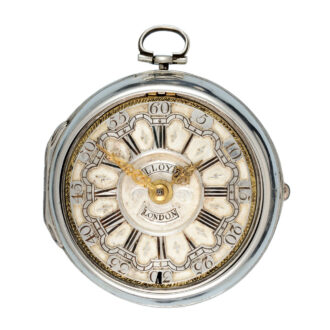
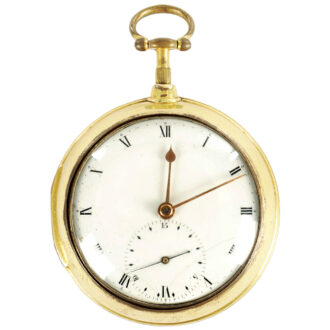
English silver verge watch of fantastic quality Circa 1738
- Kenmerk
- HC2233
- Diameter
- 49 mm
- Estimate
- € 750 - 1.500
- Price sold
- € 1.000
Fine verge pocket watch
–
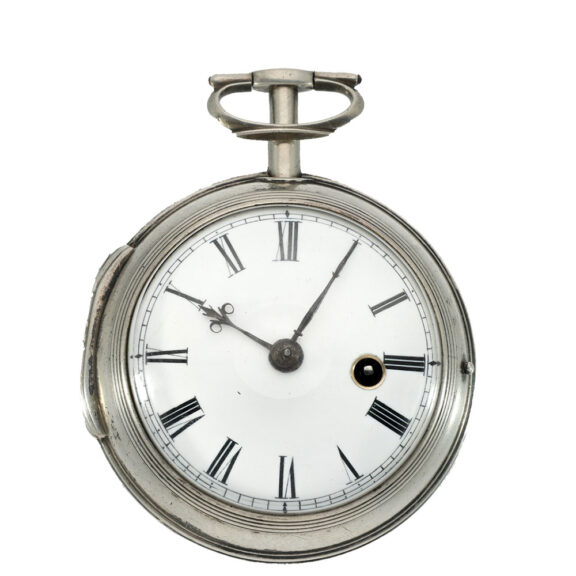
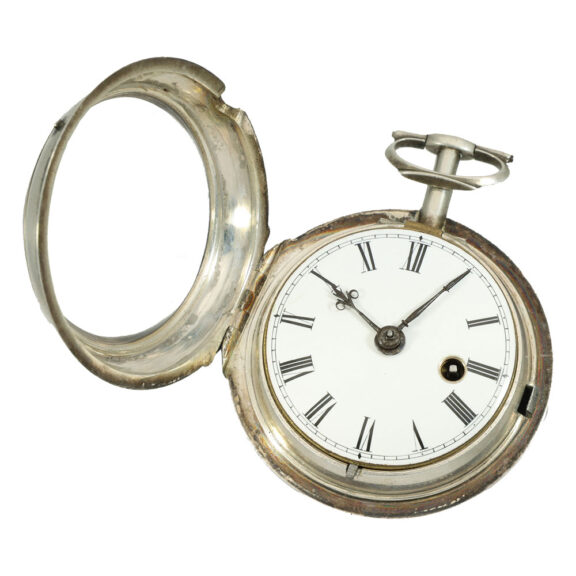
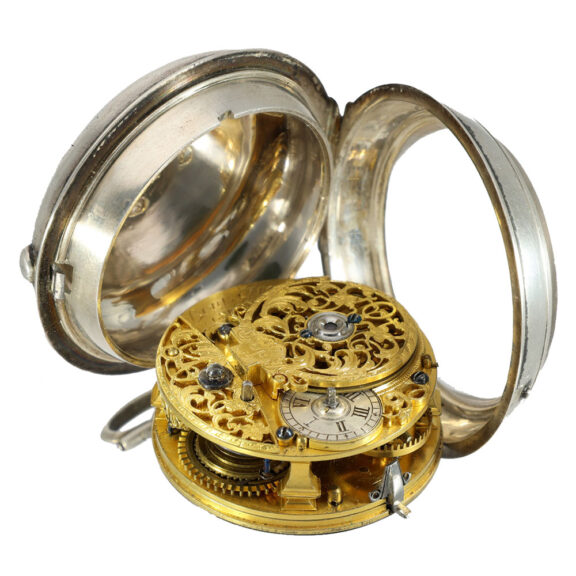
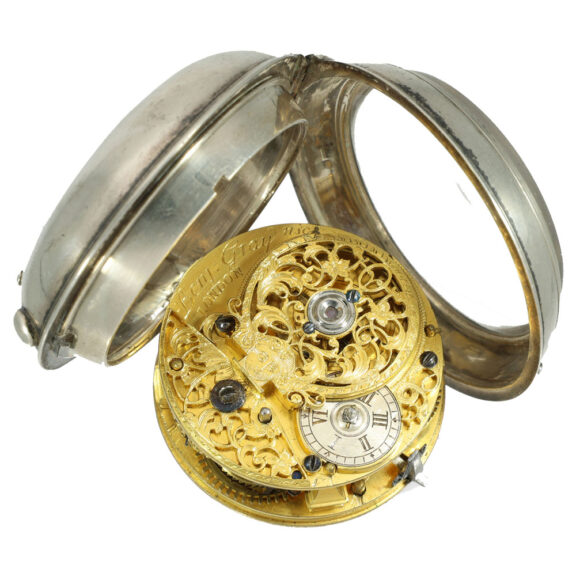
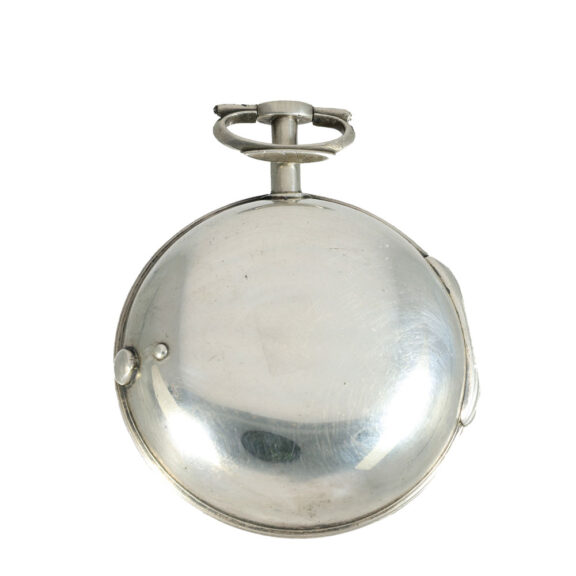
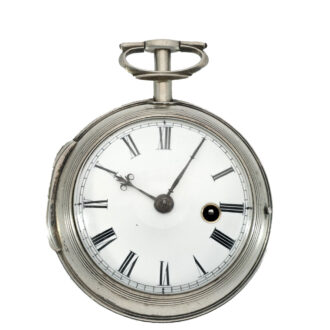
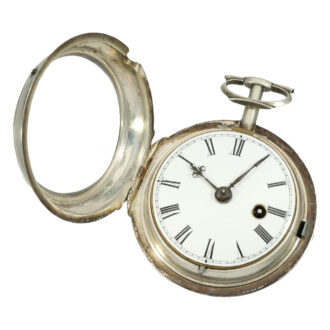
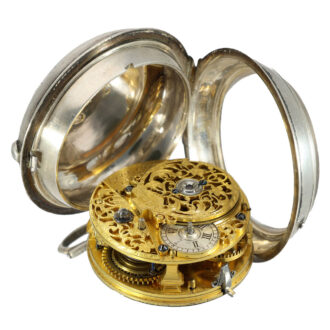
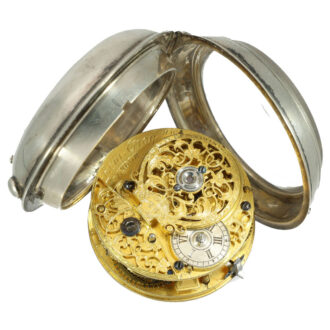
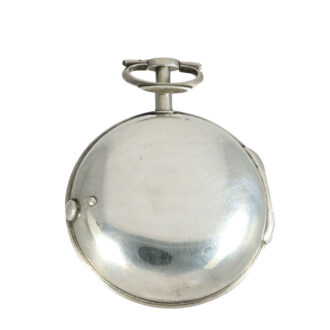
A fine verge pocket watch, made by the royal watchmaker Benjamin Gray in London, England, circa 1738. This classic antique silver pair cased watch features a plain, smooth, open faced outer case with a polished, unadorned finish. The protective case has a rounded, bulbous “bullseye” dome shape. At the 12 o’clock position, a protruding round pendant is topped with a matching metallic bow for securing a watch chain. Additionally, a prominent hinge assembly is visible on the right side of the closed case. The white enamel dial features an outer minute and hour track with Roman hour numerals and very fine original hands. The highly decorative numbered English mechanical movement is equipped with a verge escapement, a gilt brass balance cock and a Tompion style silver regulator disk.
The movement is signed.
–
Diameter: 48.5 mm
–
Weight: 87 g
–
Signed: Benj. Gray London nsc
–
Gray
Benjamin Gray (1676–1764) was a highly prominent English pocket watchmaker based in London. While he also crafted exceptional clocks, his personal records indicate that the vast majority of his workshop’s output consisted of watches rather than clocks. His extraordinary craftsmanship earned him the position of “Watchmaker in Ordinary” to King George II in 1742.
–
In 1743, Gray entered a partnership with Justin Vulliamy, a highly talented Swiss emigré clockmaker who had come to London to study advanced escapements. The business began signing its pieces as Gray & Vulliamy. The business partnership was cemented into a family legacy when Vulliamy married Gray’s daughter, Mary, in 1746.
Upon Benjamin Gray’s death in 1764, Justin Vulliamy assumed full control of the firm, signing pieces as Justin Vulliamy, London. He continued providing elite timepieces to the Royal Family, including the new King George III.
–
In the 1770’s, Justin’s son, Benjamin Vulliamy, joined the business (trading as Vulliamy & Son). This era was famous for combining state of the art mechanical clocks with fine Derby porcelain cases. They built the famous Regulator Clock for the King’s Kew Observatory, which effectively kept official London time until 1884.
–
The firm was passed down to the fourth generation under Benjamin Lewis Vulliamy, who served as Master of the Clockmakers’ Company five times and built massive public clocks, such as the turret clock for Windsor Castle.
–
The family business officially closed its doors following Benjamin Lewis Vulliamy’s death in 1854, ending a magnificent 138 year legacy of royal horology that originally began with Benjamin Gray.
Signed: Benj. Gray London nsc
Share this page: