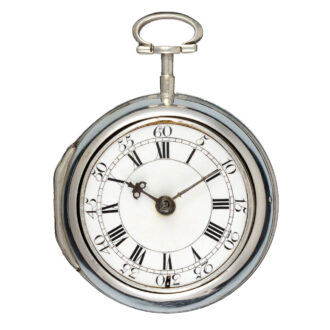
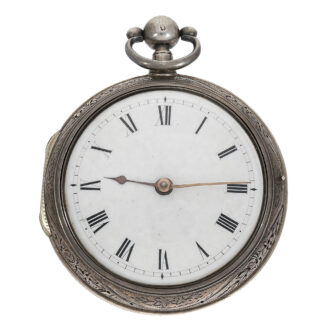
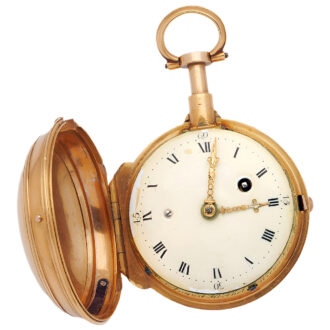
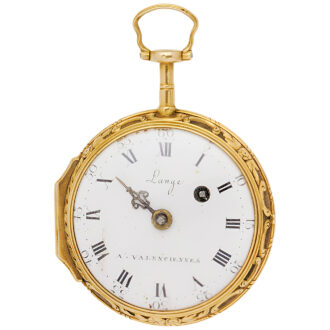
Triple cased half quarter repeating alarm verge Circa 1756
- Kenmerk
- SA9423
- Diameter
- 90 mm
- Estimate
- € 125.000 - 250.000
- Price sold
- € 235.000
Magnificent two-train half quarter repeating repousse alarm coach watch
–
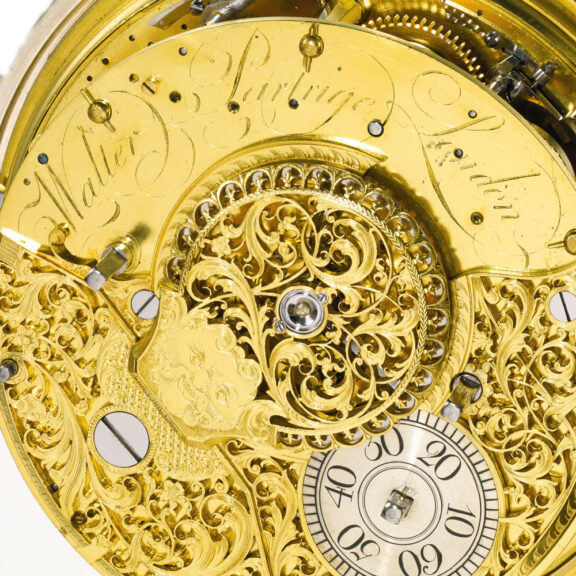
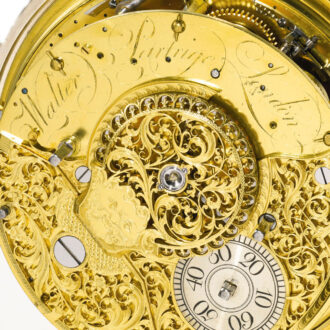
An English magnificent, very rare and massive silver triple cased two train half quarter repeating repousse coach watch with alarm, circa 1756, gilded full plate movement, verge escapement, decoratively pierced balance cock engraved with foliage, a grotesque mask at the neck, broad foot similarly decorated, flat steel three-arm balance, fusee and chain for the going train, standing barrel for alarm, four polished steel hammers, two for repeating and two for the alarm sounding on a large bell to the inside case back, multi-faceted slim baluster pillars, movement signed Walter Partrige, London, bell scratch signed Robt. Romley, London, gilt metal dust cap signed Walr. Partrige, Tower Street, London.
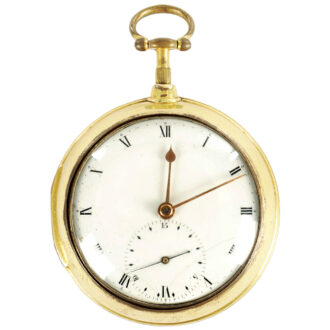
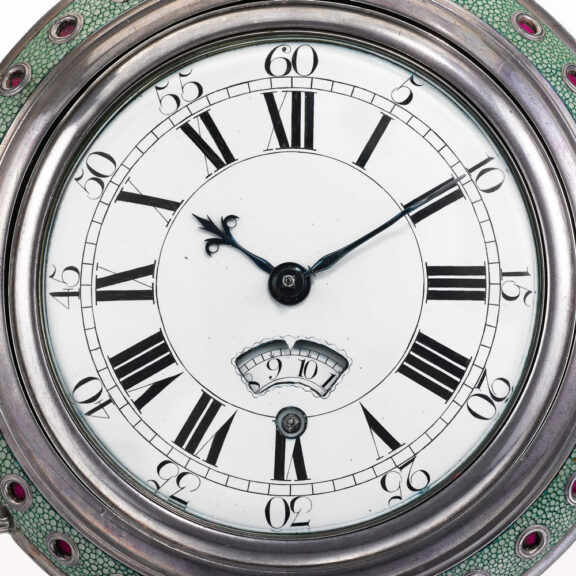
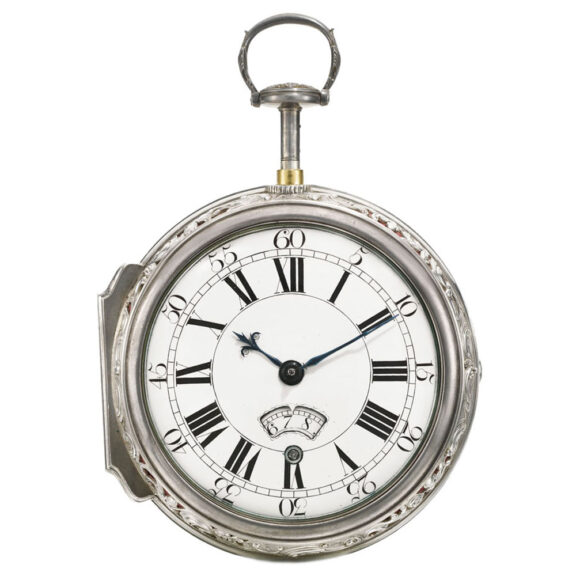
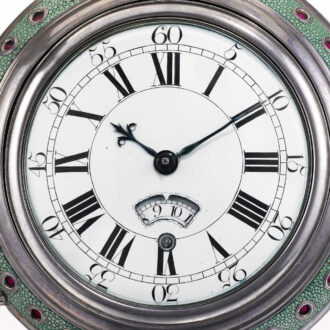
White enamel dial, Roman numerals, outer Arabic minute ring, aperture above 6 o’clock for alarm, blued steel beetle and poker hands, the minute hand kinked to accommodate alarm set square.
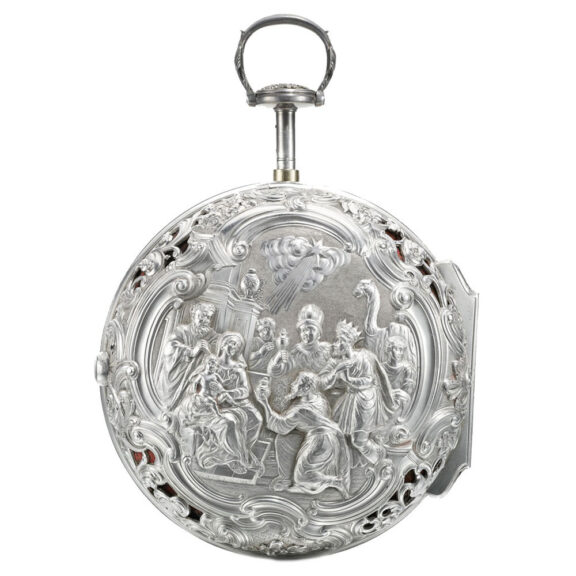
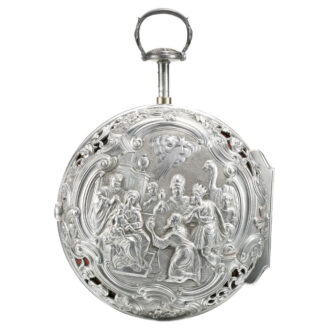
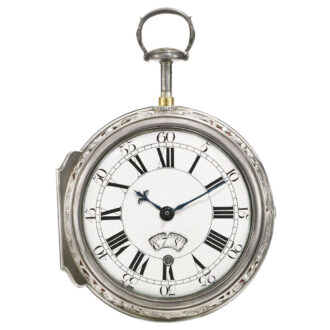
Silver inner case with pierced and engraved scrolling floral decoration with grotesque animals and a mask at the base, winding for going and alarm trains to the back, pulse piece beneath bezel at 4 o’clock, pendant with French control marks, the bow with applied leaf-form decoration, middle case with very fine silver repoussé scene depicting the Adoration of the Magi, signed A. Romer, F, framed by pierced and engraved border with scrolls, flowers and shells, the bezel similarly decorated, inner and repoussé cases and with case maker’s mark D.A. script incuse for Daniel Aveline, outer case covered with shagreen and with pierced silver roundels.
–
Diameter: 200 mm
–
Signed: Walter Partrige London
–
This exceptional watch is of quite monumental proportions and the magnificent repoussé to the middle case is almost overwhelming in the scale and detail of its execution. Measuring some 90mm larger than the average sized coach watch, only a handful of other English watches of comparable size are known. Three English watches of similar size include a coach watch by Ellicott, which is almost exactly contemporaneous in date to the Partridge, being hallmarked a year later in 1757. A further watch of comparable size (204mm in diameter) by Windmills which is hallmarked for 1729 is in the Historiches Museum, Basel. The Ellicott is pair cased and measures 180mm in diameter. A well-documented watch, having featured in several publications, the Ellicott was at one time in the collection of Percy Webster and was later in the collection of the Time Museum (sold Sotheby’s New York, 2nd December 1999, lot 16). A third watch which was also included in the 1970 Webster sale at Sotheby’s (lot 69), is a musical coach watch by William Hughes, circa 1780, which measures 180mm in diameter.
Partrige’s movement has clearly been specially made for this watch and is of the best quality London work. The enamel dial and the fine beetle and poker hands are typical of the period, but the numerals are noticeably strong: the watch was made so that, for instance, it could be hung from a bed-hook and the time read from a distance and in poor light. A key square at six o’clock adjusts the alarm setting in an aperture above. Of course the embossed and chased scene of the Adoration of the Magi would have been a suitable subject for a ‘coach’ or ‘travelling’ watch.
The signature A. Romer. F, can be found on the repoussé case to the step below the Virgin’s feet. Recent unpublished research by Dr. Richard Edgcumbe has identified the chaser as Andrew Romer. Edgcumbe has established that ‘Andreas Romer’ was of the parish of St Giles in the Fields when he married Elisabeth Martin at the Huguenot Church of the Savoy, Spring Gardens, on 14th April 1744, and also that Andrew ‘Rummer’ paid his Sun Insurance policy on goods worth £200 in 1755, this policy describing him as a chaser and living on the west side of New Belton Street. Andrew and his wife had four children, the first, also Andrew, had Stephen Rimbault, the well-known clockmaker, as a godfather. Rimbault’s wife, Françoise, was one of the godmothers of the second child, Elizabeth, and both the Rimbaults were godparents of the third, Stephen (who presumably took his name from his godfather). This Stephen Romer is recorded from 1790-96 as a goldsmith and jeweller at 33 Bridge Street, Covent Garden. The godfather of the fourth child, Charlotte, was Diederich Nicolaus Anderson, of Danish origin, a distinguished modeller and chaser of gilt bronze.
Andrew Romer took as apprentices Edward Norton Storr on 21st April 1753 and Thomas Storr on 3rd November 1757. [see:Registers of Duties Paid for Apprentices’ Indentures, National Archives, IR 1/19 and IR 1/21]. While E.N. Storr died in 1767, Thomas Storr (1743-1803, who by 1788 had become a victualler) was married in the late 1760s to Sarah Fullaway. Their only surviving son was Paul Storr (1770-1844), thought to have received his early training as a silver chaser, who went on to become a manufacturing silversmith. He was under contract between 1807 and early 1819 to the royal goldsmiths, Rundell, Bridge & Rundell, before establishing in 1822 the well-known business of Storr & Mortimer, later Hunt & Roskell. It is interesting to note that the working silversmith Emick Romer (see Grimwade, p. 646) was the son of Michel Michelsen Römer of Oslo in Sweden. Another Swedish working silversmith living in London was Andrew Fogelberg, who also happened to be Paul Storr’s first known employer. Stephen Rimbault’s son, Paul Rimbault of (9) Denmark Street, St. Giles in the Fields, clockmaker, died in 1785. His will, signed with a codicil on 11 May 1785 and proved on 2 June 1785, was witnessed by, among others, James Morisset, of the firm of Morisset & Wigman, gold workers and enamellers, also of Denmark Street, who supplied work to Rundell & Bridge (see Claude Blair, Three Presentation Swords, Victoria and Albert Museum, 1972).
Thus we have a picture of Andrew Romer as a man with a tightly knit network of family and business relationships, whose influence was such that he was able to turn to significant figures in the horological and metalworking worlds for godparents of his children, one of whom, at least, worked in a similar trade to his father. Richard Edgcumbe has not come across any evidence as to whether Andrew was related to John Christopher Romer, or indeed Emick Romer, but one imagines there could well be a family connection. John Romer of Compton Street, Soho, was of course an important associate of George Wickes, the Royal Goldsmith, from before 1752 and, after 1760, Wickes’s successors Parker and Wakelin. Perhaps John Romer’s most famous piece is the magnificent Cosby Cup 1772-3, preserved in the Mansion House, on which there are plaques signed ‘G. D. Gaab’ (see, Edgcumbe: Art of the Gold Chaser, figs. 25a-d). George Daniel Gaab, lived in the same street and was married in the same year as Andrew Romer (1744, the same year also as John Romer). In 1763, Gaab was listed in Mortimer’s Universal Directory as a ‘Chaser in Gold and Silver, and Designer and Modeller for Jewellers & c….Belton Street, at the bottom of Hanover-street, Long Acre’. There are remarkable similarities between the two men’s work and it is probable that they were a considerable influence on one another. The strong relief employed on the watch case and distinctively fleshy facial features within the scene can be compared to the work by Gaab in Fig. 24a of Dr. Edgcumbe’s book, The Art of the Gold Chaser, along with the shell-work (op. cit. fig. 24d) and the pronounced terminal knots to the cartouche scrolls (op. cit. fig. 22b). The flowers and foliage decorating the pierced borders are comparable with those on Queen Elizabeth the Queen Mother’s box.
Walter Partrige or Partridge signed just a few watches and clocks but those recorded are all of high quality. It appears that he was well connected, there is, for example, a mahogany longcase clock by him of about 1760 in the Royal Collection at Hampton Court Palace. Partrige was admitted to the freedom of the Barbers’ Company by patrimony in 1748 and is recorded as a watchmaker of Tower Street, paying quarterage until he died in 1767/8. In December 1758, his apprentice, John Woollett, was turned over to James Green, one of the experts appointed by Parliament to examine John Harrison’s timepiece.
The printed papers beneath the material inside the back of the middle case are in French which, together with the control mark on the pendant, strongly suggests the watch was, at one time, in a French collection. It is tempting to speculate, particularly bearing in mind the clock in Hampton Court Palace, whether such an outstanding and important watch could have been made for George, the Prince of Wales, as a gift to mark his eighteenth birthday on 4 June 1756, the year of the hallmark. The future George III was already interested in horology, and a coach/travelling watch would have been an ideal present for a young man.
Walter Partrige’s father, also named Walter, was free of the Barbers’ Company by servitude in 1712 and is recorded as a letter-carrier with the address of Old Fish Street. It is most likely that his son’s given address is a truncation of Great Tower Street, or the extension, Little Tower Street in the City, and not the Tower Street in the West End.
Signed: Benjn. Ward London
Share this page: