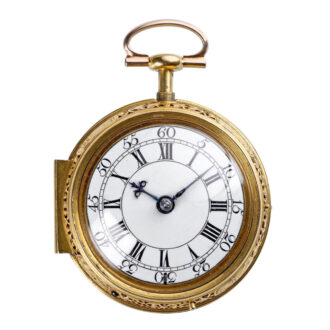
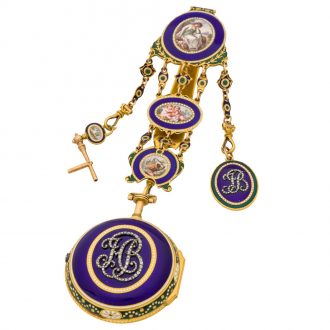
English verge pocket watch of museum quality Circa 1707/1716
- Kenmerk
- AD9538
- Diameter
- 55 mm
- Estimate
- € 75.000 - 150.000
- Price sold
- € 99.600
Gold watch from the most famous of all English watchmakers, Thomas Tompion
–
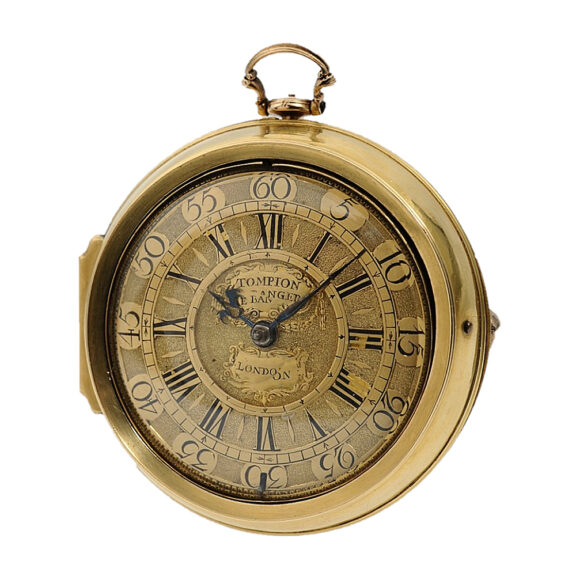
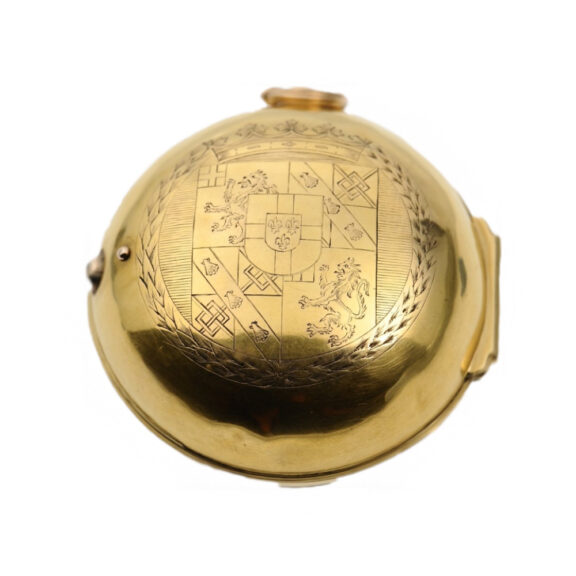
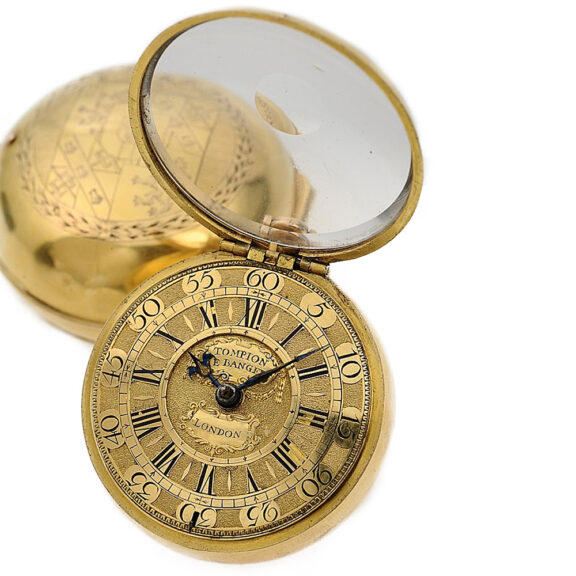
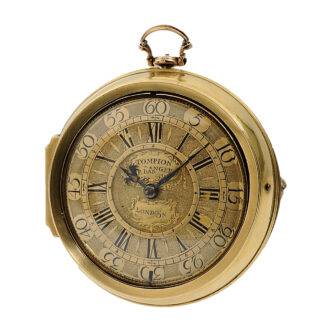
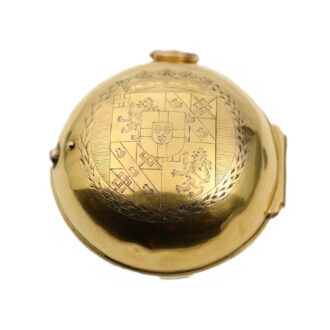
An English, pair-cased verge pocket watch of museum quality from the most famous English watchmakers with the engraved coat of arms of John Spencer-Churchill, 3rd Duke of Marlborough, circa 1707/1716.
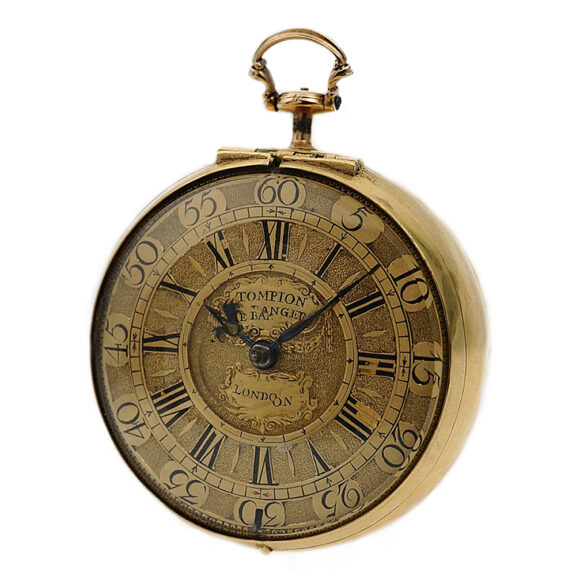
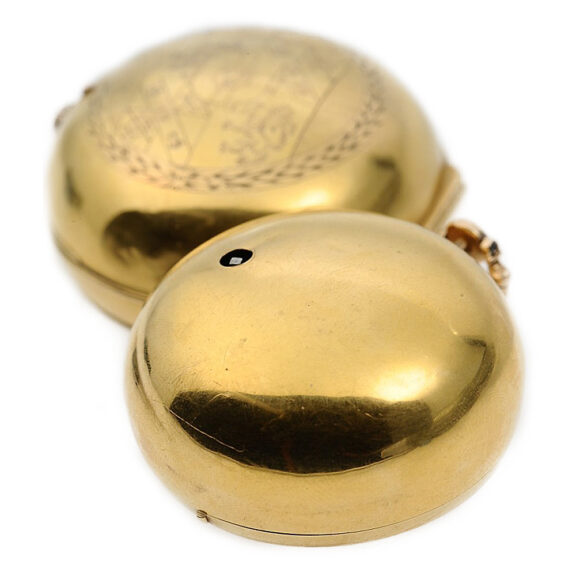
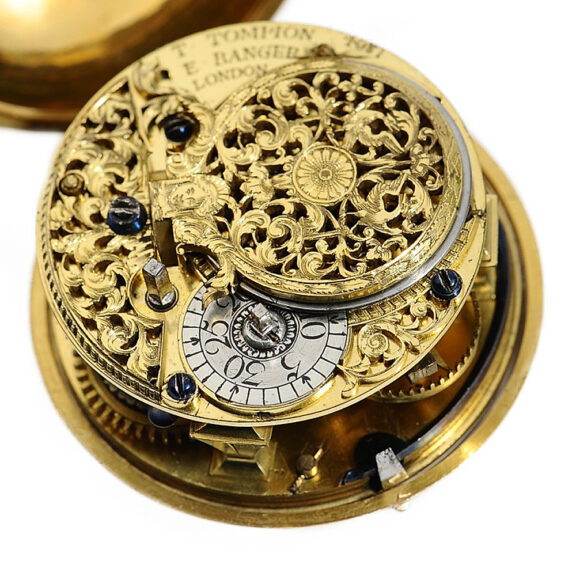
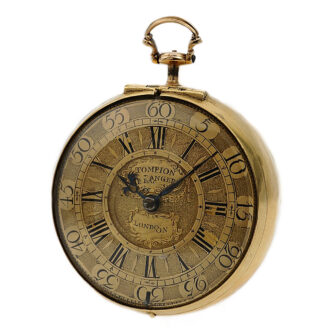
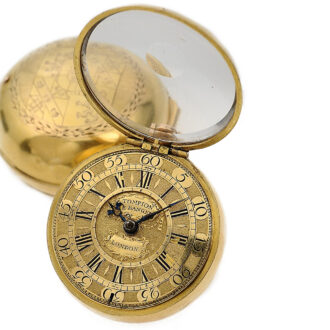
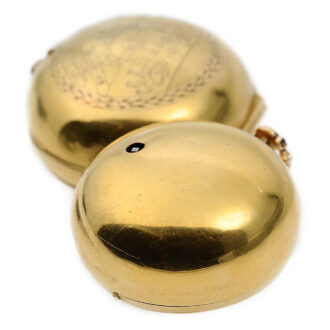
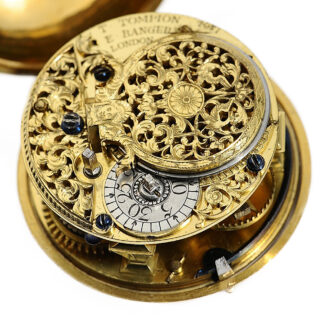
Two cases: a 22-carat gold outer case with engraved coat of arms and coronet of a Duke, case maker’s punch mark AD (Abraham Dearmer?), and large lateral hinge; and a 22-carat gold polished inner case with case maker’s punch mark AD (Abraham Dearmer?). Signed gold, champlevé dial with inlaid radial Roman hours and blued steel Poker & Beetle hands. Signed, fine full plate movement, keywind, fire gilt, applied pierced and florally engraved ornaments, chain/fusee, Egyptian movement pillars, three-arm steel balance, and a very finely engraved pierced balance cock with cherub face.
–
Diameter: 55 mm
–
Weight: 147 g
–
Signed: Thomas Tompion / Edward Banger, London
–
Both cases are marked AD. The outer case is finely engraved with the arms of John Spencer-Churchill 3rd Duke of Marlborough (1706-1758), so it is possible that the watch, supplied c.1707, had belonged to his grandfather John-Churchill 1st Duke of Marlborough.” Charles Spencer, 3rd Duke of Marlborough KG, PC (22 November 1706 – 20 October 1758), known as The Earl of Sunderland between 1729 and 1733, was a British soldier and politician from the Spencer family. He briefly served as Lord Privy Seal in 1755. He led British forces during the Raid on St Malo in 1758.
–
Thomas Tompion (1637-1713)
Undoubtedly, Thomas Tompion must be considered the most famous of all English clockmakers; in the 18th century, he alone was responsible for the rise to supremacy of English clockmaking. He became a brother of the Clockmakers’ Company in 1671 and moved in 1674 to a workshop in Water Lane, from where he conducted his business for the rest of his life. In the very same year, Tompion met Robert Hooke when Hooke sought his help in proving that his invention of the balance spring was before that of Huygens’. This brought Tompion to the notice of King Charles II, and his status was rapidly elevated.
Tompion created the first clock for the Greenwich Observatory in 1676 and collaborated with Booth and Houghton in 1695 in patenting an escapement with a horizontal escape wheel, considered a forerunner of the cylinder. Buckingham Palace today holds two-equation clocks which were probably supplied to William III in the 1690s. Sometime between 1680 and 1685, Tompion started to number his production, apparently being the first maker to do this. He was elected Master of the Clockmakers’ Company in 1703. Tompion’s niece Margaret was the daughter of his sister Margaret Kent; she married the watchmaker Edward Banger, who worked with Tompion from 1701 to 1708. In 1711 Tompion formed a partnership with George Graham that lasted until the end of his life. Thomas Tompion died in 1713 and was laid to rest in Westminster Abbey.
Signed: Thomas Tompion / Edward Banger, London
Share this page: