English rare silver gilt verge with mock pendulum Circa 1710
- Kenmerk
- SA0413
- Diameter
- 57 mm
- Estimate
- € 6.000 - 12.000
- Price sold
- -
Silver gilt verge with mock pendulum
–
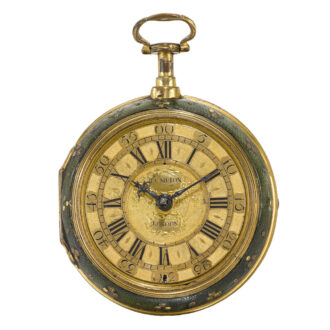
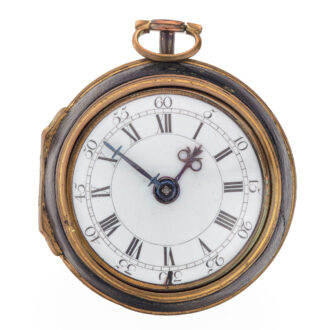
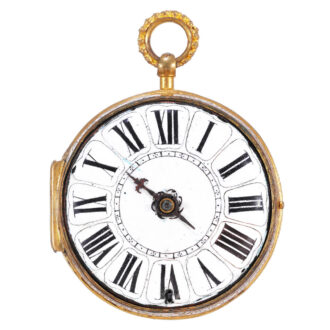
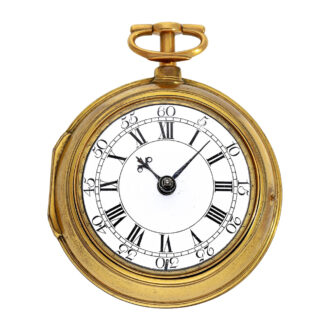
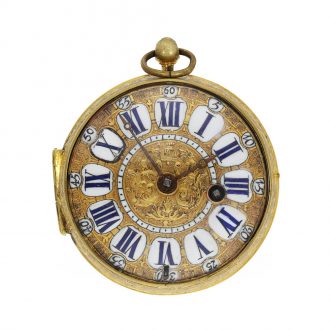
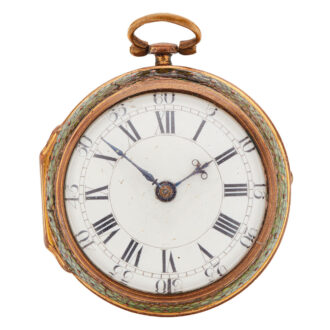
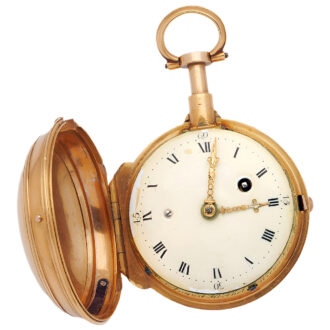
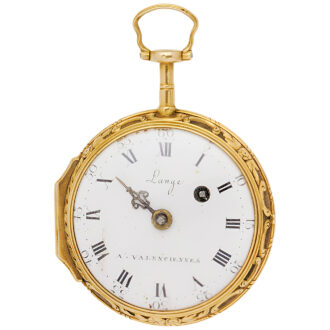
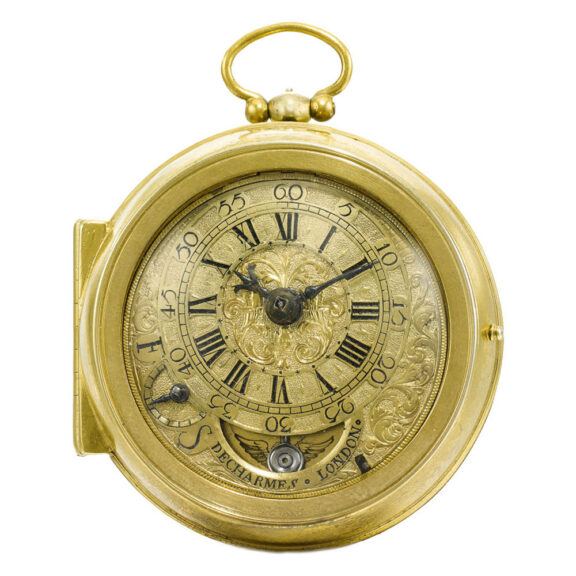
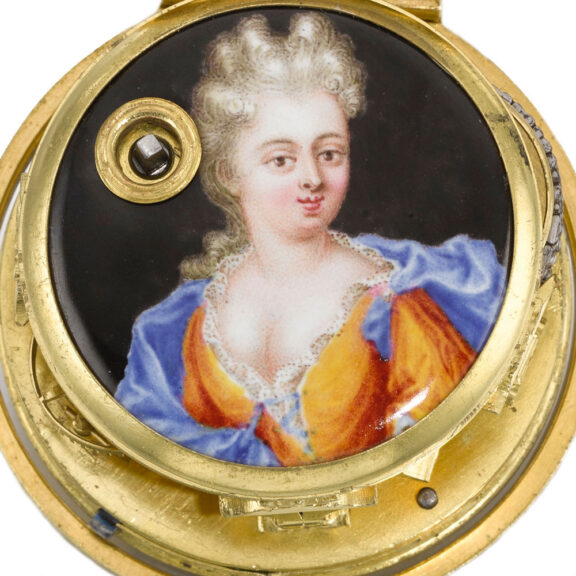
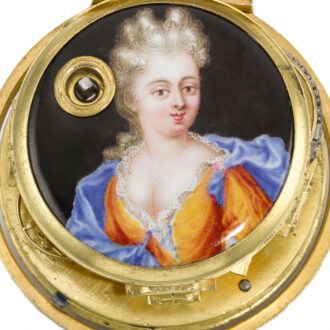
An English rare and unusual silver gilt pair cased verge watch with mock pendulum and concealed enamel portrait of a lady, circa 1710, gilded full plate movement, the backplate with polychrome enamel painted portrait of a lady, verge escapement, fusee and chain, Egyptian pillars.
Gilded champlevé dial, off set chapter ring with black Roman numerals, half-hour divisions between and to the ring beneath, outer Arabic minute ring, the center and surround with scrolling foliage against a stippled ground, regulation between 7 and 8 o’clock, crescent shaped aperture beneath 6 o’clock to reveal the balance in the form of a pendulum, an engraved winged putto beneath, blued steel tulip and poker hands, signed De Charmes, London.
Plain silver gilt inner case, the back with winding aperture, inner case with maker’s mark ML with cornet above, plain silver gilt outer case, square hinge.
–
Diameter: 57 mm
–
Signed: De Charmes London
–
Simon de Charmes and David, probably his son, were Frenchmen who became Free Brothers of the Clockmakers’ Company in 1691. Their watches are in the English style but tend, as in the design of this watch, to display strong Continental overtones. The dial is handsomely arranged with an off set chapter ring beneath which an aperture reveals the balance, an arm of which is affixed with a disc to mimic the action of a pendulum.
The placement of the balance to the movement’s top plate allows for the addition of the enamel portrait plaque to the backplate. A similar watch by De Charmes is known (Jonathan Snellenberg’s catalogue, April 1997) which shows a nearly identical portrait thought to be of the Duchesse de Fontanges (1660-1681), mistress of Louis XIV. The lady has much the same dress and hairstyle, the significant difference being that the hair has a ribbon omitted in the present portrait, tied on the left hand side. It is said that the Duchesse – who was considered a great beauty – tied the ribbon in her hair after she lost her hat whilst riding and that, thereafter, the ladies of the court wore their hair up, tied with a fontange, this fashion spreading to England.
Signed: De Charmes London
Share this page: