Outstanding early Swiss gold musical automaton Circa 1787
- Kenmerk
- SA2429
- Diameter
- -
- Estimate
- € 1.000.000 - 2.000.000
- Price sold
- € 2.250.000
–
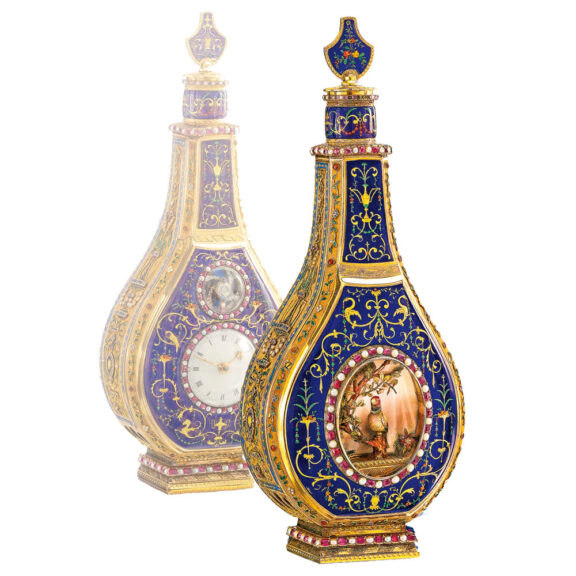
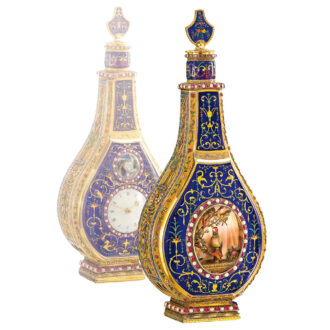
An early Swiss gold scent flask with a watch and a singing bird automaton, set with enamel, pearls and gemstones. It was made in Geneva in 1786–1787 by Jaquet-Droz, Leschot & Frisard for the Chinese market, and sold to James Cox in London in 1787. The bird’s song is played by a serinette, a tiny pipe organ.
–
The flask
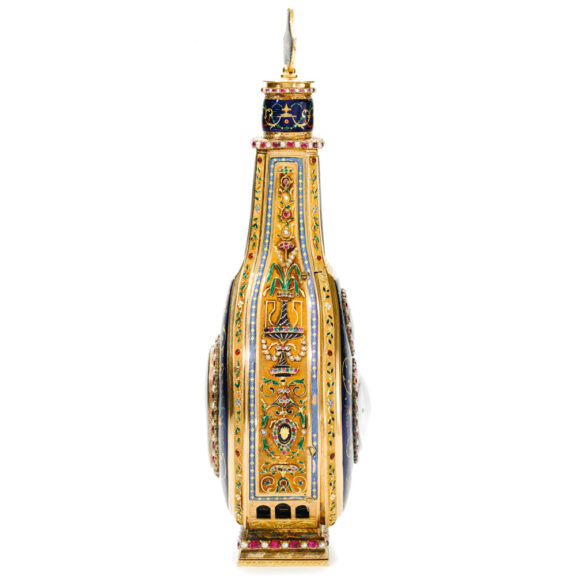
The case has a flattened pear shape.
–
Front: a white enamel watch dial, with a diamond-set balance swinging above it.
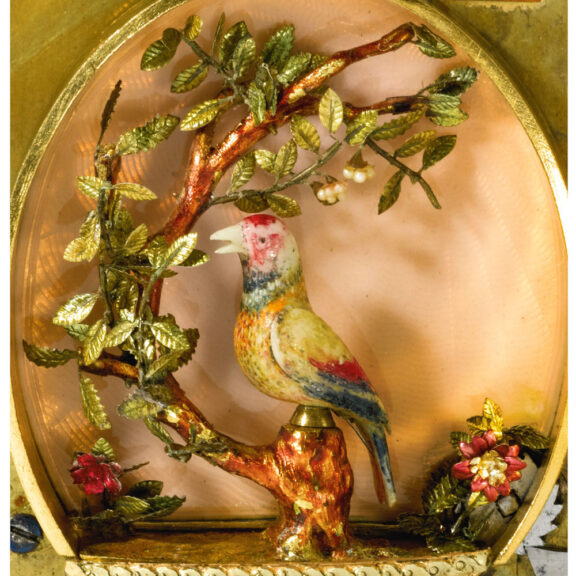
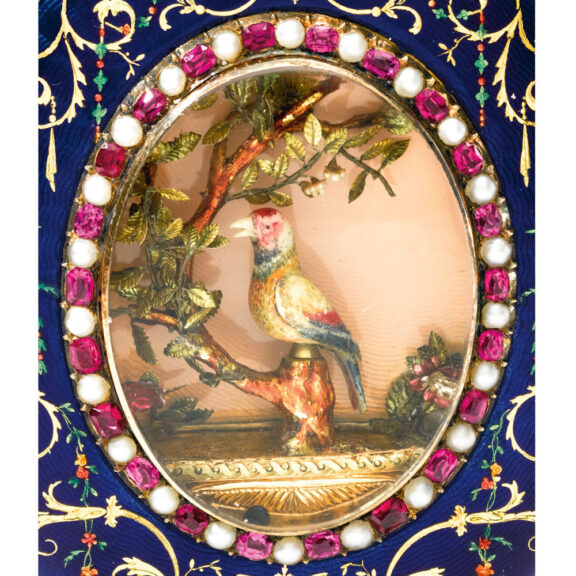
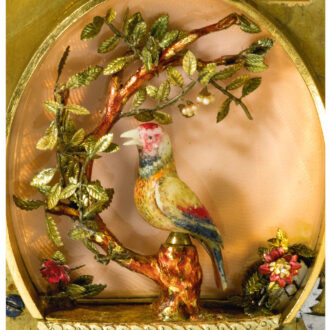
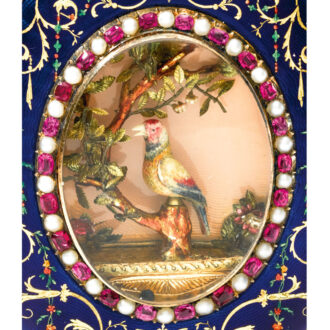
Back: a richly painted singing bird on a leafy branch, set in a recess against translucent pink enamel.
Bezels and borders: alternating rubies and half pearls.
Decoration: on both sides, Renaissance-style arabesques in gold paillons (small gold foils), with birds, grotesques and urns of fruit, on a translucent blue enamel ground.
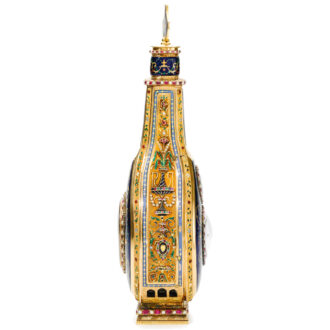
Sides: chased with the same ornament, partly enamelled and set with rubies, emeralds, diamonds and sapphires.
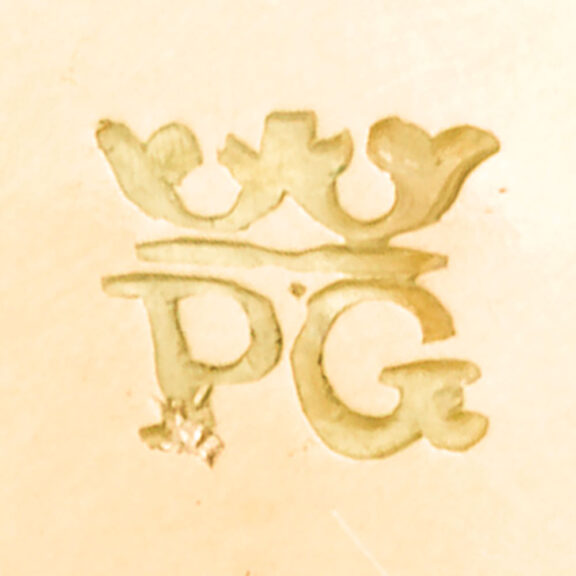
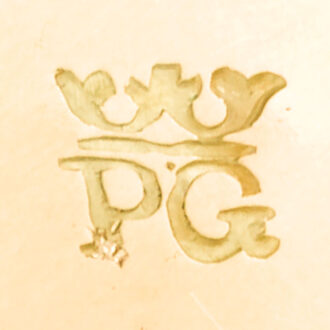
Top: the scent compartment, with a stopper that doubles as the watch key. The stopper is enamelled on both sides to match, and its base is stamped PG beneath a crown.
Base: a hinged compartment lined with a mirror.–
—
The singing bird
A small gold button sets the bird, only 12 mm tall, in motion. It sings realistically, opens and closes its beak, turns its body and moves its tail up and down.
–
The song comes from a six-pipe organ, built as two groups of three pipes that follow the curve of the case. Bellows push compressed air through metal tubes to the pipes. A pinned cylinder opens and closes six valves to play the melody.
–
The watch
The watch has a gilt brass verge movement with a fusee, a white enamel dial with Roman numerals, and gold hands. The movement and balance are mounted on a shaped plate engraved with a cartouche of leafy scrolls. The winding arbor is below the dial at 5 o’clock. The dial and balance can be seen through glazed openings in the hinged cover.
–
Length overall: 160 mm
–
Height of singing bird: 12 mm
–
Signed: Jaquet-Droz Leschot and Frisard Geneva
–
Accompanied by a fitted leather box.
–
“The playthings of kings”: the Jaquet-Droz singing bird scent flasks
“The playthings of kings” is how the distinguished horological author Alfred Chapuis described the singing bird automata of the late 18th century, in his standard work Automata (1958). He wrote: “Only for the princely clients of former days could such richly produced objets d’art be made, for the decoration of the boxes was in the same class as the mechanism.”
–
Chapuis could easily have been describing this scent flask. He clearly chose the finest examples for his book. In post-war Switzerland he was already a prolific and highly respected author, with access to the best collections in Europe, including those of Gustave Loup, Maurice Sandoz and Sir David Salomons.
–
A documented history
It is very unusual for an object of this age to have a recorded early history. On 16 February 1787, Jean-Frédéric Leschot (1746–1824) sent two identical scent flasks from Geneva to James Cox in London, who had ordered them. Each had a serinette, a singing bird and a watch. The account ledger describes them as:
“No. 1–2 scent flacons enamelled in blue with applied rings and flowers in pearls and rubies with sapphires, watch with the balance set with diamonds, a serinette with bird placed on a tree trunk (in a medallion), which moves its beak and tail.”
The two together cost £235 18s.
–
The other flasks
The Jaquet-Droz and Leschot account books record a second set of similar scent flasks, also with serinettes, singing birds and watches. They were sent to James Cox on 26 and 27 April 1787 for £226 8s. Unlike the first two, they were recorded as a pair. This pair is illustrated in Harcourt-Smith’s 1933 catalogue of the Palace Museum in Peking.
–
A fifth flask, of a slightly different shape and a little later in date, is in the L.A. Mayer Museum in Jerusalem, formerly the Sir David Salomons Collection. On this one the bird sits in a covered compartment. It shows an innovation that Leschot described in a letter to Duval in London in 1792:
–
“Two pairs of mechanism for bottles with a watch, the same as those sent to you recently. I hope to succeed in adding something different, whereby the medallion, which in the previous ones remained open after the bird’s song, will close itself.”
–
A tiny organ
Bernard Pin, author of Watches & Automata: The Maurice Sandoz Collection, praised the elegance of this flask and also its mechanism:
“We should venture to say that the ingenuity with which the singing bird’s mechanism has been integrated is also worthy of praise. For in this piece, the song is obtained by the use of a tiny bird organ.”
–
Later, the organ was gradually replaced by a whistle with a sliding piston. That system was more compact, but less interesting to look at.
–
Historians agree that Jaquet-Droz & Leschot, together with Jacob Frisard, were the first to put singing birds into small objects such as scent flasks, watches and snuff boxes (Chapuis, Automata, pp. 194–195)
–
The canary craze
The birds were made to imitate the live canary, which had become hugely popular in 18th-century Europe. The Spanish brought canaries to Europe after conquering the Canary Islands in the late 15th century. They were bred so eagerly that by the early 18th century there were 29 distinct varieties.
–
Canaries were loved for their song, and teaching them to sing became an obsession. The serinette, a small barrel organ, was the tool for the job. Hervieux de Chanteloup, author of the New Treatise of Canary Birds and the leading authority on training canaries, explained how:
“As to the manner of proceeding, at each lesson one must repeat nine or ten times the tunes one wants to teach them; & those tunes must be played without repeating the beginning twice.”
–
Trade secrets
Leschot’s letters have largely survived, and they tell us a lot about his business: from his trouble with certain difficult people to his fear that trade secrets would fall into the wrong hands. The scent flasks are mentioned in several letters from 1791 to 1793. By then both Pierre and Henri-Louis Jaquet-Droz, father and son, had died, and Leschot ran the firm.
–
In 1792 Leschot wrote to MM. Duval in London: “These various pieces with mechanical birds embodied many trade secrets.” On 2 November 1793 he wrote to his associate Henri Maillardet in London: “My friend M. Frisard like myself thoroughly agrees with you that the smallest number of people possible should be told how these things work, apart from relatives who are close by one in the workshop and whom we can trust not to turn their knowledge to our disadvantage.”
–
In February 1793 he wrote to Louis George in Berlin:
“As for the singing bird snuffbox which you have seen, this mechanical piece certainly comes from our workshop. I had the honor to inform you a few years ago that we do this sort of work putting a mechanical bird into a jeweled object such as a snuff box or scent bottle.”
–
The case maker: Philippe Gervais
The case is stamped PG beneath a crown, probably the mark of the workshop of Philippe Gervais (1734–1796), a Geneva jeweller. He was the son of André Gervais, who came from Hanau in Germany. Philippe was registered as a resident of Geneva on 7 September 1761.
–
Two years later he was accepted as a master, under the usual restrictions for foreigners. His masterpiece was “a most acceptable gold and enamel snuff box set with diamonds”. On 26 February 1764 he married Gabrielle Rey, a Geneva woman, and they had three children. He died in Geneva on 19 August 1796.
–
The incuse PG mark beneath a crown is usually found on luxury objects combined with watches. Examples include a diamond-set chatelaine in two-colour gold and enamel, and several coloured gold snuff boxes set with watches. Another fine scent bottle by Gervais is in the Sandberg Watch Collection.
–
Jacob Frisard (1753–1810)
Jacob Frisard was an inventive mechanical genius. He is credited with many of the advances that brought Swiss automata and singing bird boxes to their peak in the early 19th century.
–
He was born in January 1753 in Villeret, in the Bernese Jura, the son of Louis Frisard and Marie-Madeleine Bourquin. Following family tradition, he trained as a clockmaker in La Chaux-de-Fonds. According to Sharon Bailly, he then worked for about twelve years for clockmakers in Turin, from 1772. There he married Catherine Vastapani in 1778. They had at least fourteen children, and concern for his large family shaped many of his career decisions.
–
Around 1784 the family moved to Carouge, just outside Geneva. Frisard made watches there and worked closely on mechanical inventions with Jaquet-Droz and Leschot. In 1792, fearing the French invasion of Savoy, he fled to Bienne. The family apparently did not return to Geneva until around 1800. Much of what we know about his work, skills and character comes from the letters Leschot sent him during those years.
–
He was without doubt a mechanic of the highest ability. He is credited with inventing the mechanism that closes the lid of a singing bird box smoothly after the bird has gone back into its nest. He felt his talent was overshadowed by the fame of Jaquet-Droz and Leschot. In later years he tried to promote his own, more elaborate creations by travelling, as they had done. He died in 1810 in a small town in Bulgaria, on his way back from Constantinople.
–
James Cox (c. 1723–1800)
James Cox was the leading 18th-century dealer in jewelled automata and “toys”, and his name is forever linked with these objects. He was born in London around 1723. In 1738 he was apprenticed to Humphrey Pugh of Fleet Street, a silver spinner who ran a toy shop. Cox became a freeman of the Goldsmiths’ Company in 1745 and later registered his own mark. His skills as a craftsman were always secondary to his inventiveness and talent for selling.
–
His career had many ups and downs. After a poor start and an early bankruptcy, he began again on a larger scale. He focused on exporting ever more fanciful objects to the Far East, where they were known as “sing-songs”. When the risky Chinese market declined, he opened a museum in Spring Gardens to show his pieces. In 1775 the collection was famously sold off by lottery.
–
The lottery made a profit, and he sold important pieces to Catherine the Great, but Cox went bankrupt again in 1778. He continued as a jeweller until he retired to Watford in 1795.
Signed: Jaquet-Droz Leschot and Frisard Geneva
Share this page: