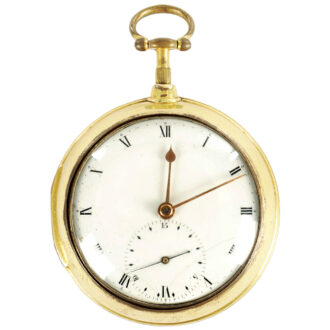
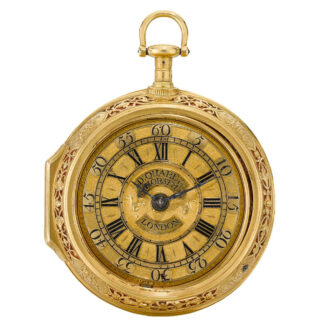
Gold English quarter repeating pair cased verge Circa 1719
- Kenmerk
- SA0328
- Diameter
- 50 mm
- Estimate
- € 25.000 - 50.000
- Price sold
- € 55.000
Very fine gold English quarter repeating verge watch
–
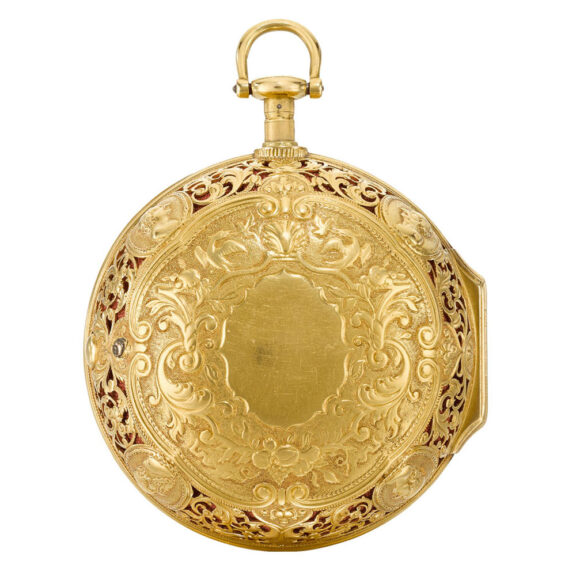
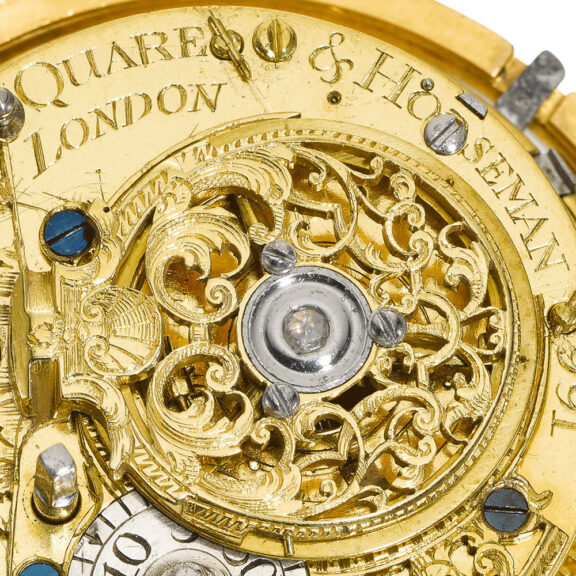
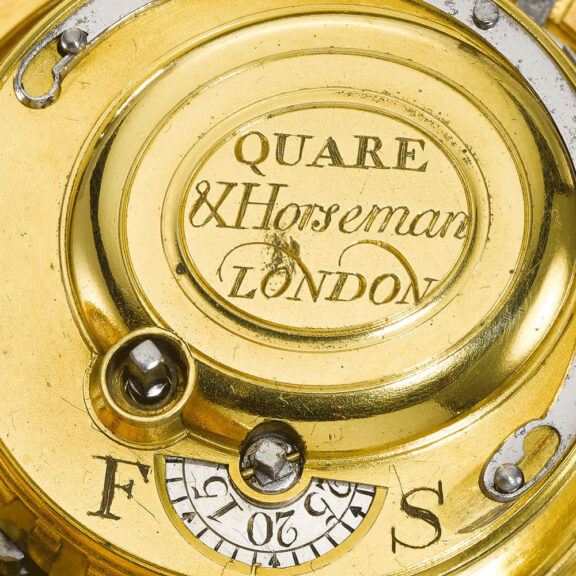
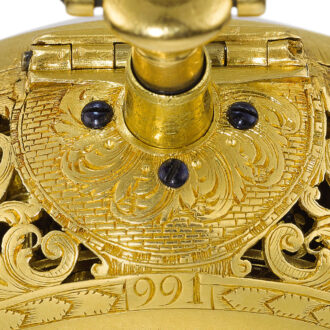
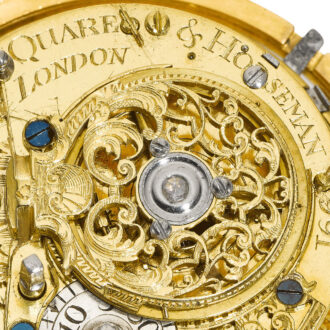
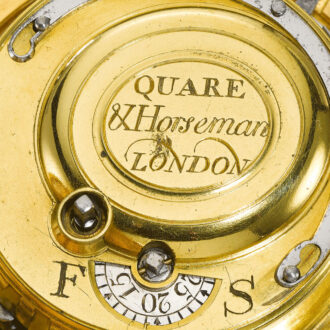
A very fine gold English quarter repeating pair cased verge watch, circa 1719, gilded full plate movement, verge escapement, decoratively pierced and floral engraved balance cock with a shell at the neck, flat three-arm balance with spring, fusee and chain, turned pillars, polished steel hammers repeating on a bell to the inside case back, signed Quare and Horseman, London, gilt metal dust cap signed Quare and Horseman, London.
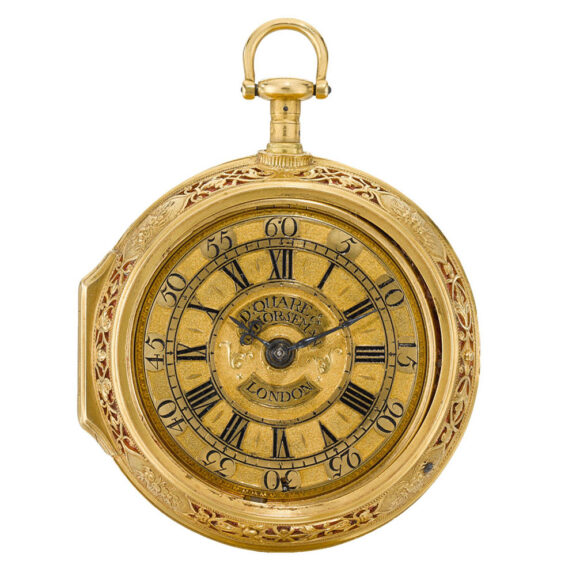
Gold champlevé dial, Roman numerals with half-hour divisions between and to the ring below, outer Arabic minute ring, blued steel beetle and poker hands, the center with banners signed Quare and Horseman, London.
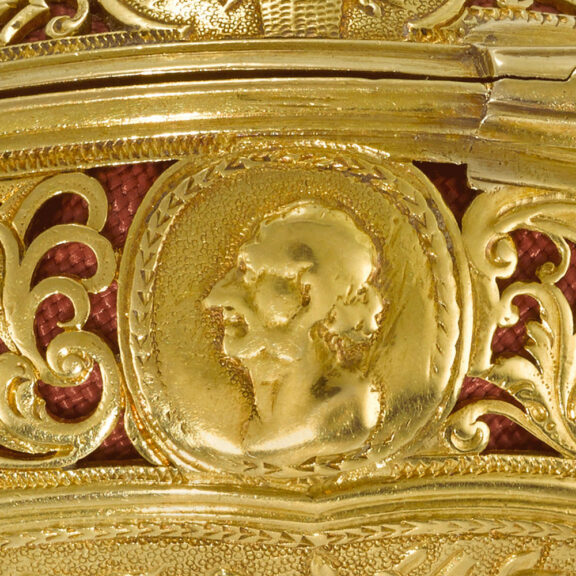
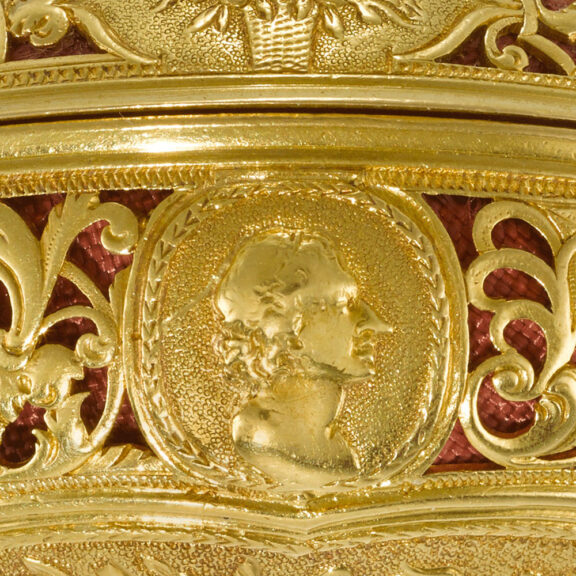
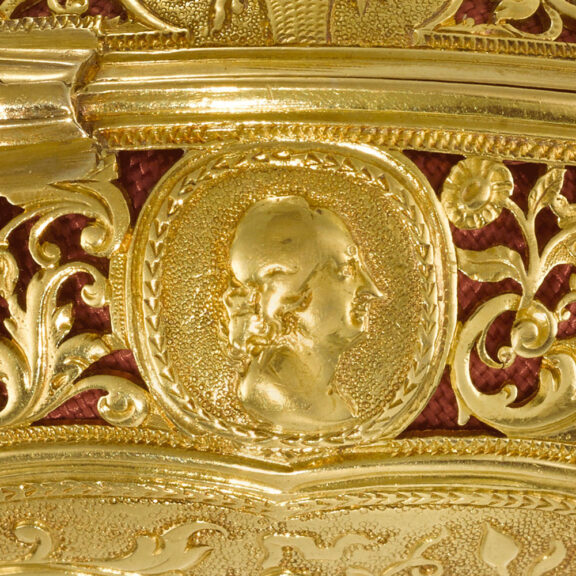
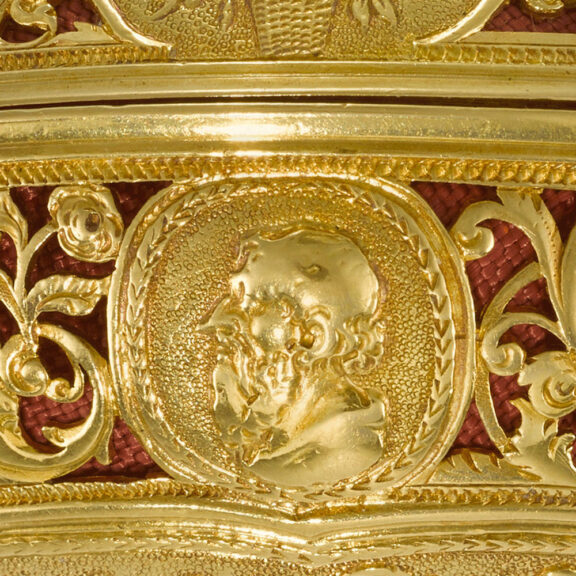
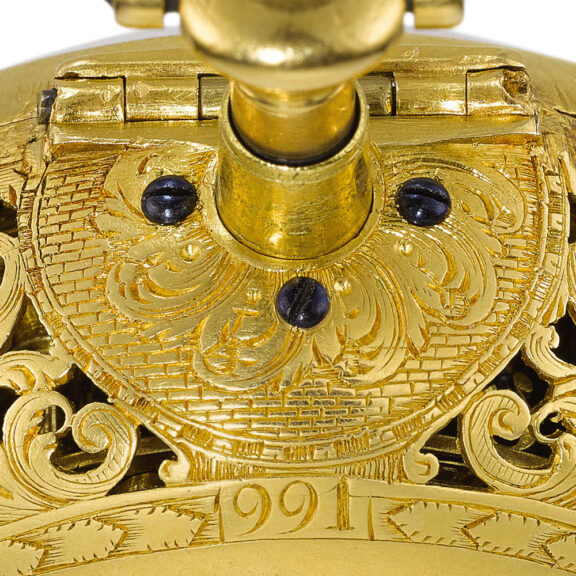
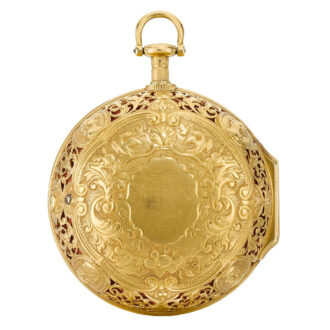
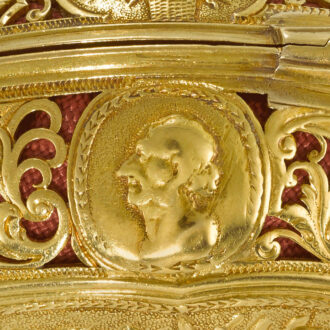
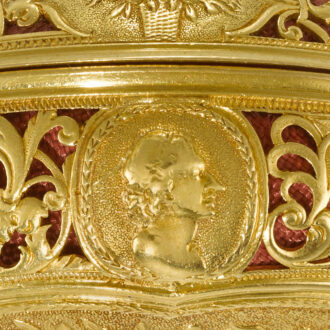
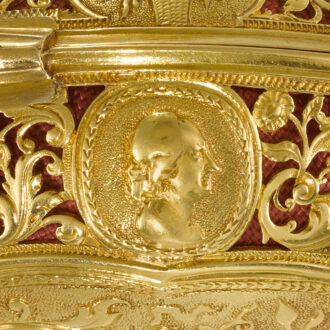
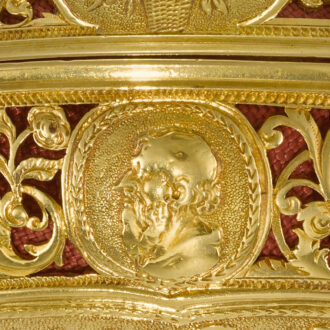
Gold inner case pierced for sound emission and decoratively engraved with foliage inhabited by birds and dolphins, a youth’s head to the base, possibly Phoebus Apollo, beneath the bell with maker’s mark SL.IL for Sarah Jaques and John Lee, gold outer case, the pierced band composed of four pierced and chased panels interspersed by four portrait busts one possibly representing Homer, the bezel with four floral medallions between pierced panels, plain central reserve surrounded by embossed shells, flowers, grapes and scrolls, pulse piece to the bezel between 6 and 7 o’clock, maker’s mark struck three times AR conjoined in outline cameo, probably for Adam Roumieu the Younger.
–
Diameter: 50 mm
–
Signed: Quare and Horseman London
–
According to family tradition, this watch was originally owned by Silvanus Bevan F.R.S. (1691-1765). The watch subsequently passed to Silvanus’s nephew also called Silvanus then through two Richards and two Roberts and finally Richard Bevan, Rector of Abberley who lent the watch to the Hartlebury Museum in Worcestershire from 1968-1987 before its sale at Christie’s.
Like the elder Silvanus Bevan, Daniel Quare was also a Quaker and Quare’s daughter Elisabeth was married to Silvanus. The wedding of Silvanus and Elisabeth Quare was quite a society affair and even the Prince and Princess of Wales were due to attend, however, the Prince and Princess sent their apologies the night before the wedding since a Parliamentary ruling “forbade attendance by the royal family at dissenting places of worship” [see Jagger, C. Royal Clocks, 1983, p.48]. Nevertheless, many important figures did attend the wedding, including the Duchess of Marlborough and the Venetian Ambassador and his wife – and although the Princess was unable to attend the wedding itself, she did attend the dinner which followed [see op. cit. pp. 47-48]. A Bevan family tradition had stated that the watch was given to Silvanus by Quare on the occasion of his marriage to Quare’s daughter Elisabeth in 1715. However, although this cannot be true as the watch had not yet been made and Elizabeth died in 1718, it does seem unlikely that Silvanus would have carried a watch by any other maker than Quare.
Daniel Quare (c.1647/8-1724) was born in Somerset. A highly esteemed watchmaker, Quare was admitted to the Clockmakers’ Company in 1671, later becoming Master in 1708. Quare established himself as an important horological innovator by inventing a type of repeating work around 1680. Whilst Quare was developing his repeating mechanism, his rival, the Revd. Edward Barlow, was developing his own version. Barlow had invented the rack form of striking in 1676 and, in 1685, Thomas Tompion made a watch for Barlow that incorporated the latter’s repeating system. Three years later, in 1688, Daniel Quare and Edward Barlow presented their different forms of repeating watches to King James II in order that he might declare which he regarded the superior. The King favored Quare’s form, noting that Barlow’s required two pushers, one for the hour strike and one for the quarters, whilst Quare’s single push-piece activated both the hours and quarters.
As a Quaker, Quare was unable to be appointed Royal Clockmaker, however, as Cedric Jagger notes in his book Royal Clocks, Quare “was given free access via the Back Stairs.” Indeed, Quare was well connected both at home and abroad, a fact borne out by the impressive wedding guest lists of his daughters Anne and Elizabeth, which boasted noble families and envoys from around Europe. In 1718 Quare went into partnership with Stephen Horseman, after which their work was signed ‘Quare and Horseman’. Daniel Quare is buried at the Quakers’ cemetery at Bunhill Fields, Finsbury.
Signed: Quare and Horseman London
Share this page: